The morning of my wedding was supposed to mark the beginning of a new chapter after three long years of grief. My five-year-old daughter Sophie sat at my feet, a small crown of white daisies resting in her hair. She looked up with serious eyes and asked why she could not call my groom Evan “Daddy.” I told her gently that her real father was irreplaceable. I believed I had finally found a man who could love both of us. I was wrong.
As the ceremony drew closer, Evan moved through the room with a restless energy that did not feel like ordinary nerves. He kept one hand on a leather folder and glanced toward the door more often than necessary. My brother Peter arrived in a sharp charcoal tuxedo, full of laughter and easy affection. He offered me his arm and walked me toward the start of the celebration. Yet beneath the surface of smiles and clinking glasses, a quiet unease began to settle in my chest. There were brief, knowing looks between the two men that felt less like friendship and more like shared purpose.
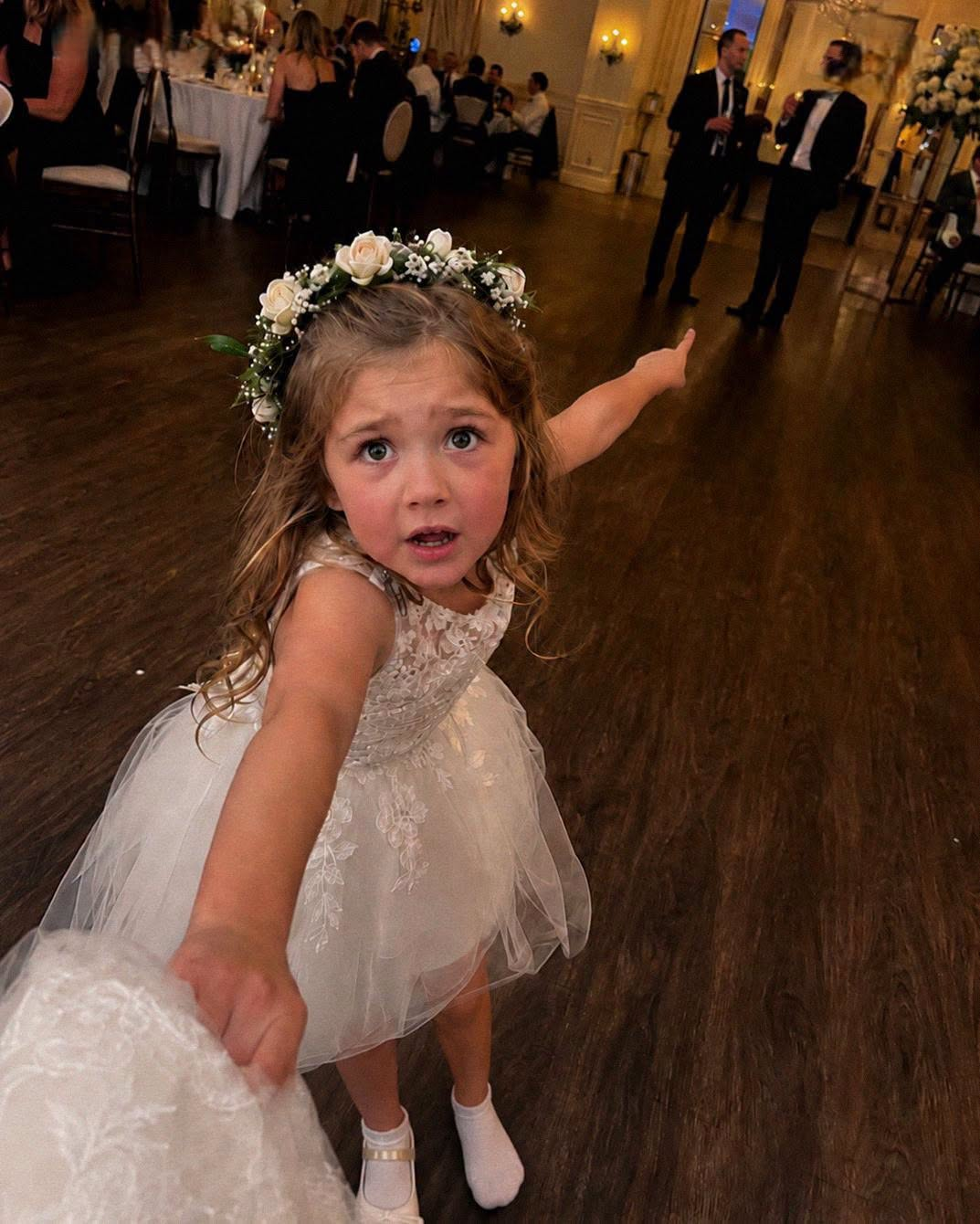
The decisive moment arrived during the reception. Sophie tugged hard at the lace of my dress until a stitch gave way. Her flower crown was crooked and one of her white shoes was missing. She looked frightened. In a small, trembling voice she whispered that Evan and Uncle Peter had been bad. Kneeling down, I asked her what she meant. She explained that she had crawled under a couch in the garden room to retrieve her shoe and overheard them talking about papers, money, and a trust.
With the blunt honesty only a child can manage, Sophie repeated the words she had heard. Evan had said I would never suspect anything because I was lonely, and that loneliness had been the entire point. My blood turned cold. The trust she mentioned was the fund my late husband had established for her future — a sum sealed until she turned eighteen unless I remarried and the new husband signed as a co-trustee alongside a family member. Peter had introduced me to Evan. Peter had been the one offering comfort during my darkest months. In that instant the full shape of the deception became clear.
I kept my expression steady and sent Sophie away with the nanny. Then I stepped into the hallway and called my late husband’s estate attorney. Confirmation came quickly. Peter had requested access to the trust only three weeks earlier, claiming I had authorized it. He had not succeeded, but the intention was unmistakable. The realization that my own brother had spent years preparing me for this moment left me feeling both foolish and fiercely protective of my daughter.
I remembered a voice memo I had accidentally recorded months earlier at a dinner party. I had meant to capture a recipe and had forgotten to stop the recording. When I played it back, Peter’s voice came through clearly: he was telling someone I was ready after two years of grief and that I would say yes to anyone who was kind to Sophie. Evan’s voice followed, asking specifically about the child’s account. Peter explained that the new husband would sign as co-trustee with a family member — meaning himself.
The scale of the plan was staggering. Three years of careful emotional support, eight months of deliberate courtship, and a wedding day designed to unlock access to my daughter’s future. My brother had coached a stranger to exploit my loneliness in order to bypass the legal protections my late husband had put in place. I stood in the hallway with one hand against the wall until the nausea passed. When I returned to the ballroom I was no longer the radiant bride. I was a mother in possession of the evidence I needed.
I walked to the stage and took the microphone. The room grew quiet. Evan smiled, expecting a toast. That smile faded when I looked directly at Peter and announced that I wanted to play a voice memo recorded by my brother eight months earlier, the night he introduced me to my groom. I pressed play. The speakers carried their clear, calculated conversation about grief, loneliness, and the trust. The collective gasp from the guests was immediate. Peter’s glass slipped from his hand and shattered on the marble floor.
I told the room I knew about the trust and the recent request for paperwork. I knew exactly what my daughter had overheard in the garden room. Evan stepped forward and tried to claim I was confused, but the words no longer carried any power. I stated that the marriage would be challenged, that the evidence was already with the attorneys, and that Peter was never to enter our lives again. Then I walked off the stage without looking back, the train of my wedding dress trailing behind me like something I was finally ready to leave behind.
In the weeks that followed, the legal process moved steadily. The trust was resealed with stronger protections. The marriage was annulled. Peter and Evan faced the consequences of their attempted fraud. At home, mornings returned to a quieter rhythm. Sophie and I sat together at the kitchen table while she ate her cereal in the soft light. There was no new ring, no new title of “Daddy,” only the steady peace of a house that once again belonged fully to us.
I had not lost a future that day. I had protected the one that already existed. The smallest and most honest voice in the room had seen what the adults around her had missed, and by listening to her I had stopped a carefully constructed plan before it could take root. The wedding that never truly began became the moment I chose my daughter’s security over the illusion of companionship. That choice remains the clearest decision I have ever made.
Most Popular!
-
 My Husband Abandoned Me 300 Miles From Home as a Joke — Then He Showed Up Five Years Later to Destroy Everything I Built
-
The Mystery Gear: Why Your Old Car Had a Secret “E” Button That Could Save Your Life and Your Wallet
-
The Brutal Truth: My Husband Tried to Control Me on Our Third Day of Marriage — He Didn’t Know Who He Was Dealing With
-
The Midnight Trap: Why One Single Ring Could Cost You Your Entire Life Savings
-
Deadly Garnish: Why Your Innocent Kitchen Staple Is Actually a Silent Risk Lurking in Your Fridge
-
The Illegal Tag Myth: Why You’ve Been Living in Fear of Your Own Mattress
-
The BBQ Bomb: My Father-in-Law Treated My Home Like His Personal Five-Star Restaurant — Until I Served Him an $1,800 Reality Check
-
I Discovered My Mother-in-Law Selling My Priceless Wedding Dress at a Garage Sale — Then I Realized Why She Was Really Doing It