The cardboard boxes had taken over our new apartment, leaving me exhausted and overwhelmed. When my mother-in-law Denise offered to store our family heirlooms in her basement, I felt genuine relief. I packed the wedding box myself, carefully placing my grandmother’s 1962 gown, my mother’s 1989 dress, and a collection of irreplaceable mementos that included the last handwritten card from my late mother. I labeled the box clearly: “WEDDING. DO NOT OPEN.” It was the only physical proof I still had that I belonged to a line of women who had loved and been loved. I never imagined those memories would be scattered across a driveway within three weeks.
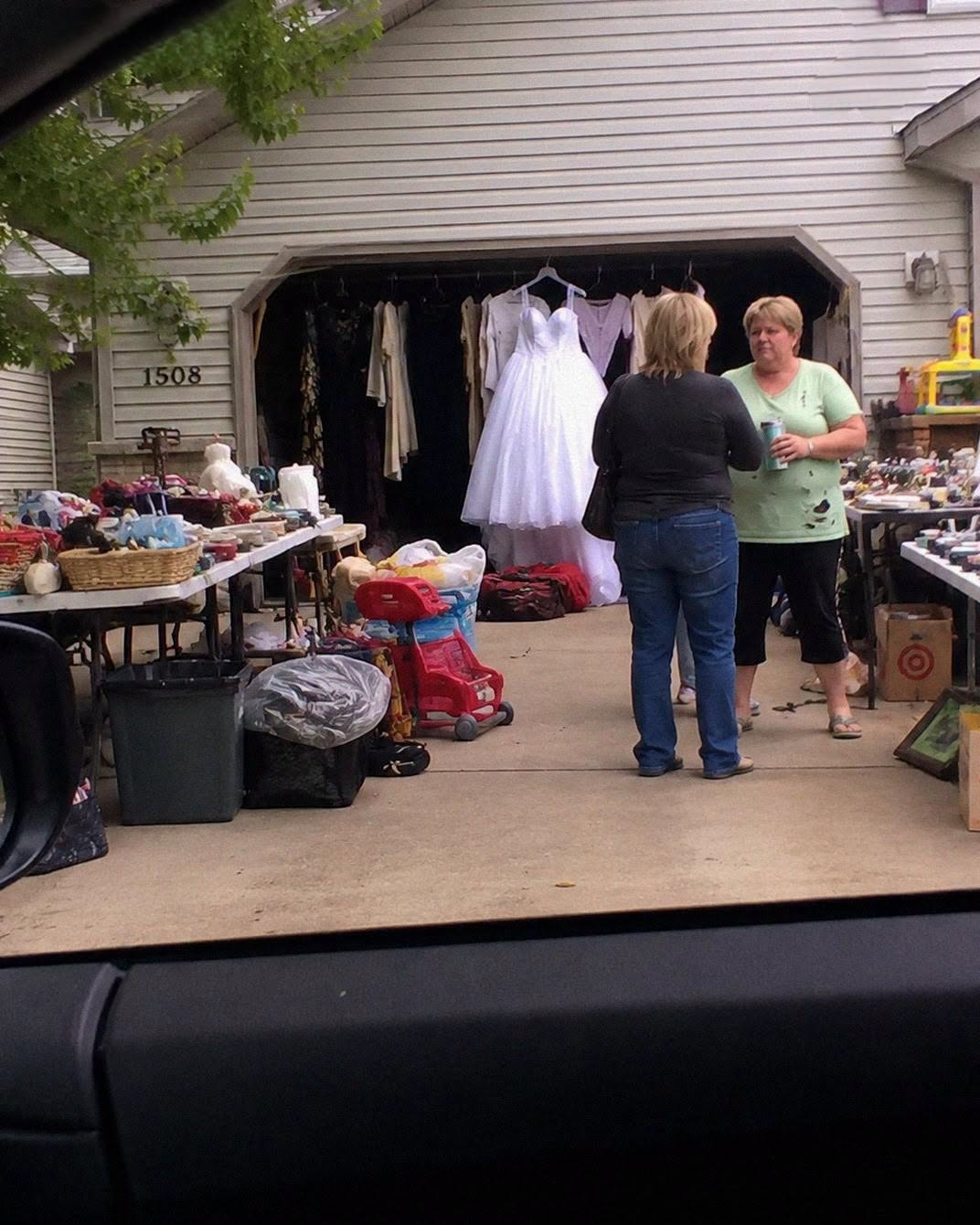
It began with a simple errand. My husband Ethan texted from work and asked me to pick up a folder from his parents’ house. When I turned onto their street, my foot slipped off the gas pedal. Their driveway had been transformed into an open garage sale. Strangers moved between tables, examining lamps and kitchenware. Hanging from a portable rack in the center of it all was my grandmother’s wedding dress. A woman stood there pinching the delicate lace sleeve as if it were ordinary fabric. I left the car where it was and walked straight up the driveway, demanding to know what was happening.
Denise’s face drained of color the moment she saw me. She tried to speak, but I was already past her, scanning the tables. The wedding box sat open and half empty. The leather-bound guest book was gone. The stack of handwritten cards was gone. I dropped to the concrete as the full scale of the loss hit me. Denise clutched the dress against her chest, her hands shaking, and whispered that Ethan had told her I had already sorted through the items and given my approval.
I did not believe her, yet I also could not understand why she would take part in something so personal. I demanded the receipt book and forced her to write down the names and numbers of everyone who had purchased something from the box. For the next two days I made call after call, tracking down strangers who had walked away with pieces of my history. Most people were kind and returned what they had bought. The guest book and the written vows came back. My mother’s final card never did. It had already been thrown away.
When I confronted Ethan at our apartment, the truth was worse than the original discovery. He was drowning in eighty-seven thousand dollars of debt from a failed business venture he had hidden for fourteen months. He had not simply asked his mother for help. He had lied to her about my consent so that she would be the one to empty the box while his own hands stayed clean. He had turned his mother into the person who would have to face me.
I packed a bag that same night, took the recovered dress, and left for my friend Marcy’s house. I did not yet know the story was unfinished. While sorting the items I had managed to reclaim, I found a small folded note tucked behind the leather cover of the guest book. It was written in Denise’s handwriting: “Ethan, this is the third time I’m asking you. Tell her. I will not sell that dress. I’ve put a price on it that no sane person will pay so you have your two more weeks, but I’m done after that. If you don’t tell her by the 15th, I will.”
The realization landed harder than the first shock of seeing the dress on the rack. Denise had not been an eager participant. She had been a mother trapped in her son’s lies, deliberately setting an impossible price on the gown so that it would never actually sell. She had been buying time, hoping Ethan would finally tell the truth before the situation collapsed completely. I drove back to her house that evening, not to shout, but to demand the full story.
We sat at her kitchen table while she explained every step of the pressure she had been under. Later that same day we made Ethan sit with us. He broke down and admitted the scale of the debt and the months of deception. There was no dramatic forgiveness scene. I told him I needed complete transparency, professional counseling, and an end to the habit of protecting peace at the cost of my security. I said I did not know whether our marriage would survive, but I knew it could not survive on the foundation of secrets he had spent more than a year building.
Weeks have passed since that afternoon. The dress now hangs in our closet, a fragile piece of fabric that survived three generations only to come within moments of being sold for pocket change. My mother’s card is gone permanently, a loss that still feels sharp. In its place is the slower, more difficult work of rebuilding honesty. Denise and I speak regularly now, not simply as mother-in-law and daughter-in-law, but as two women who both experienced the same man’s willingness to sacrifice our trust to protect his pride.
Trust, I have learned, is not an heirloom. It cannot be packed into a labeled box and stored safely in someone else’s basement. It has to be maintained every day through truthfulness and consistency. Ethan is attempting to repair what he broke, yet the shadow of those fourteen months remains. When I look at the ring on my hand and the dress hanging in the closet, I no longer see only symbols of commitment. I see evidence that I once trusted a label on a cardboard box more carefully than I trusted the man who asked me to marry him. I will not make that mistake again.
Most Popular!
-
 My Husband Abandoned Me 300 Miles From Home as a Joke — Then He Showed Up Five Years Later to Destroy Everything I Built
-
The Mystery Gear: Why Your Old Car Had a Secret “E” Button That Could Save Your Life and Your Wallet
-
The Brutal Truth: My Husband Tried to Control Me on Our Third Day of Marriage — He Didn’t Know Who He Was Dealing With
-
The Midnight Trap: Why One Single Ring Could Cost You Your Entire Life Savings
-
Deadly Garnish: Why Your Innocent Kitchen Staple Is Actually a Silent Risk Lurking in Your Fridge
-
The Illegal Tag Myth: Why You’ve Been Living in Fear of Your Own Mattress
-
The BBQ Bomb: My Father-in-Law Treated My Home Like His Personal Five-Star Restaurant — Until I Served Him an $1,800 Reality Check
-
I Spent Years Hating My Ex-Husband for His Infidelity, But at His Funeral His Father Handed Me a Letter That Revealed the Sickening Truth