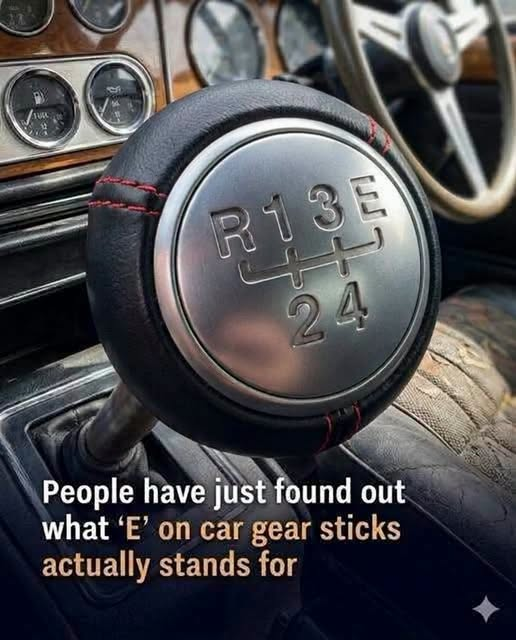
Many drivers who grew up with cars from the 1980s and 1990s still remember a small switch or marking labeled simply “E.” It sat near the gear selector or appeared as an extra-tall gear on some manual transmissions. At the time it felt like a minor curiosity. In reality that modest feature represented one of the first widespread attempts to put fuel efficiency under the driver’s direct control.
The “E” stood for Economy or Efficiency. It was born out of the oil crises of the 1970s, when sudden spikes in fuel prices forced both manufacturers and drivers to rethink the relationship between performance and consumption. Automakers responded with a mechanical solution that let the driver choose a more conservative operating mode without permanently altering the car’s character.
On many automatic-transmission vehicles the switch changed shift points. Engaging it caused the transmission to move into higher gears at lower engine speeds. The car would often start in second gear rather than first, reducing the high-torque, high-fuel phase of acceleration. Once underway, the transmission resisted downshifting unless the driver pressed the accelerator firmly. The result was smoother, quieter progress and noticeably lower fuel use on steady roads.
Manual-transmission versions took a different approach. Some models, particularly certain European cars, offered an extra-tall overdrive gear marked “E.” Shifting into it dropped engine revolutions dramatically during highway cruising. Cabin noise fell, vibration decreased, and fuel consumption improved. The trade-off was limited acceleration; drivers quickly learned to drop back to a lower gear when climbing hills or passing.
The financial benefit was straightforward. In an era of higher fuel prices and less efficient engines, the ability to reduce consumption by several percent on every tank added up over months and years. Drivers who used the mode consistently on commuting and highway trips often noticed the difference at the pump. The feature rewarded deliberate, less aggressive driving with measurable savings.
There was also a subtler safety effect. Because the economy setting discouraged rapid downshifts and sudden bursts of power, it nudged drivers toward smoother inputs and earlier anticipation of traffic. The car felt less eager to surge, which in turn encouraged a calmer style behind the wheel. While no one claimed the button itself prevented accidents, the driving habits it promoted were generally more controlled.
The tactile nature of the old “E” mode is part of what made it memorable. A physical switch or a distinct gear required a conscious decision. Drivers had to choose efficiency rather than having it imposed by software. That small act of intention created a different relationship with the vehicle. Many people who used the feature regularly developed a clearer sense of how engine speed, load, and fuel use interacted.
Modern cars have largely replaced the old mechanical solution with electronic “Eco” modes. Today’s systems adjust throttle response, shift schedules, climate-control settings, and sometimes even regenerative braking all at once. The results are often more comprehensive than the simple “E” switch could achieve. Yet the older approach retained a certain clarity: the driver remained the one making the final choice about how the car should behave.
As transmissions grew more complex—moving from three- and four-speed units to eight-, nine-, and ten-speed designs—the need for a separate economy switch diminished. Computers now optimize shift points continuously based on dozens of sensors. The physical “E” gradually disappeared, leaving only the memory of a time when efficiency was something a driver actively selected rather than an automatic background process.
For owners of classic and late-twentieth-century vehicles, the feature still offers practical value. Engaging the economy setting on a long highway run can restore some of the fuel efficiency those older engines are capable of when treated gently. It also serves as a reminder that many of the gains modern cars achieve through software were once pursued through straightforward mechanical means.
The old “E” button never promised dramatic performance or advanced technology. What it offered was a simple contract between driver and machine: choose a quieter, more measured way of traveling and the car will reward you with lower fuel use and a calmer experience. In an age of increasingly automated vehicles, that small piece of driver agency still feels worth remembering. The next time you encounter an older car with that modest switch or extra gear, it is worth trying. The savings may be modest, but the lesson about intentional driving remains as relevant as ever.
Most Popular!
-
 My Husband Abandoned Me 300 Miles From Home as a Joke — Then He Showed Up Five Years Later to Destroy Everything I Built
-
The Brutal Truth: My Husband Tried to Control Me on Our Third Day of Marriage — He Didn’t Know Who He Was Dealing With
-
The Midnight Trap: Why One Single Ring Could Cost You Your Entire Life Savings
-
Deadly Garnish: Why Your Innocent Kitchen Staple Is Actually a Silent Risk Lurking in Your Fridge
-
The Illegal Tag Myth: Why You’ve Been Living in Fear of Your Own Mattress
-
The BBQ Bomb: My Father-in-Law Treated My Home Like His Personal Five-Star Restaurant — Until I Served Him an $1,800 Reality Check
-
I Discovered My Mother-in-Law Selling My Priceless Wedding Dress at a Garage Sale — Then I Realized Why She Was Really Doing It
-
I Spent Years Hating My Ex-Husband for His Infidelity, But at His Funeral His Father Handed Me a Letter That Revealed the Sickening Truth