Personality quizzes have a special kind of magnetism. A simple prompt appears on the screen—look at a group of faces, pick the one that draws your eye first—and suddenly you are promised deep insight into your character. The results often feel uncannily accurate. You read a description of yourself as responsible, optimistic, curious, or deeply empathetic and think, “That is exactly me.” The experience is entertaining, shareable, and strangely satisfying. Yet the real story behind these quizzes is less about secret psychological tests and more about how the human mind works when it is invited to see itself reflected.
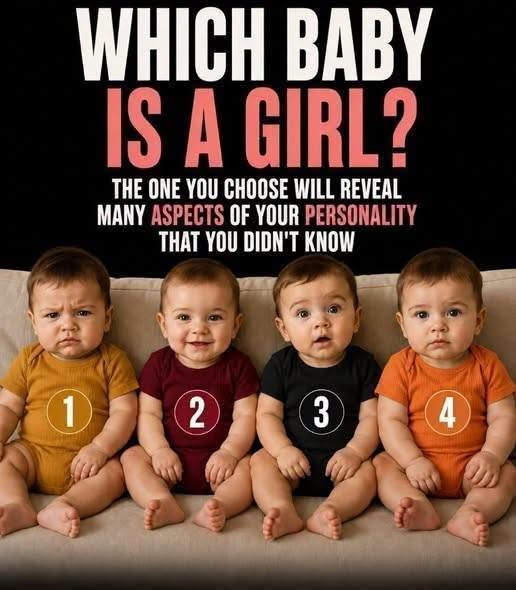
These quizzes succeed because they tap into a well-documented tendency called the Barnum effect, sometimes known as the Forer effect. In the 1940s, psychologist Bertram Forer gave students a personality assessment and then provided identical feedback to every participant. The statements were deliberately vague and flattering: “You have a great need for other people to like and admire you.” “You have a tendency to be critical of yourself.” Nearly everyone rated the description as highly accurate. The statements were general enough to apply to most people, yet specific enough to feel personal. Modern online quizzes operate on the same principle. Whether you choose Baby 1 or Baby 4, the resulting profile is written to sound insightful while remaining broad enough that almost anyone can recognize pieces of themselves.
First impressions play a powerful supporting role. When you look at a set of images and feel drawn to one face more than the others, your brain is not performing a neutral analysis. It is responding to subtle cues shaped by your own history, current mood, and unspoken values. A soft expression might remind you of safety. A brighter gaze might signal energy and possibility. The choice feels instinctive because it is guided by patterns your mind has been building for years. Psychologists note that rapid judgments about faces happen within fractions of a second and are influenced by everything from personal experiences with similar-looking people to cultural associations with certain expressions. The quiz simply gives that automatic process a dramatic narrative.
What makes the results feel revealing is not that the quiz has unlocked hidden truths. It is that the human mind is exceptionally skilled at finding meaning and confirming what it already suspects. Once you read a positive description, confirmation bias goes to work. You recall moments when you were the reliable one in a crisis or the person who lifted the mood of a room. Memories that fit the description become more vivid; moments that contradict it fade into the background. The quiz does not create new self-knowledge so much as it organizes existing self-knowledge into a flattering story.
There is nothing inherently wrong with enjoying that process. Lighthearted quizzes can serve as conversation starters, brief mental breaks, or playful ways to notice what currently holds your attention. In a culture that often feels rushed and fragmented, pausing to consider “What draws me?” can be a small act of self-reflection. The danger arises only when the results are treated as definitive or diagnostic. No image of a baby, no matter how carefully selected, can measure emotional intelligence, long-term character, or the complexity of a real personality. Human beings are inconsistent, context-dependent, and capable of growth. A single choice on a screen cannot capture that range.
A more useful approach is to treat the quiz as a mirror rather than a verdict. Notice which description felt most true and ask why. Did the emphasis on responsibility resonate because you have recently been carrying extra weight for others? Did the language of optimism feel accurate because you have been deliberately practicing gratitude? The value lies in the questions the experience raises, not in the labels it assigns. Real self-understanding tends to come from slower, less dramatic sources: honest conversations, patterns that repeat across years, feedback from people who know you in different settings, and the quiet accumulation of choices made when no one is watching.
These quizzes also reveal something about collective curiosity. People are endlessly interested in themselves and in one another. We want frameworks that make sense of why we feel drawn to certain people, why certain situations energize us, and why we react the way we do under pressure. Popular psychology content fills that desire quickly and accessibly. At its best, it sparks genuine interest in how minds work. At its weakest, it substitutes entertainment for deeper inquiry. The healthiest response is to enjoy the entertainment while keeping the limitations in clear view.
There is also a social dimension worth noticing. Sharing a quiz result often becomes a way of signaling identity. Posting “I got the empath” or “I’m the steady one” can be a low-stakes method of telling others how you see yourself or how you would like to be seen. In that sense, the quiz functions less as a diagnostic tool and more as a form of gentle self-presentation. Understanding this can make the experience more playful and less loaded. You are not discovering a fixed essence; you are participating in a cultural game of reflection and recognition.
Ultimately, the lasting insight these quizzes offer has little to do with which baby you selected. It has to do with the human tendency to seek coherent stories about who we are. We prefer narratives that feel complete and affirming. We are quick to accept descriptions that flatter and slower to sit with more complicated or contradictory truths. Recognizing that pattern is itself a form of self-awareness. The next time a colorful quiz promises to expose your deepest secrets, you can smile at the invitation, notice what captures your attention, and then return to the slower, richer work of understanding yourself through lived experience rather than through a single click.
The real secrets worth uncovering are rarely hidden in a lineup of images. They emerge in how you treat people when you are tired, what you protect when resources are limited, and what you continue to value after the novelty of any label has worn off. Those patterns take time to observe and courage to acknowledge. No personality test can do that work for you. It can only offer a brief, entertaining reminder that the mind is always interpreting, always seeking meaning, and always ready to see itself in the stories it is told.
Most Popular!
-
 Love, Loyalty, and the Quiet Strength of Choosing Family When It Matters Most
-
Airplane Seat Conflicts, Missing Belongings, and the Quiet Power of a Child’s Observation
-
When Loyalty Meets Inheritance: The Complicated Bonds Between Caregivers and the Families They Serve
-
The Emotional Weight of Intimacy That Doesn’t Match: Why Some Connections Leave Lasting Marks
-
The Letter M on Your Palm: What Palmistry Claims and What Science Actually Knows
-
When a Child Leaves and Years Later Returns With the Truth: Navigating Estrangement, Manipulation, and the Long Road Back
-
What Your Sleeping Position Actually Says About Your Body—and How to Make It Work for You
-
Growing Up in the Shadow of Global Fame: What It Really Means for Jennifer Lopez’s Children