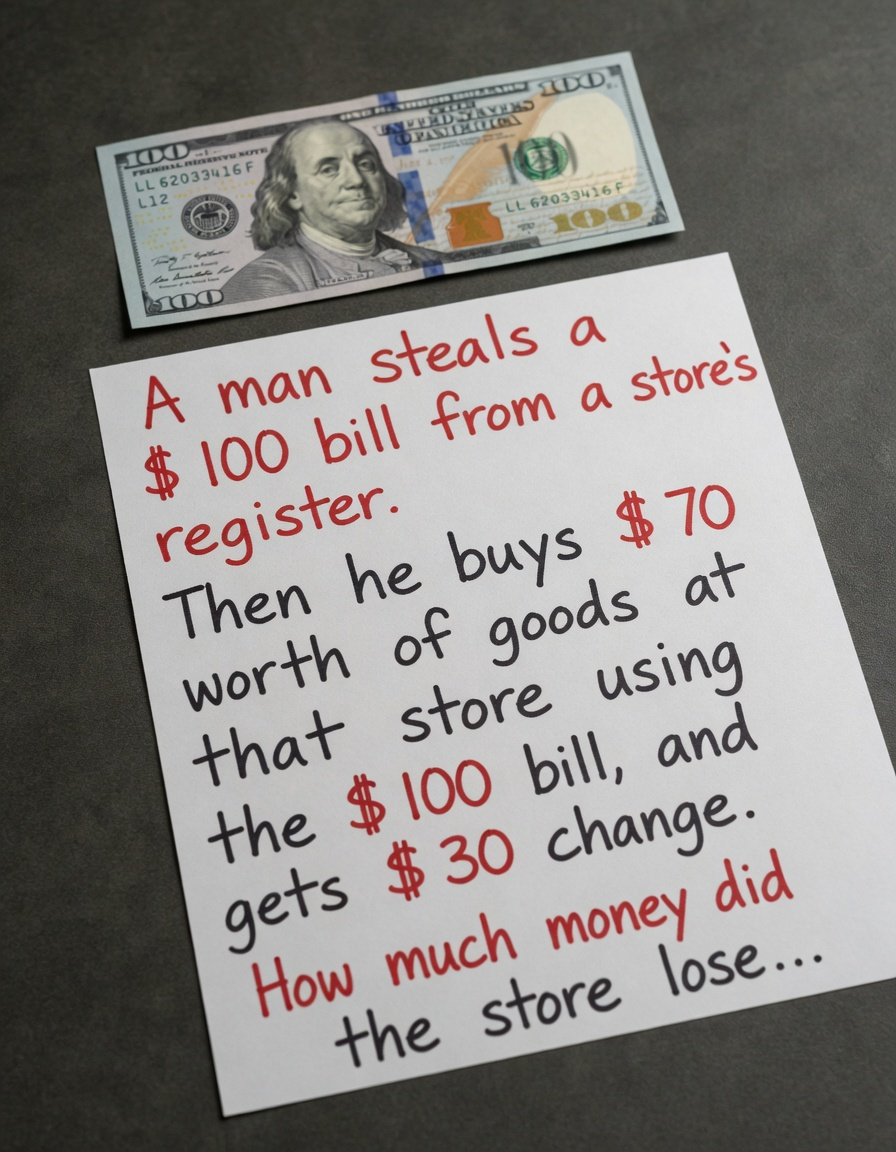
A thief walks into a store and steals a $100 bill from the cash register. Later that same day, the thief returns to the store and uses that exact stolen $100 bill to buy $70 worth of merchandise. The cashier, unaware of the theft, gives the thief $30 in change. The question is simple: How much money did the store ultimately lose?
This deceptively straightforward riddle has sparked endless arguments across social media, comment sections, and family dinner tables. Some people confidently say $100. Others insist it’s $70. A vocal group swears the answer is $130. The intensity of the debates proves one thing — our brains love to overcomplicate even the simplest problems when they’re wrapped in a clever story.
Let’s break it down clearly, step by step, without the emotional narrative that tricks so many people.
- The thief steals $100 from the register. At this point, the store is down $100.
- The thief returns and spends that same $100 bill on $70 worth of goods. The store receives its own $100 back but gives away $70 in merchandise.
- The cashier then hands the thief $30 in change.
So what is the total loss?
The store lost the original $100 (which was stolen) plus the $70 in merchandise. The $30 change is simply returning part of the stolen money. The net result is a $100 loss for the store — the exact amount that was taken in the first place. The thief effectively walked out with $70 worth of free goods and $30 in cash, all funded by the initial theft.
The confusion usually comes from double-counting or getting lost in the story. People start thinking about the thief spending “stolen money” as somehow different from regular money, or they try to calculate how much the store “gained back.” But money is money. The store ended up missing $100 from its register, and that’s the bottom line.
This riddle works so well because it plays on how our brains process information. We get caught up in the narrative — the thief, the store, the change — and start overthinking instead of focusing on the simple movement of money. It’s a perfect example of why clear, logical thinking matters more than emotional storytelling.
If you got the answer wrong the first time, you’re in good company. Thousands of people argue passionately about this exact riddle every single day. The real lesson isn’t just about the math. It’s about learning to slow down, avoid distractions, and focus on what actually matters in a problem.
The next time someone shares a “simple” riddle that seems too obvious, take a breath before answering. Your brain might be trying to trick you — just like it tricks millions of others every day with this exact scenario. The store lost $100. End of story. But the real value is in recognizing how easily we can be led astray by clever wording and unnecessary details.
Keep that in mind the next time life throws a complicated situation your way. Sometimes the clearest answer is the right one — even when your mind wants to make it much more difficult than it needs to be.
Most Popular!
-
 Eggs, Cholesterol, and Timing: What Actually Matters for Most People
-
When a Partner Leaves With More Than a Suitcase: Protecting Yourself From Financial Betrayal
-
When Financial Support Meets Contempt: Recognizing Exploitation Inside a Marriage
-
Why Some Sensory Toys and Household “Hacks” Do Not Belong in the Microwave
-
When Grief Clouds Judgment: Misreading Silence and the Quiet Ways People Show Care
-
When One Partner Does All the Hosting: Recognizing Imbalance Before Resentment Takes Over
-
How Many Holes Are in a T-Shirt? What a Simple Puzzle Reveals About How We See
-
The Quiet Stories Inside Secondhand Objects: When a Thrift-Store Find Carries Someone Else’s History