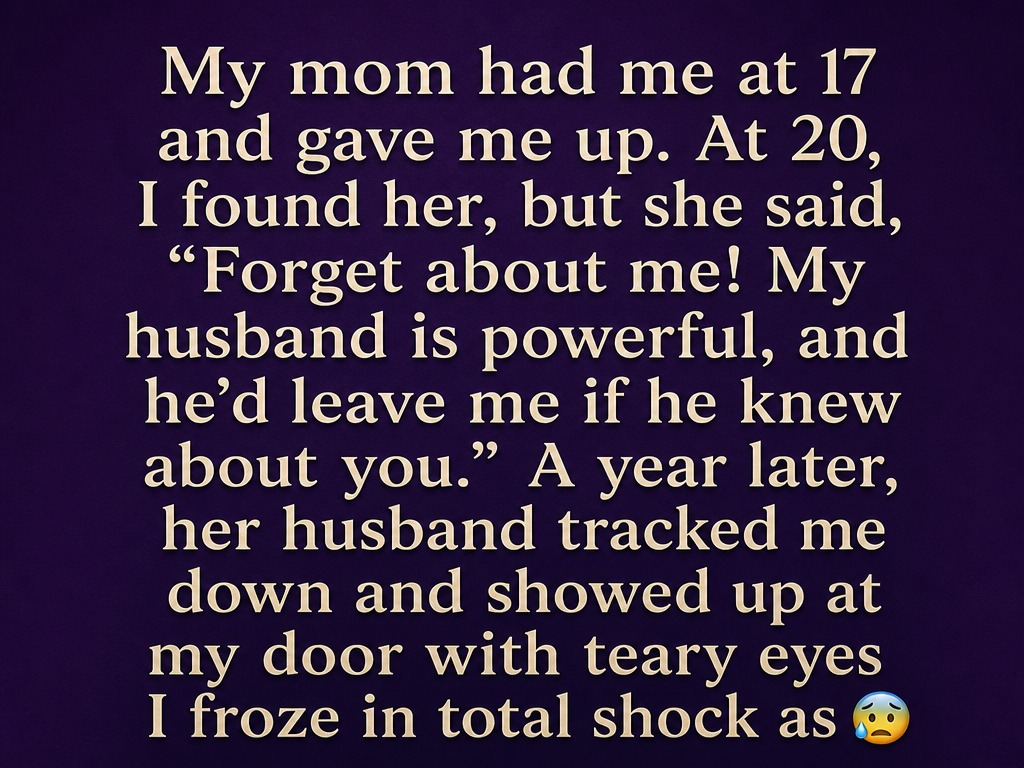
Some doors in life feel too heavy to open. Others open when you least expect it, flooding your heart with emotions you didn’t know you were still carrying. For most of my adult life, I lived with a quiet emptiness I could never quite name. It wasn’t dramatic or loud. It was simply there — a soft ache that surfaced during holidays, birthdays, and quiet moments when the world slowed down. I was adopted as a newborn, and while my adoptive parents gave me a loving home filled with stability and care, I always wondered about the woman who had carried me for nine months and then made the impossible choice to let me go.
I grew up knowing I was adopted. My parents never hid it from me. They told me stories about how they had prayed for a child and how my arrival felt like an answered prayer. They celebrated my birth mother in small, respectful ways, always speaking of her with gratitude rather than judgment. Yet as I moved into my twenties and thirties, the questions grew louder. Who was she? Why did she give me up? Did she ever think about me? Was she okay? These questions lived in the background of my life like a song playing on low volume — always present, never fully silenced.
When I turned thirty-eight, something inside me shifted. Maybe it was the milestone birthday, or watching my own children grow up and start asking about their family history. Whatever it was, I decided it was time. I began the search through adoption records, DNA testing, and quiet inquiries. The process was slow and emotionally exhausting. There were dead ends, false hopes, and long nights wondering if I was stirring up pain that should remain buried. But one ordinary Tuesday afternoon, everything changed.
Her name was Clara. She lived in a small coastal town about three hours away. When I finally worked up the courage to drive there, my hands shook on the steering wheel the entire way. I parked across the street from her modest blue house with white trim and flowering plants spilling over the porch. I sat in my car for nearly twenty minutes, trying to steady my breathing. Then I walked up the steps and knocked.
The woman who opened the door looked like an older version of me. Same eyes. Same slight curve in the smile. Same nervous habit of touching her collarbone when surprised. For a long moment, neither of us spoke. Tears filled her eyes before she whispered my name — the name she had given me before signing the papers that separated us. She stepped forward and pulled me into an embrace that felt both foreign and deeply familiar. In that hug, thirty-eight years of wondering collapsed into something raw and real.
We sat on her porch for hours that first day. She told me about being seventeen and terrified when she discovered she was pregnant. Her family had strict expectations. The father of the baby had disappeared the moment he learned about the pregnancy. She felt alone and unprepared to give a child the life she believed I deserved. Giving me up wasn’t a rejection, she said. It was the hardest act of love she had ever performed. She had thought about me every single day since.
The conversation felt like healing until her husband came home.
His name was Richard. He was polite at first, but the moment Clara explained who I was, his entire demeanor changed. His jaw tightened. His eyes grew cold. Later that evening, when Clara stepped away to make tea, he pulled me aside and spoke in a low, controlled voice. He told me that my appearance in their life threatened everything they had built. He had no idea Clara had given up a child. He said if I continued contact, he would leave her. He painted a picture of her life without him — financial ruin, loneliness, shame. Then he asked me to leave and never come back.
I drove home that night feeling shattered. The joy of finally meeting my birth mother had been replaced by a new kind of pain. I had opened a door only to have it slammed in my face again. For weeks afterward, I wrestled with anger, sadness, and confusion. Part of me wanted to respect Richard’s wishes and disappear. Another part refused to let go after coming so close. I wondered if I was being selfish for wanting a relationship with the woman who had given me life.
The silence stretched for nearly eight months. I focused on my own family — my husband and our two children. I threw myself into work and tried to convince myself that I had closure. But the ache remained. Then one rainy Sunday morning, there was a knock at my door.
Richard stood on my porch, soaked from the rain, looking smaller and more vulnerable than I remembered. He asked if he could come in. For the next two hours, he told me a story I never expected to hear. He had grown up in a rigid, loveless household where emotions were considered weakness. When he married Clara, he had promised himself he would create something different. But when he learned about me, old fears resurfaced. He was terrified of losing control, of his carefully constructed life falling apart. He admitted he had given Clara an ultimatum out of fear rather than strength.
He had spent the past months watching his wife grow quieter and more distant. He realized that by trying to protect their marriage from the truth, he had damaged it more deeply. That morning, he had come to ask for my forgiveness — not just for himself, but so Clara could finally have peace.
We cried together that day. Not the dramatic, movie-style tears, but the quiet kind that come when years of tension finally break. I told him I didn’t need to replace him in Clara’s life. I simply wanted space to know my mother. He nodded, and for the first time, I saw genuine remorse in his eyes.
The reunion that followed was slow and careful. Clara and I began meeting for coffee once a month. We shared stories, laughed at similarities in our mannerisms, and gently explored the complicated feelings that came with our history. Richard joined us occasionally. He was never fully comfortable, but he showed up. That effort meant more than perfection ever could.
Looking back, the most healing part wasn’t the initial meeting or even Richard’s apology. It was the slow process of forgiveness that followed. I had to forgive Clara for the fear that kept her silent for decades. I had to forgive Richard for reacting from his own wounds. And most importantly, I had to forgive myself for believing that being given up meant I was somehow less worthy of love.
This experience taught me that family is rarely simple or linear. It is messy, layered, and often requires courage to show up even when it hurts. Second chances don’t always look like perfect happy endings. Sometimes they look like awkward conversations, careful boundaries, and the quiet decision to keep trying.
Today, Clara and I have built something real. We don’t see each other every week, but the connection is genuine. Richard has softened over time. My children now have another grandmother who tells them stories about their mother as a baby. The family tree that once felt broken has grown new branches in unexpected places.
If there’s one lesson I carry from this journey, it is this: forgiveness is not about forgetting the pain. It is about refusing to let that pain define your future. It is choosing connection over resentment, understanding over judgment, and love over fear — even when love arrives decades late and wrapped in complications.
The reunion that healed more than I expected didn’t erase the years we lost. Instead, it gave us something better: the chance to write a new chapter together. One built on honesty, grace, and the beautiful, imperfect truth that families can be remade even after they have been broken.
And in the end, that second chance was worth every difficult step it took to reach it.
Most Popular!
-
 Eggs, Cholesterol, and Timing: What Actually Matters for Most People
-
When a Partner Leaves With More Than a Suitcase: Protecting Yourself From Financial Betrayal
-
When Financial Support Meets Contempt: Recognizing Exploitation Inside a Marriage
-
Why Some Sensory Toys and Household “Hacks” Do Not Belong in the Microwave
-
When Grief Clouds Judgment: Misreading Silence and the Quiet Ways People Show Care
-
When One Partner Does All the Hosting: Recognizing Imbalance Before Resentment Takes Over
-
How Many Holes Are in a T-Shirt? What a Simple Puzzle Reveals About How We See
-
The Quiet Stories Inside Secondhand Objects: When a Thrift-Store Find Carries Someone Else’s History