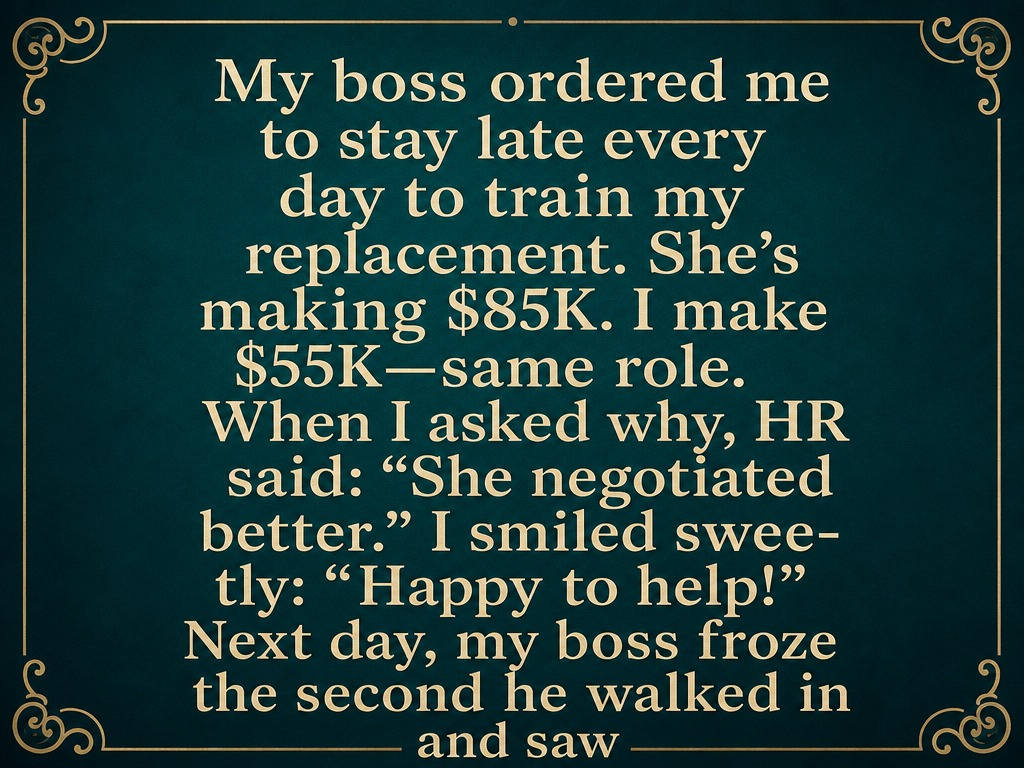
Some moments in life don’t arrive with dramatic music or obvious warning signs. They slip in quietly, disguised as just another ordinary workday, until suddenly everything you thought you knew about your value shifts beneath your feet. For me, that moment came on a rainy Tuesday morning when I sat across from a bright-eyed 24-year-old named Jenna, walking her through the complex reporting systems I had built from scratch over twelve years at the company. I was training my own replacement, and in that process, I finally saw myself clearly for the first time.
The decision to leave hadn’t been impulsive. After more than a decade of consistent performance reviews that praised my dedication, reliability, and creative problem-solving, I had watched newer employees climb the ladder faster than I ever had. My salary had barely moved despite taking on increasing responsibilities. When I finally gathered the courage to ask for a promotion and a meaningful raise, the response from leadership was polite but firm: “We really value what you do here, but we don’t have budget for that right now.” Two weeks later, they posted my job description internally with a significantly higher salary range. The message couldn’t have been clearer. I wasn’t being valued. I was being used.
Still, I stayed longer than I should have. Loyalty runs deep for some of us, especially women who have been taught that being dependable matters more than being respected. I told myself that things would change, that my quiet contributions would eventually be recognized. Instead, I received the news that a younger, less experienced candidate had been hired to “bring fresh energy” to the team. My manager actually had the nerve to ask me to train her during my final four weeks. “You’re the best person to show her the ropes,” he said with a smile that didn’t reach his eyes. I agreed because part of me still hoped that staying professional would somehow prove my worth. Looking back, that decision became the greatest gift I could have given myself.
The first few days of training Jenna were mechanical. I showed her the filing systems, the client databases, the monthly reporting templates I had refined over years of late nights and careful attention to detail. She was eager and asked good questions. But as the days passed, something unexpected began happening inside me. Every time I explained a process I had created, I heard my own voice gaining strength. Every time Jenna expressed genuine admiration for how organized and efficient everything was, I felt a quiet pride I hadn’t allowed myself to feel in years.
On the third day, Jenna looked up from her notes and said something that stopped me cold. “I can’t believe they’re letting you leave. This whole system is basically your brain on paper. How did they not fight to keep you?”
I didn’t have an answer for her then. But that simple question cracked something open inside me. For the first time, I allowed myself to feel the full weight of how undervalued I had been. I had built relationships with difficult clients that no one else could manage. I had created workflows that saved the company thousands of hours and countless errors. I had mentored younger team members while quietly handling the workload of two people. And yet, when it came time to recognize that value financially or through promotion, the company had chosen convenience over loyalty.
As I continued training Jenna, I started noticing patterns in my own behavior that I had normalized for far too long. I had regularly stayed late without extra compensation. I had taken on emergency projects during vacations. I had smiled through meetings where male colleagues with less experience received praise for ideas I had originally suggested. I had convinced myself that being the reliable one would eventually be enough. Training someone else to step into my role forced me to see my contributions clearly, without the filter of self-doubt or people-pleasing that had clouded my vision for years.
By the second week, I was no longer just showing Jenna the technical aspects of the job. I was teaching her how to advocate for herself in ways I never had. I shared stories about times I had been overlooked and what I wished I had done differently. I encouraged her to document her wins, to speak up in meetings, and to never undervalue the expertise she would bring to the role. In helping her prepare for success, I was finally giving myself the validation I had withheld for so long.
The most powerful moment came during our final training session. Jenna asked me why I was really leaving. I told her the truth — not the polished version I had shared with management, but the raw reality of feeling invisible despite my best efforts. As I spoke, tears welled up in my eyes, not from sadness but from a deep sense of release. For the first time, I wasn’t ashamed of wanting more. I wasn’t apologizing for recognizing my own worth. I was owning it.
On my last day, I walked out of that building with my head held higher than it had been in years. I didn’t have a new job lined up yet, but I had something more valuable: clarity. I understood now that respect at work isn’t something you earn by shrinking yourself or working harder than everyone else. It’s something you claim by recognizing your contributions and refusing to accept less than you deserve.
The months that followed my departure were both challenging and liberating. I took time to rest, something I hadn’t done in over a decade. I updated my resume with honest pride in my achievements. I started freelancing as a systems consultant, helping smaller companies organize their operations the way I had done for my previous employer. The work felt meaningful because I was no longer pouring my energy into a place that didn’t value it. For the first time, I was choosing projects and clients that aligned with my worth.
One of the most surprising outcomes was how my departure affected the team I left behind. Several colleagues reached out months later to say that my exit had sparked important conversations about workload, compensation, and recognition. Jenna herself sent me a message thanking me for being honest during our training sessions. She had negotiated a higher starting salary than originally offered, citing some of the points I had encouraged her to consider. Knowing that my experience had helped someone else avoid the same traps brought a deep sense of purpose.
This journey taught me several important lessons about respect at work that I wish I had understood much earlier. First, your value isn’t determined by how long you stay in one place or how quietly you endure disrespect. It’s measured by the impact you create and the standards you refuse to compromise. Second, training your replacement can be one of the most clarifying experiences possible because it forces you to see your contributions objectively. When you watch someone else step into the role you built, you finally see the full scope of what you brought to the table.
Third, and perhaps most importantly, loyalty should never be one-sided. Companies that truly value their employees demonstrate it through fair compensation, growth opportunities, and basic respect. When those things are consistently missing, staying out of loyalty becomes self-betrayal rather than virtue. I had confused endurance with dedication for far too long.
Today, I run my own consulting practice helping professionals recognize their worth and negotiate accordingly. I work with many women in their forties and fifties who, like me, spent years undervaluing themselves in environments that benefited from their quiet reliability. The work feels meaningful because I’m not just teaching systems and processes. I’m teaching people how to stop abandoning themselves in the name of being “good employees.”
If you’re currently in a situation where you feel undervalued, unseen, or stuck training someone who will be paid more than you were, please hear this: your worth isn’t defined by your employer’s failure to recognize it. You have the power to rewrite your story. Start documenting your achievements. Begin exploring your options. Give yourself permission to want more without feeling guilty about it. The discomfort of leaving what’s familiar is temporary. The regret of staying where you’re undervalued lasts much longer.
My departure wasn’t the end of my career. It was the beginning of truly respecting myself in professional spaces. Training my replacement didn’t diminish me. It illuminated me. And in that illumination, I finally saw clearly what I had always been worth.
The journey hasn’t been easy, but it has been freeing. I no longer tie my value to any single company’s opinion of me. I measure it by the peace I feel at the end of each day, the respect I demand in every professional interaction, and the example I set for my own children about what it means to honor yourself.
If you’re reading this and recognizing pieces of your own story, know that change is possible. Sometimes the most powerful thing you can do is walk away from a table that no longer serves you — even if you were the one who built it. Your worth was never up for negotiation. The only question was whether you would finally stop accepting less than you deserve.
And on that rainy Tuesday morning, training my replacement, I finally stopped. The freedom that followed has been worth every difficult conversation, every moment of doubt, and every brave step into the unknown. You deserve that freedom too.
Most Popular!
-
 Eggs, Cholesterol, and Timing: What Actually Matters for Most People
-
When a Partner Leaves With More Than a Suitcase: Protecting Yourself From Financial Betrayal
-
When Financial Support Meets Contempt: Recognizing Exploitation Inside a Marriage
-
Why Some Sensory Toys and Household “Hacks” Do Not Belong in the Microwave
-
When Grief Clouds Judgment: Misreading Silence and the Quiet Ways People Show Care
-
When One Partner Does All the Hosting: Recognizing Imbalance Before Resentment Takes Over
-
How Many Holes Are in a T-Shirt? What a Simple Puzzle Reveals About How We See
-
The Quiet Stories Inside Secondhand Objects: When a Thrift-Store Find Carries Someone Else’s History