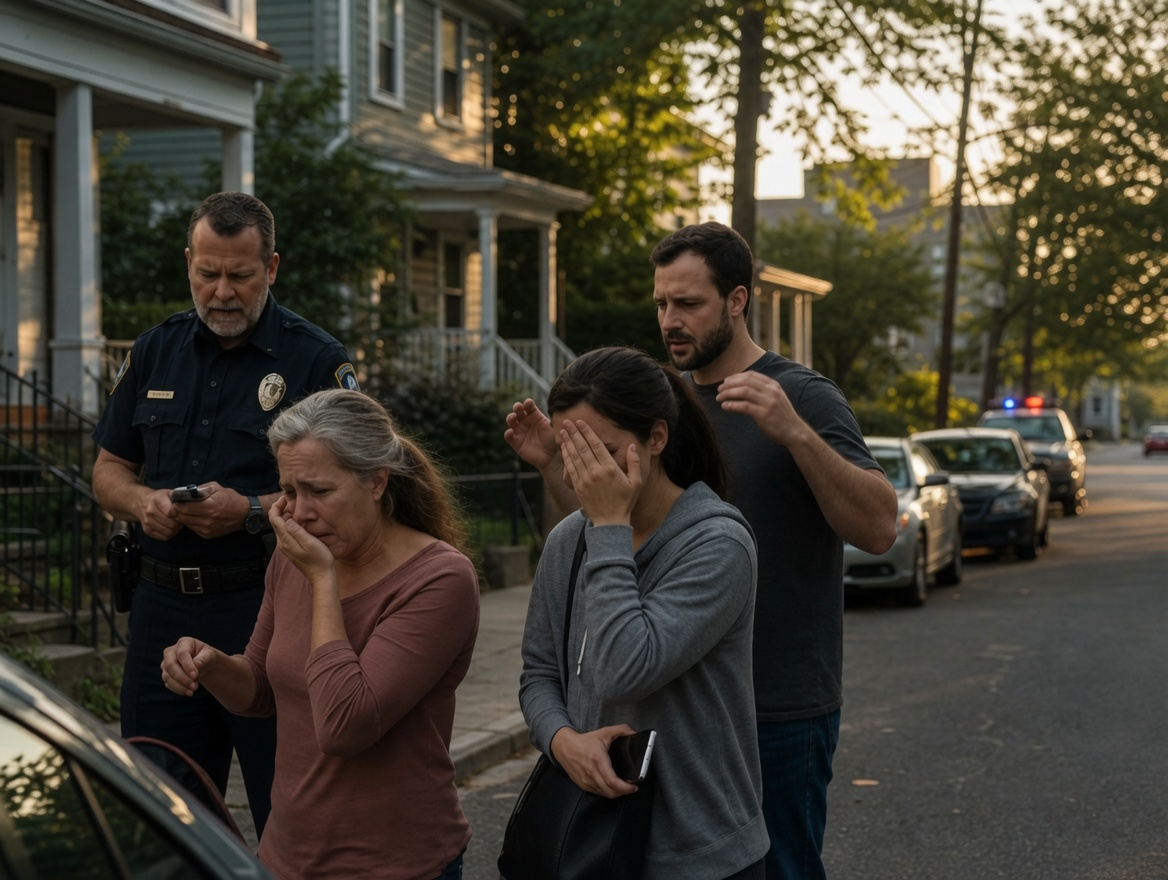
I had just finished a twelve-hour shift at the hospital, the kind where every muscle ached and my mind felt like static. All I wanted was to pull into my driveway, kick off my shoes, and collapse on the couch with a cup of tea. The house on Maplewood Lane had been my sanctuary for the past seven years — a modest but beautiful three-bedroom I had bought after my divorce, renovated slowly on weekends, and filled with things that finally felt like mine. It wasn’t perfect, but it was paid for and peaceful. It was home.
As I turned onto my street, something felt wrong before I could even see the house clearly. There were too many cars parked along the curb. When my driveway came into view, my heart slammed against my ribs so hard I nearly swerved off the road.
A large white moving truck sat squarely in front of my garage. Two men in work uniforms were carrying boxes up the front steps and through my open front door. Furniture I didn’t recognize was already stacked on the porch. For one disorienting second, I thought I had driven to the wrong address. But no — there was my blue mailbox with the slightly crooked number 1428, my flower pots still lined up along the walkway, my wind chimes hanging from the porch roof.
I parked across the street, hands shaking so badly I could barely turn off the engine. My first instinct was to call the police. My second was pure panic. Had I been robbed? Was this some kind of elaborate scam? I grabbed my phone and started recording as I walked toward the house, my nurse’s scrubs still rumpled from the long shift.
That’s when I saw her.
Standing behind the truck, directing the movers with a clipboard in her hand like she owned the place, was my mother. Next to her, arms crossed and looking impatient, stood my father. And leaning against the truck with a smug expression I knew too well was my older sister, Rachel.
I stopped dead in the middle of the street. The world tilted. For several long seconds, I couldn’t speak. Couldn’t move. The betrayal hit so deep and so sudden that it felt like someone had punched me in the chest.
My mother looked up and saw me. Instead of shame or surprise, her face lit up with that familiar, calculated smile she used whenever she wanted something. “Oh, good, you’re home early! We tried to call but you must have been busy at the hospital again.”
I finally found my voice, though it came out hoarse and trembling. “What the hell are you doing?”
My father stepped forward, trying to look reasonable. “Sweetheart, let’s not make a scene in front of the neighbors. We’re just helping you out. You’ve been working so hard, and the house is too big for one person. We decided it was time for the family to be together again.”
Rachel laughed lightly, as if this were all perfectly normal. “Come on, Emily. Don’t be dramatic. Mom and Dad sold their place up north. They need somewhere to live, and you have all this space. It just makes sense.”
I stared at them, trying to process what I was hearing. These were the same parents who had barely spoken to me for the past three years after I refused to lend them $40,000 for yet another one of their “business ideas.” The same sister who had ghosted me after I confronted her about spreading rumors that I was “selfish” for not helping the family more. The same people who had criticized my divorce, my career choices, and my decision to live alone. Now they were moving into my house without asking — without even a conversation.
The movers kept carrying boxes inside as if this were completely ordinary. I recognized some of my parents’ old furniture mixed in with new pieces they must have bought with money I didn’t know they had. My mother had already hung her favorite curtains in the living room window. The violation felt so complete it was almost surreal.
I stepped onto my own porch and blocked the doorway. “Stop. Everyone stop right now. This is my house. You do not have permission to be here.”
My mother’s smile faltered for the first time. “Emily, be reasonable. We’re family. Family helps family. You’ve always been so independent, but it’s time to think about what’s best for all of us.”
“What’s best for all of us?” My voice rose despite my efforts to stay calm. “You mean what’s best for you. You didn’t ask. You didn’t call. You just showed up with a moving truck like you owned the place.”
Rachel rolled her eyes. “God, you’re so selfish. Mom and Dad are getting older. They need support. You have this big house sitting here empty half the time while you’re at work. It’s perfect.”
The movers had paused, looking uncomfortable. One of them glanced between us, clearly unsure whose orders to follow.
I pulled out my phone again, this time dialing 911. “I’m calling the police. You have ten minutes to get your things out of my house before they arrive.”
My father’s face turned red. “You would do that to your own parents? After everything we’ve done for you?”
“Everything you’ve done for me?” The words tasted bitter. “You mean the years of criticism? The guilt trips? The money you’ve asked for and never repaid? The way you disappeared when I needed you most after my divorce? That everything?”
The neighbors had started coming out onto their porches. Mrs. Alvarez from across the street watched with wide eyes. Mr. Thompson stood on his lawn, arms crossed, clearly ready to step in if needed. I wasn’t alone, and that knowledge gave me strength.
My mother tried one last time, switching to the soft, pleading voice she used when she wanted to manipulate me. “Emily, honey, please. We have nowhere else to go. Your father’s health isn’t good. We thought you’d understand.”
For a moment, the old guilt tried to creep in. The part of me that had been trained since childhood to put family first, to sacrifice, to never say no. But something had finally broken inside me. I looked at the moving truck, at the strangers carrying my family’s belongings into the home I had worked so hard to build and maintain alone, and I felt nothing but clarity.
“No,” I said firmly. “You made your choices. Now I’m making mine. Get out of my house.”
The police arrived within minutes. After explaining the situation and showing them the deed to the property in my name, they asked my parents and sister to remove their belongings. The movers, realizing they had been brought into a family dispute under false pretenses, quickly unloaded everything back onto the truck. Rachel tried to argue, but one firm warning from an officer silenced her.
As the truck finally pulled away, my mother shot me one last look — a mixture of anger, disbelief, and something that almost looked like regret. I didn’t wave. I didn’t cry. I simply stood on my porch and watched them leave.
That evening, I sat alone in my living room with a cup of tea, the house quiet except for the ticking of the clock. The violation still stung, but underneath it was something stronger: pride. I had protected what was mine. I had finally chosen myself after years of being conditioned to choose everyone else first.
The weeks that followed brought complicated emotions. My parents tried calling multiple times. Rachel sent angry texts accusing me of abandoning family. A few distant relatives reached out, taking sides without knowing the full story. But I stood firm. I changed my locks. I updated my security system. And most importantly, I started therapy to unpack the years of guilt and obligation that had made me vulnerable to this kind of intrusion in the first place.
Looking back, that day with the moving truck became a turning point I didn’t know I needed. It forced me to confront how deeply I had internalized the idea that family could take whatever they wanted from me simply because we shared blood. It taught me that love and loyalty should never mean self-abandonment. And it showed me that sometimes protecting your peace requires uncomfortable boundaries — even with the people who are supposed to love you most.
Today, my house feels like mine again. I’ve planted new flowers in the front beds. I’ve redecorated the guest room into a peaceful reading nook instead of the space my parents had already claimed in their minds. I’ve started saying no more often — to extra shifts, to guilt trips, to anyone who treats my kindness as an entitlement.
The experience also changed how I view family. Blood may connect us, but respect, boundaries, and mutual care define whether those connections remain healthy. Some relationships can be repaired with time and honest effort. Others teach us the painful but necessary lesson of letting go.
If you’re reading this and carrying similar weight with family members who take more than they give, please hear me: your home is your sanctuary. Your peace is worth protecting. Your kindness is a gift, not an obligation. And sometimes the most loving thing you can do — for yourself and for them — is to close the door when someone tries to walk through it without permission.
That afternoon with the moving truck didn’t destroy my relationship with my family forever. But it did destroy the version of me who believed I had to sacrifice everything to keep them close. In its place, a stronger, wiser, more self-respecting woman finally stepped forward.
And she’s never letting anyone move into her home — or her life — without her full consent again.
Most Popular!
-
 Eggs, Cholesterol, and Timing: What Actually Matters for Most People
-
When a Partner Leaves With More Than a Suitcase: Protecting Yourself From Financial Betrayal
-
When Financial Support Meets Contempt: Recognizing Exploitation Inside a Marriage
-
Why Some Sensory Toys and Household “Hacks” Do Not Belong in the Microwave
-
When Grief Clouds Judgment: Misreading Silence and the Quiet Ways People Show Care
-
When One Partner Does All the Hosting: Recognizing Imbalance Before Resentment Takes Over
-
How Many Holes Are in a T-Shirt? What a Simple Puzzle Reveals About How We See
-
The Quiet Stories Inside Secondhand Objects: When a Thrift-Store Find Carries Someone Else’s History