Some betrayals don’t arrive with shouting or slammed doors. They creep in quietly, wrapped in familiar voices and shared blood, disguised as family needing help. I learned this lesson the hardest way possible — by trusting my sister completely and watching that trust slowly unravel over three long years. What began as an act of love and loyalty ended with a painful awakening about boundaries, self-worth, and the dangerous illusion that family will always treat your kindness with care.
My name is Ivy, and for most of my adult life, I poured everything I had into building something meaningful. After years of working in corporate jobs that left me drained and uninspired, I took the leap and opened a small flower shop in our quiet suburban town. “Bloom & Grace” wasn’t just a business — it was my dream realized. The space smelled of fresh eucalyptus and roses, with soft natural light filtering through large windows. Customers came for bouquets but stayed for the calm atmosphere and the way the arrangements seemed to capture emotions words often failed to express. It wasn’t a massive financial success, but it was mine. I had built it from nothing, and after eight years of early mornings, late nights, and careful saving, I finally sold it for a modest but life-changing profit. For the first time in years, I felt a deep sense of peace and possibility ahead.
Then the phone rang one quiet evening.
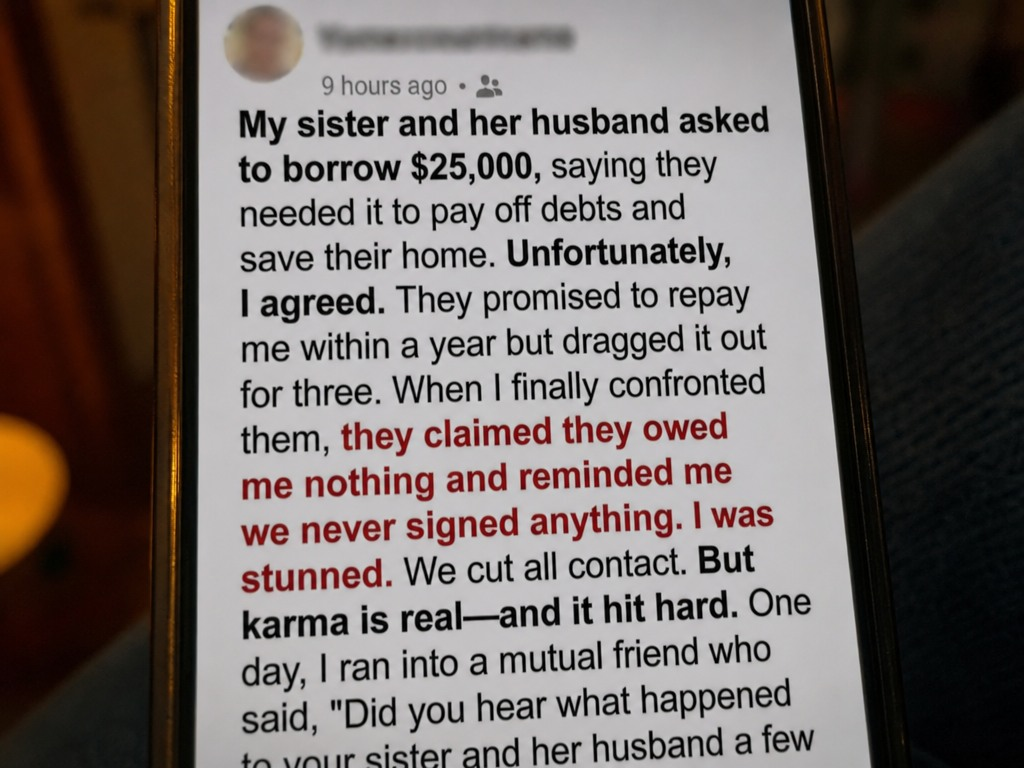
It was my younger sister Lisa. Her voice trembled as she explained the situation. She and her husband Rick were drowning. They had fallen behind on their mortgage after Rick’s business took a hit during an economic slowdown. Bills were piling up, and foreclosure loomed like a dark shadow over their home and their two young children. “We just need a little breathing room,” she said, her words breaking with emotion. “Just enough to get back on our feet. I swear we’ll pay you back, Ivy. You’re the only one I can turn to.”
Rick got on the line too. His voice was heavy with what sounded like genuine desperation. “This would save us, Ivy. We’ll draw up papers if it makes you feel better. Family helps family, right?”
They were family. My only sister. The girl I had protected growing up, the one who had cried on my shoulder through breakups and life struggles. Of course I helped. That was my first and perhaps biggest mistake.
The next morning, I transferred $25,000 — nearly everything I had made from selling the flower shop. It wasn’t an insignificant amount. It represented years of sacrifice, missed vacations, and choosing the dream over comfort. But I told myself that if our roles were reversed, Lisa would do the same for me. We met at her kitchen table the following weekend and wrote up a simple agreement. Nothing overly formal — just a handwritten note with the amount, a one-year repayment timeline, and both of our signatures. We hugged afterward, and Lisa cried tears of gratitude. Rick shook my hand firmly and promised I wouldn’t regret it.
For the first six months, I stayed silent. I didn’t want to be the sister who hounded her family over money. I told myself they needed time, that pressuring them would only add stress to an already difficult situation. But one year came and went with only vague excuses. “It’s been a rough quarter,” Rick would say with a shrug whenever I gently brought it up. “The kids had unexpected expenses,” Lisa would add. “We’re stretched so thin right now.”
Yet their social media told an entirely different story. Lavish weekend getaways to beach resorts. New designer handbags for Lisa. A shiny new SUV in Rick’s driveway. Pictures of expensive birthday parties and catered holiday dinners filled their feeds. Every post felt like a quiet slap. I began saving screenshots, not out of spite at first, but because deep down I knew I was being taken advantage of. The evidence piled up quietly on my laptop — proof that contradicted every excuse they offered.
By the third Thanksgiving, I could no longer stay silent. Lisa had outdone herself that year. Her home looked like something from a lifestyle magazine — perfectly set tables, a catered feast, expensive wine flowing freely. The kids ran around in new clothes while holiday music played softly in the background. When the children left the room to play, I finally spoke.
“Hey,” I began, trying to keep my voice steady and calm. “We need to talk about the money. It’s been three years now.”
The atmosphere in the room shifted instantly. Lisa’s smile dropped like a mask. Rick leaned back in his chair with an arrogant smirk that made my blood run cold.
“You’re really bringing this up during Thanksgiving dinner?” Lisa asked, her tone sharp and accusatory.
Rick chuckled. “That little paper you had us sign? That won’t hold up in court. It was barely even legal.”
“I’m not talking about court,” I replied quietly, my hands trembling under the table. “I’m talking about integrity. About keeping your word to family.”
Lisa slammed her fork down. “You said you’d be fine without it! You acted like it was no big deal!”
“That didn’t mean it was a gift,” I said, my voice barely above a whisper. “I trusted you.”
“You’re acting like we stole from you,” she snapped, her face flushing with anger rather than shame.
I stood up from the table before dessert was served. I walked out of that house with my heart pounding and my eyes burning with unshed tears. For the first time in three years, I saw the truth clearly — not in their words, but in their complete lack of remorse. They had never intended to pay me back. My kindness had been taken for weakness, and my loyalty had been used against me.
The following week, I sat in a lawyer’s office with the simple agreement and all my saved evidence. He reviewed everything carefully, then sighed and delivered the news gently. “It’s too informal. You could try to sue, but the odds aren’t strongly in your favor, and it would be expensive and emotionally draining.” I left that office with a heavy heart but a clear decision forming inside me. I was done carrying their debt and their excuses.
Life didn’t magically improve overnight, but slowly I began to rebuild. I returned to floral design work, not as a full business owner this time, but in a way that felt more personal and sustainable. I specialized in intimate wedding arrangements and small private events. I also started teaching weekend workshops where women learned to create their own beautiful arrangements for affordable home gatherings. The work brought me joy again. My savings began to grow, but more importantly, so did my sense of self-worth and independence.
Then, one quiet Saturday afternoon after a workshop, there was an unexpected knock at my studio door. It was Lisa. She looked different — worn down, tired, but somehow softer around the edges. She stood there awkwardly, twisting her hands.
“I heard you teach these now,” she said quietly. “I’m sorry, Ivy. I know I can’t undo what I did. But I want to try to make things right. Can I join one of your classes? Maybe we can start over?”
I didn’t answer immediately. I let the silence stretch between us. Then I told her the truth I had finally accepted. “I support growth, Lisa. But I no longer support excuses. If you want a relationship with me, it has to be built on honesty and respect — not on what I can give you financially.”
She nodded, tears filling her eyes. It felt like the first real conversation we’d had in years. No debts hanging over us. No guilt. Just two sisters trying, however imperfectly, to rebuild something honest.
The real lesson from this entire experience wasn’t about the $25,000 I may never see again. It was about the illusion we often hold — that the people who share our blood will automatically treat our kindness with the same care we offer them. Sometimes family can hurt us the deepest precisely because we lower our guards so completely around them.
But here’s what I’ve learned through the pain: even after betrayal, you can rise. You can rebuild your life on stronger foundations. You can forgive without forgetting, and you can set boundaries without closing your heart entirely. I may have lost money, but I found something far more valuable — my strength, my peace, and the power to choose who gets access to my life and my resources.
Today, I still create beautiful things with flowers. I still teach women how to bring beauty into their homes and lives. And I still believe in helping others. But now I do it with wisdom and clear boundaries. Kindness is still part of who I am — it always will be. But it no longer comes without discernment.
If you’re reading this and carrying a similar weight with family — whether it’s money, emotional labor, or repeated broken promises — please hear this: your loyalty is a gift, not an obligation. Your kindness has value. And sometimes the most loving thing you can do, for yourself and for them, is to stop enabling patterns that harm everyone involved.
The road to healing isn’t always smooth or quick. But it is possible. And on the other side, you might just find a stronger, wiser, more peaceful version of yourself waiting — one who knows her worth and refuses to settle for anything less than the respect she deserves.
That, more than any amount of money, is a lesson worth every tear, every difficult conversation, and every hard-earned boundary.
Most Popular!
-
 Eggs, Cholesterol, and Timing: What Actually Matters for Most People
-
When a Partner Leaves With More Than a Suitcase: Protecting Yourself From Financial Betrayal
-
When Financial Support Meets Contempt: Recognizing Exploitation Inside a Marriage
-
Why Some Sensory Toys and Household “Hacks” Do Not Belong in the Microwave
-
When Grief Clouds Judgment: Misreading Silence and the Quiet Ways People Show Care
-
When One Partner Does All the Hosting: Recognizing Imbalance Before Resentment Takes Over
-
How Many Holes Are in a T-Shirt? What a Simple Puzzle Reveals About How We See
-
The Quiet Stories Inside Secondhand Objects: When a Thrift-Store Find Carries Someone Else’s History