The Evening I Thought I Knew the Truth About My Neighbor’s Marriage — And the Lesson That Changed Me Forever
It is remarkable how quickly the mind can construct an entire story from a single moment. One glance, one snippet of conversation taken out of context, and suddenly we believe we hold the complete truth about someone else’s life. I learned this the hard way on what should have been an ordinary Tuesday evening — an evening that began with nothing more than a desire for a quiet meal and ended with a profound shift in how I view other people, their private struggles, and my own tendency to rush to judgment.
The restaurant was one of those neighborhood places that feels familiar and comforting. Soft lighting, gentle background music, and the low hum of conversations created an atmosphere where time seemed to slow down. I had stopped in after a long day at work, hoping for a simple plate of pasta and a few minutes to unwind before walking home. I expected nothing more than that. What I got instead was a front-row seat to what I believed was the unraveling of my neighbors’ marriage.
Sarah and Mark had lived next door to me for nearly eight years. They were the kind of couple other people quietly envied. Mark was dependable, always the first to offer help when someone needed a hand with yard work or moving furniture. Sarah was warm and quick with a smile, the type of person who remembered birthdays and brought over homemade cookies during difficult times. They seemed solid. Stable. The kind of marriage that made you believe some relationships really do last.
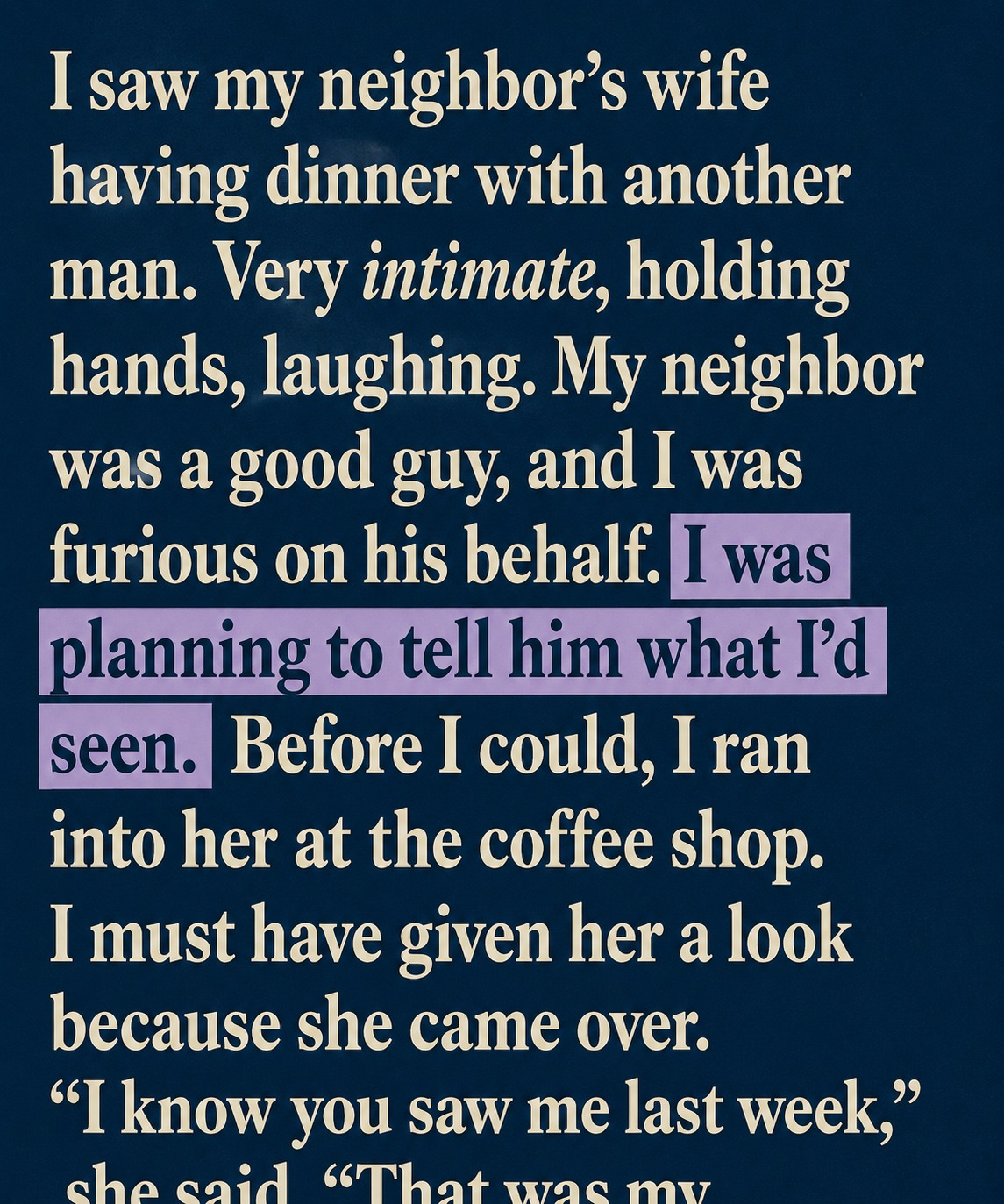
That evening, I noticed Sarah sitting in a corner booth. She wasn’t alone. Across from her was a man I had never seen before. They were leaning toward each other, speaking in low voices, laughing softly in that intimate way that suggested deep familiarity. There was an ease between them that felt personal, almost tender. From where I sat, it looked like something more than friendship. My stomach tightened as I watched them. I told myself I wasn’t spying, but I couldn’t look away.
In that single moment, my mind raced ahead and filled in every missing detail. I decided the man must be someone from her past. I imagined secret meetings, hidden messages, and the slow erosion of the marriage I had always admired. I pictured Mark coming home from work, completely unaware, trusting his wife while she built another life behind his back. By the time I paid my bill and stepped out into the cool night air, I had already written the entire story in my head. I felt angry on Mark’s behalf. I felt disappointed in Sarah. Most of all, I felt a strange sense of righteous certainty that I had uncovered something important.
For the next several days, the image replayed constantly in my thoughts. I found myself watching their house more closely than usual. When Mark came home from work, I studied his face for signs of suspicion or sadness. When Sarah waved at me from across the yard, I forced a smile while my mind whispered accusations. The more I thought about it, the more convinced I became that I had a responsibility to act. Staying silent, I told myself, would make me complicit. Surely honesty demanded that I warn Mark or at least confront Sarah about what I had seen.
I rehearsed the conversation in my head dozens of times. I imagined myself approaching Mark gently, sharing what I had witnessed as a concerned neighbor. I told myself that real friendship sometimes requires difficult truths. The more I repeated these ideas to myself, the more justified I felt. My confidence grew, built entirely on fragments and assumptions.
What I didn’t realize was how fragile that confidence truly was.
A few mornings later, a light rain had softened the streets and kept most people indoors. I stopped at a small café near my home to grab a coffee and wait out the weather. As I stood in line, Sarah walked in. She spotted me immediately, offered a warm smile, and came over before I could decide whether to slip away. There was no tension in her expression, no hint of guilt or defensiveness. She looked like the same Sarah I had always known — kind, open, and completely at ease.
We chatted for a few minutes about ordinary things — the weather, neighborhood news, how her garden was doing. Then, almost casually, she mentioned the man I had seen her with at the restaurant. She told me he was her brother, who had traveled from across the country for a short visit. They had chosen that particular restaurant because it held special memories from their childhood. It was where their parents used to take them for special occasions. The closeness I had witnessed wasn’t romance. It was the comfort of family during a difficult season.
But she didn’t stop there.
Sarah quietly shared that she had been facing a serious health challenge — something she was still coming to terms with herself. She hadn’t yet told Mark, not because she wanted to hide it, but because she needed time to process the diagnosis and gather her strength before sharing the burden. Her brother’s visit had given her a safe space to talk freely, to cry without worrying about how it would affect her husband, and to feel supported while she prepared herself emotionally. What I had interpreted as secrecy and betrayal was actually vulnerability and love in one of its quietest forms.
In that moment, embarrassment washed over me like a cold wave. My carefully constructed story collapsed instantly. The certainty I had felt just days earlier now seemed arrogant and foolish. I had been so eager to be right, so convinced that my perspective was complete, that I had ignored the possibility I might be completely wrong. I apologized to Sarah that day, though the words felt inadequate. She accepted my apology graciously, but I could see the relief in her eyes that I hadn’t acted on my assumptions.
That conversation became a turning point for me. It forced me to confront how easily we fill in blanks with our own narratives when we don’t have the full picture. We see a moment, a glance, or a conversation and believe we understand the entire context of someone else’s life. We judge quickly because it feels safer than sitting with uncertainty. We convince ourselves that our observations equal truth, when in reality they are often just fragments filtered through our own experiences, fears, and biases.
Since that evening, I have tried to practice a different approach. When I notice something that seems off in someone else’s life, I pause before forming conclusions. I remind myself that every person carries stories I know nothing about. Behind closed doors, people face challenges, illnesses, financial worries, family tensions, and emotional struggles that rarely show on the surface. A single glimpse — no matter how convincing it appears — is almost never the complete story.
The experience also taught me something important about compassion. True kindness often looks like restraint rather than action. Sometimes the most helpful thing we can do is mind our own business and offer silent support instead of rushing in with assumed solutions or warnings. I had been so focused on being a “good neighbor” that I nearly caused unnecessary pain. Learning to hold back when I don’t have the full context has been one of the hardest but most valuable lessons of my adult life.
Sarah and Mark are still together. She eventually shared her health concerns with him, and they faced the challenge as a team. Their marriage didn’t fall apart because of secrets. It grew stronger through honesty and mutual support. Watching them from a respectful distance reminded me that relationships are far more complex and resilient than they often appear from the outside.
Today, when I see my neighbors going about their lives, I try to remember that evening in the restaurant. I think about how close I came to damaging something I didn’t fully understand. I choose patience now where I once chose certainty. I choose curiosity instead of judgment. And I choose silence more often, trusting that people generally know what they need better than I do.
The mind is remarkably quick at building stories. But wisdom comes from learning when to set those stories aside and simply observe with humility. Lives unfold in ways we rarely see completely. Hearts carry burdens we cannot imagine. And assumptions, once spoken, can cause wounds that are difficult to heal.
That ordinary evening taught me that the truth is rarely as simple as it first appears. Sometimes the most important thing we can do is slow down, withhold judgment, and remember that everyone around us is fighting battles we know nothing about. In choosing understanding over certainty, we become better neighbors, better friends, and better versions of ourselves.
And in the end, that quiet lesson may be the most valuable one of all.
Most Popular!
-
 Eggs, Cholesterol, and Timing: What Actually Matters for Most People
-
When a Partner Leaves With More Than a Suitcase: Protecting Yourself From Financial Betrayal
-
When Financial Support Meets Contempt: Recognizing Exploitation Inside a Marriage
-
Why Some Sensory Toys and Household “Hacks” Do Not Belong in the Microwave
-
When Grief Clouds Judgment: Misreading Silence and the Quiet Ways People Show Care
-
When One Partner Does All the Hosting: Recognizing Imbalance Before Resentment Takes Over
-
How Many Holes Are in a T-Shirt? What a Simple Puzzle Reveals About How We See
-
The Quiet Stories Inside Secondhand Objects: When a Thrift-Store Find Carries Someone Else’s History