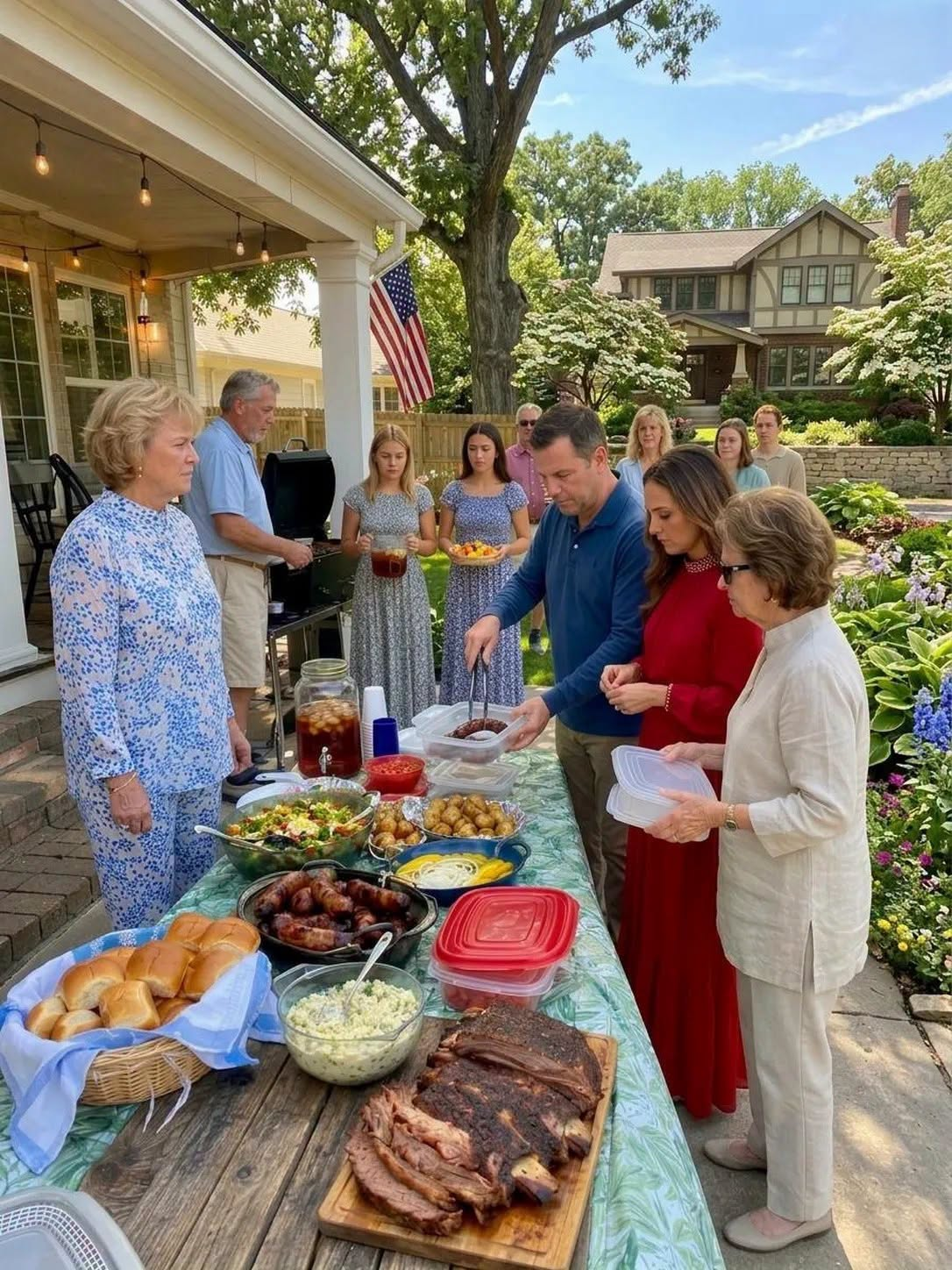
The patio fell into complete silence when I took the plastic container out of my son’s hands. I had been awake since before dawn, tending the grill and preparing what was meant to be a simple Sunday celebration of family. Instead, my daughter-in-law Rachel and her mother Stella were packing the best cuts of brisket and ribs into their own containers before most of the other guests had even been offered seconds. My husband Tom stood by the grill with his jaw locked tight, while my nieces watched in quiet disbelief.
At sixty-five I have always believed that feeding people is one of the clearest ways to show care. My modest home outside Fort Worth has been the gathering place for nearly forty years. Birthday parties, graduations, holidays, and countless Sunday cookouts have all taken place under the same shade trees. For this particular meal I had chosen thirty-three pounds of good beef from the local market — brisket, ribs, skirt steak, sausages, and thick-cut steaks. The grocery bill alone came to two hundred and fifty dollars, not counting the sides, the bread, the drinks, or the peach cobbler that had taken hours to prepare.
My nieces Erica and Louisa arrived early, bringing an apple pie, a fruit salad, and a bottle of wine. Rachel and Stella arrived later carrying two large bags filled with empty plastic containers. From the moment they stepped into the backyard the tone of the afternoon shifted. They offered no compliments. Instead they criticized the table arrangement, made pointed comments about my rose bushes, and decided my sausages were too salty while they filled their own plates. They spent much of the meal photographing the food and positioning the platters so that it appeared they had played a central role in the preparation.
The real entitlement showed itself once the main courses were finished. Without asking, Rachel opened her tote bag and began directing my son Julian to fill the containers with the leanest, most expensive pieces of meat — the same pieces I had planned to use for Tom’s and my lunches during the coming week. She did not lower her voice or attempt to be discreet. She pointed at another untouched platter and told Julian to take the softer pieces, treating my backyard as if it were a restaurant offering free takeout.
The boldness of it left me momentarily speechless. They claimed they were only preventing waste, yet no one had been asked whether they wanted more food. They had contributed nothing, helped with none of the cleaning, and were systematically emptying the table while other guests were still present. Tom looked at me, waiting for a decision. I stepped forward, closed the lid of the container Julian was holding, and spoke clearly.
“Please leave,” I said. “Right now.”
The reaction was immediate. Rachel was silent for the first time all afternoon. Stella turned red and began stammering about how embarrassing I was being, while Rachel recovered enough to accuse me of jealousy. None of it mattered. I walked them to the gate and watched them drive away, my heart still pounding.
The consequences arrived quickly. Julian sided with his wife, telling me I had humiliated her over a few leftovers and that I needed to apologize to keep the peace. He stopped calling and stopped visiting. The silence in the house became heavy. Eventually I packed a bag and went to stay with my sister Isabella in San Antonio. Over a quiet glass of wine she helped me see the situation more clearly. The argument had never been about the cost of the meat or the plastic containers. It was about boundaries. For years I had allowed my generosity to be interpreted as unlimited permission. I had taught my son to be kind, but I had not taught him that kindness should never be treated as a resource to be drained.
Weeks later my phone rang. It was Julian. He did not begin with an apology, but he began with recognition. He said he had finally understood what I had seen that afternoon. Rachel had admitted to him that the containers were never really about leftover food. They were about proving she could take what she wanted from my house without consequence. For the first time he was looking at the pattern rather than defending the demand of the moment. The road back to regular contact was slow, but the lesson had landed.
I no longer host every gathering with the same open-ended expectation. When people come to my table they are welcome, but the table is not a free resource. I cook because I love to feed people, not because I am obligated to supply whoever arrives with empty containers and a sense of entitlement. The day I closed that plastic lid was the day I stopped confusing generosity with permission. My time, my effort, and even my brisket have a value, and I finally decided they were worth protecting.
Most Popular!
-
 My Husband Abandoned Me 300 Miles From Home as a Joke — Then He Showed Up Five Years Later to Destroy Everything I Built
-
The Mystery Gear: Why Your Old Car Had a Secret “E” Button That Could Save Your Life and Your Wallet
-
The Brutal Truth: My Husband Tried to Control Me on Our Third Day of Marriage — He Didn’t Know Who He Was Dealing With
-
The Midnight Trap: Why One Single Ring Could Cost You Your Entire Life Savings
-
Deadly Garnish: Why Your Innocent Kitchen Staple Is Actually a Silent Risk Lurking in Your Fridge
-
The Illegal Tag Myth: Why You’ve Been Living in Fear of Your Own Mattress
-
The BBQ Bomb: My Father-in-Law Treated My Home Like His Personal Five-Star Restaurant — Until I Served Him an $1,800 Reality Check
-
I Discovered My Mother-in-Law Selling My Priceless Wedding Dress at a Garage Sale — Then I Realized Why She Was Really Doing It