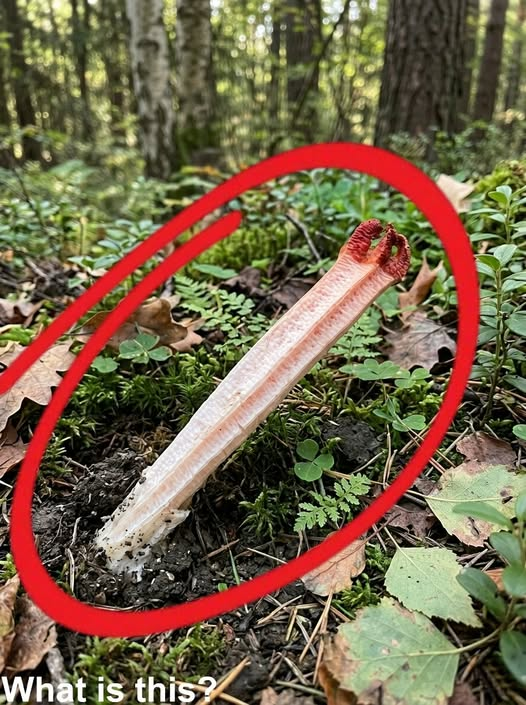
We had been hiking for nearly an hour when my son Leo suddenly stopped and pointed at the base of a massive old oak tree. At first, I thought he had spotted an unusual rock or a cluster of mushrooms. But as I stepped closer, my stomach dropped. Protruding from the damp soil was something that looked disturbingly like a human hand — twisted, bright red, and glistening with a thick, slimy fluid. The fingers were curled in a way that made it seem as though something was trying to claw its way out of the earth.
The forest around us had gone strangely quiet. No birdsong, no rustling leaves, just the heavy silence that sometimes falls in deep woods. A foul, rotting smell hung in the air. Leo took a step back and grabbed my hand tightly. I felt the same primal urge to pull him away and leave immediately. My mind raced through worst-case possibilities — an animal carcass, something far more disturbing, or even evidence of something criminal.
I moved closer while keeping Leo behind me, trying to stay calm for his sake. The “hand” had an unnatural texture, almost rubbery, with several tentacle-like extensions instead of normal fingers. It pulsed slightly in a way that made my skin crawl. I took out my phone, more out of instinct than hope, and searched for anything that matched what we were seeing. Within seconds, results appeared that made me pause.
What we had found wasn’t human at all. It was a rare and bizarre fungus known as Devil’s Fingers, or Clathrus archeri. Also called the octopus stinkhorn, this strange organism starts as a white, egg-like sac buried in the soil. When it matures, the “egg” bursts open and releases long, red, finger-like arms covered in a dark, foul-smelling slime. The smell and appearance are designed to attract flies, which then spread its spores.
Once I understood what we were looking at, the fear began to shift into something else entirely. Nature had created something that looked like a nightmare on purpose. The fungus wasn’t trying to scare us — it was simply using every tool available to survive and reproduce. In its own strange way, it was a master of deception and adaptation.
Leo, still gripping my hand, finally stepped forward again when I explained it was a mushroom. His fear turned into wide-eyed fascination as he studied the bizarre structure. We spent several minutes examining it from different angles without touching it. He asked thoughtful questions about how something so strange could exist in the forest, and I found myself learning alongside him.
That moment stayed with me long after we continued our hike. It reminded me how quickly the mind can jump to dark conclusions when faced with the unfamiliar. In the quiet of the woods, with no immediate explanation, something completely natural had triggered a deep, instinctive fear. It made me think about how many other “monsters” in nature are simply misunderstood forms of life doing what they’ve evolved to do.
We see similar examples in other parts of the world — from carnivorous plants that lure insects with sweet smells to deep-sea creatures that use bioluminescence to hunt. Devil’s Fingers is just one of many organisms that have developed unsettling appearances as survival strategies. What looks horrifying to us is often just efficient biology.
The experience also became a quiet lesson for Leo about staying curious instead of immediately running from fear. We talked about how important it is to observe carefully before deciding something is dangerous. In a world full of dramatic headlines and quick judgments, that simple habit of looking closer felt surprisingly valuable.
By the time we reached the end of the trail, the image of that red, reaching “hand” had lost its terror. Instead, it had become a story we would tell for years — proof that the forest holds wonders far stranger than anything we usually imagine. Nature doesn’t always present itself in gentle, beautiful ways. Sometimes its creativity looks like something out of a horror movie.
I still think about that hike whenever I walk in the woods now. I pay closer attention to the ground and the strange growths that appear after rain. And I remember that the most unsettling things are often the ones we simply don’t understand yet. Once we take the time to look — really look — fear has a way of turning into respect, and sometimes even awe.
That day in the forest didn’t just teach us about a rare fungus. It reminded us that the natural world still has the power to surprise us, unsettle us, and then quietly invite us to understand it better. Sometimes the nightmares we stumble upon are simply life doing what it has always done — finding creative, even disturbing, ways to keep going.
Most Popular!
-
 Eggs, Cholesterol, and Timing: What Actually Matters for Most People
-
When a Partner Leaves With More Than a Suitcase: Protecting Yourself From Financial Betrayal
-
When Financial Support Meets Contempt: Recognizing Exploitation Inside a Marriage
-
Why Some Sensory Toys and Household “Hacks” Do Not Belong in the Microwave
-
When Grief Clouds Judgment: Misreading Silence and the Quiet Ways People Show Care
-
When One Partner Does All the Hosting: Recognizing Imbalance Before Resentment Takes Over
-
How Many Holes Are in a T-Shirt? What a Simple Puzzle Reveals About How We See
-
The Quiet Stories Inside Secondhand Objects: When a Thrift-Store Find Carries Someone Else’s History