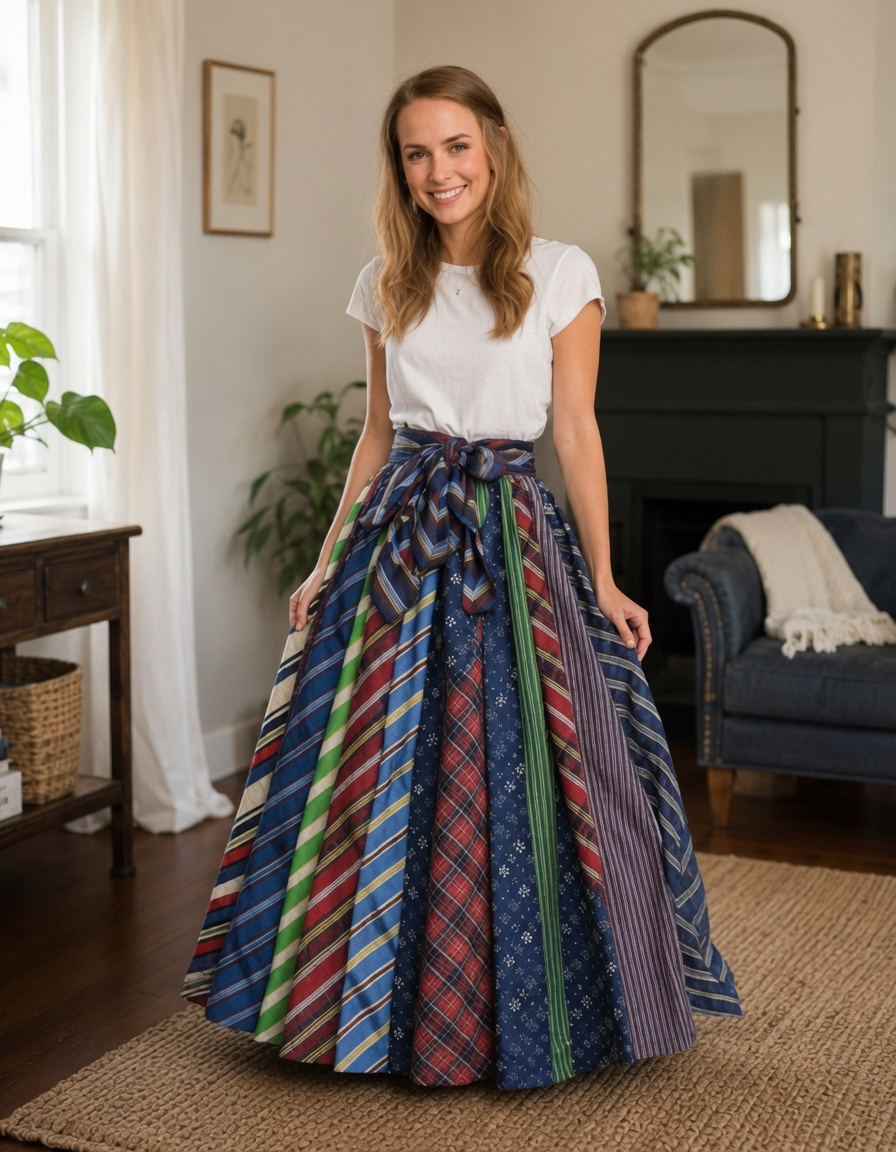
Losing a parent is never something you fully prepare for. When my father passed away suddenly from a heart attack, the world didn’t just feel different — it felt hollow. The man who had always been my loudest cheerleader, my steady hand, and my source of ridiculous jokes was gone. The silence he left behind was heavier than I could have imagined. At seventeen, I was supposed to be thinking about prom dresses, college applications, and the future. Instead, I spent most days trying to remember how to breathe without feeling like something essential was missing.
My father had been the kind of man who wore a tie every single day, even on weekends. Not because he had to, but because he liked feeling put-together. His collection was colorful, bold, and completely mismatched — bright blues with tiny sailboats, deep reds with geometric patterns, soft yellows that reminded me of sunny mornings. Each tie carried its own story. One he wore to my first piano recital. Another to my middle school graduation. A favorite striped one he had on during our last family vacation before he got sick.
After the funeral, my stepmother Carla wasted no time clearing out his things. She said it was “healthy” to move on quickly. She packed most of his clothes into donation bags while I was at school. When I came home and saw the empty closet, something inside me broke. I managed to rescue one bag from the hallway before she could take it away — a collection of his most beloved ties that she had overlooked in her rush to erase him.
I hid that bag in my room like a secret treasure. At night, I would pull them out and run my fingers over the fabric, breathing in the faint trace of his cologne that still lingered. It was the closest thing I had left to his actual presence. Those ties became my quiet rebellion against the idea that grief had an expiration date.
As prom approached, the pressure from my friends and family grew. Everyone expected me to buy a beautiful dress and try to enjoy myself. But the idea of dressing up felt wrong. How could I celebrate while carrying this massive hole inside my chest? I kept thinking about my dad and how he had promised to take pictures with me on the front porch, just like he had done for every important event in my life. The thought of going without him felt like betrayal.
One sleepless night, surrounded by his ties spread across my bed, an idea came to me. What if I brought him with me? What if instead of hiding his memory away, I wore it proudly? I decided to make a skirt entirely from his ties.
I had never sewn anything more complicated than a loose button, but grief gave me a strange kind of determination. I spent weeks watching YouTube tutorials late into the night. I practiced stitches on old scraps of fabric until my fingers ached. The process was slow and imperfect. I cried over ruined seams and had to redo entire sections multiple times. But every stitch felt like a conversation with my father. I told him about my day, about missing him, about how angry I sometimes felt at the world for taking him away. The skirt became more than fabric — it became a vessel for everything I couldn’t say out loud.
When it was finally finished, it wasn’t perfect. The seams were a little uneven. The length was slightly awkward. Some colors clashed in ways that only made sense to me. But when I put it on and looked in the mirror, I saw my father’s love stitched into every piece. It felt warm. Alive. Like he was somehow standing right behind me, smiling that proud smile I missed so much.
My stepmother Carla noticed the skirt the next morning. She stopped in the doorway of my room, looked me up and down, and let out a sharp, mocking laugh. She called it ridiculous. She said I was embarrassing myself and the whole family by “clinging to the past.” Her words stung, but I tried to let them roll off me. I told myself her opinion didn’t matter. This skirt wasn’t for her.
The night before prom, I hung the skirt carefully in my closet. I whispered goodnight to it like a silly child, but it brought me comfort. For the first time since my father died, I slept without waking up crying.
The next morning, everything changed.
When I opened the closet door, the skirt was lying on the floor in pieces. The ties had been torn apart. Seams were ripped open with scissors. Some sections were completely cut through. The beautiful, imperfect creation I had poured weeks of love and grief into was destroyed.
I screamed Carla’s name until my voice cracked. She appeared in the doorway holding a coffee mug, completely calm. She didn’t deny it. She said she had done me a favor — that I needed to stop living in the past and that the skirt would have made me a laughingstock. Her cruelty was delivered so casually that it took my breath away.
In that moment, something inside me finally snapped. The grief, the anger, and the exhaustion of trying to survive in a house that no longer felt like home all came rushing to the surface. I fell to my knees among the torn pieces of fabric and cried harder than I had at my father’s funeral.
My best friend Mallory and her mother arrived shortly after. They had come to help me get ready for prom. When they saw the destruction, they didn’t ask questions. They simply rolled up their sleeves and got to work. For hours, the three of us sat on the floor repairing what we could. They reinforced seams, layered pieces creatively, and turned the damaged skirt into something new — shorter, bolder, and visibly mended. It wasn’t the same as before, but it carried even more meaning now. It showed survival.
That evening, I walked out of the house wearing my repaired skirt with my head held high. I didn’t look back at Carla. I carried my father with me in every step.
At prom, people noticed the skirt immediately. Instead of judgment, I received curiosity and kindness. When I explained what it was made from and why, the reactions overwhelmed me. Teachers hugged me. Friends cried with me. One girl I barely knew told me it was the most beautiful thing she had ever seen. For the first time since losing my dad, I felt seen and understood.
The night ended with an unexpected award for “Most Unique Attire.” As the principal pinned the ribbon to my skirt, she whispered that my father would be incredibly proud of me. Those words wrapped around my heart like a warm embrace.
When I returned home later that night, the driveway was filled with flashing red and blue lights. Police officers were at the front door. Carla stood inside looking pale and shaken. What happened next felt like something from a movie rather than real life.
The officers were there to arrest Carla. Over the past several months, she had been committing identity theft and insurance fraud using my late father’s information. She had opened accounts, filed false claims, and used his social security number for personal gain while I was still grieving. The evidence had been building quietly, and that night they finally had enough to take her in.
As they led her away, Carla screamed accusations at me, claiming I had set her up. But the truth was clear. While I had been sewing my father’s ties into a skirt to honor him, she had been exploiting his memory for money. The contrast couldn’t have been more stark.
In the months that followed, my life transformed. Carla’s arrest brought closure I hadn’t known I needed. I moved in with Mallory’s family temporarily while the legal matters were sorted. The house I had once shared with my father and Carla was sold, and I used part of the proceeds to start a small scholarship fund in my father’s name for students who had lost a parent.
The skirt, now carefully preserved with all its mended seams and stories, hangs in my closet as a reminder of resilience. It represents not just my father’s memory, but my own strength — the ability to turn grief into something beautiful, even when others tried to destroy it.
Looking back, I realize that night with the soup and the destroyed skirt wasn’t the end of something. It was the beginning of my real life — one where I no longer shrank myself to keep the peace. One where I honored my father by living fully instead of hiding in pain. The skirt made of memories taught me that love doesn’t disappear when people do. Sometimes it simply waits for us to stitch it back together in new and unexpected ways.
Today, when I wear that skirt (yes, I still wear it on special occasions), I feel my father walking beside me. Not in the way I once wished for, but in the courage it took to create something beautiful from loss. And in the freedom that came when I finally stopped letting other people decide what my grief should look like.
Some stories don’t have neat endings. But this one gave me something better — the chance to carry love forward instead of leaving it behind. And that, more than anything, feels like the real victory.
Most Popular!
-
 Eggs, Cholesterol, and Timing: What Actually Matters for Most People
-
When a Partner Leaves With More Than a Suitcase: Protecting Yourself From Financial Betrayal
-
When Financial Support Meets Contempt: Recognizing Exploitation Inside a Marriage
-
Why Some Sensory Toys and Household “Hacks” Do Not Belong in the Microwave
-
When Grief Clouds Judgment: Misreading Silence and the Quiet Ways People Show Care
-
When One Partner Does All the Hosting: Recognizing Imbalance Before Resentment Takes Over
-
How Many Holes Are in a T-Shirt? What a Simple Puzzle Reveals About How We See
-
The Quiet Stories Inside Secondhand Objects: When a Thrift-Store Find Carries Someone Else’s History