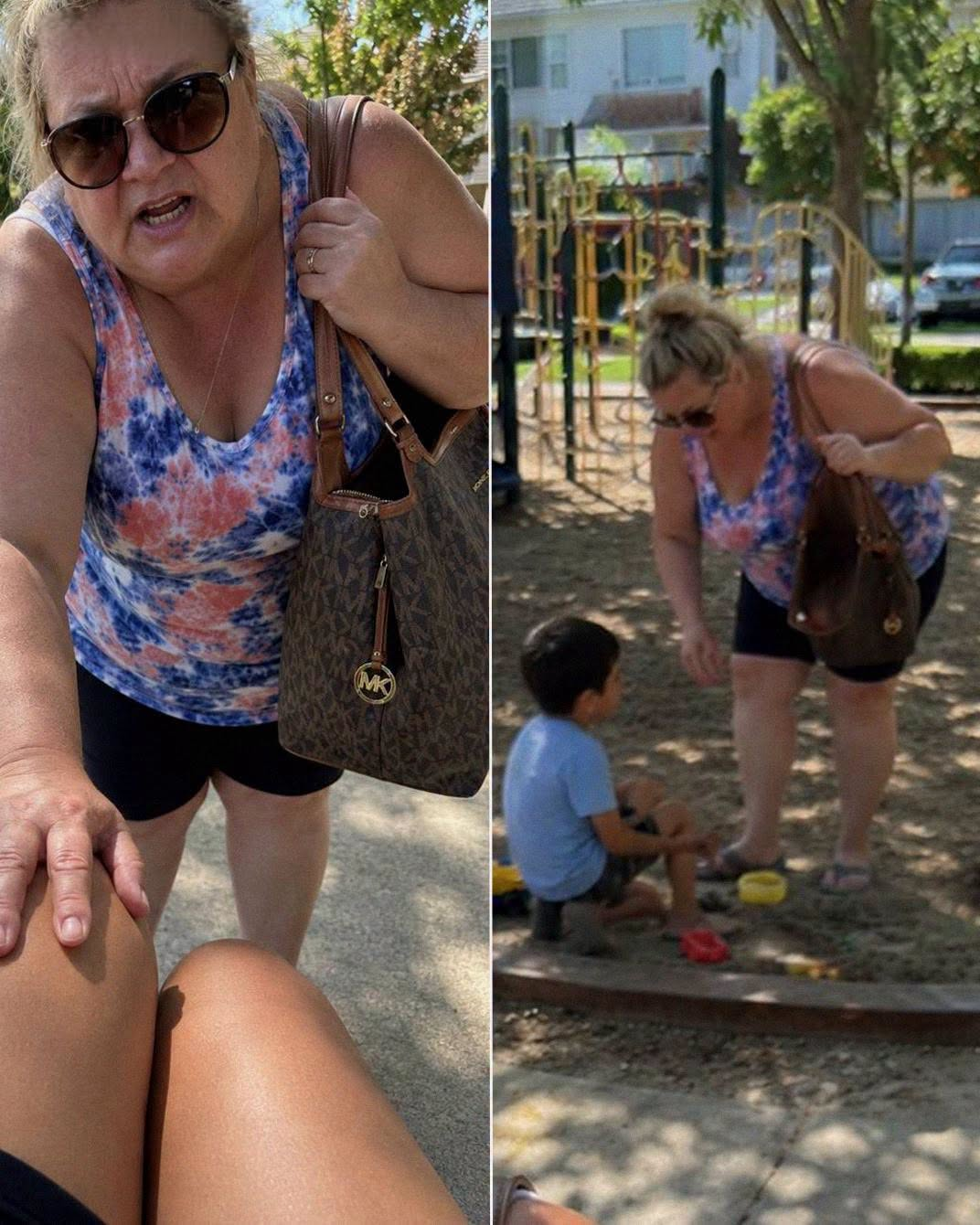
It was an ordinary Tuesday afternoon at the neighborhood park. My four-year-old son Tony was completely absorbed in the sandbox, working on a crooked castle with his red plastic shovel. I sat a short distance away, enjoying one of the rare moments when parenting felt simple. I checked a work email that took less than three minutes. When I looked up, an elderly woman was standing over my son, speaking quietly into his ear.
Every protective instinct I had flared at once. I called Tony to me in a voice sharper than I intended. He scrambled across the sand and I pulled him behind me, keeping my body between him and the stranger. The woman was in her seventies, silver-haired, wearing a faded cardigan that seemed too heavy for the weather. She clutched a large green fabric bag against her chest as if it contained something precious and fragile.
When I asked what she was doing, she did not apologize or step back. Instead she complained about the weight of the bag and asked me to help her carry it the two blocks to her apartment. Her eyes never fully focused on me. They stayed fixed on Tony with an intensity that felt wrong. When I refused, she stepped closer and said, with complete certainty, that I had brought her baby back.
She called him Drew. She insisted he had been wearing a blue sweater the day he vanished. The conviction in her voice was absolute. This was not a casual approach or a simple mistake. In her mind she was reclaiming a child who had been taken from her. I dialed emergency services while she grew more distressed, pleading not to let anyone take him away again.
Bystanders began to notice the tension. A man walking nearby stepped between us and kept a calm presence until the police arrived. The officers handled the situation with measured patience. One of them asked the woman to open the heavy bag she had been holding so tightly. Inside were not threats or anything sinister. There were faded baby blankets printed with blue stars, tiny soft shoes, a wooden rattle, and a worn stuffed bear. Beneath the items lay a yellowed photograph from 1986 showing a young mother smiling at a toddler in a blue sweater.
The photograph belonged to her. The child in the picture was her son Drew, who had disappeared forty years earlier and had never been found. Clara, as the officers later identified her, had suffered a profound mental break that left her trapped in that earlier time. She did not see a stranger’s child in the sandbox. She saw the boy she had spent decades searching for. She had wandered away from a local memory-care facility that afternoon, carrying the physical remnants of a life that had stopped for her in 1986.
The officers arranged for her to be returned safely. As she sat briefly in the sand waiting for the transport, still holding one of the old blankets, Tony stepped out from behind my legs. He held out his red plastic shovel and told her she could use it. The small gesture of kindness cut through the remaining tension. For a brief moment Clara’s expression softened into something almost lucid. She thanked him, still calling him by the name of the child she had lost.
In the weeks that followed, Tony and I began visiting the facility where Clara lived. We sat with her while she told stories about a boy who remained forever three years old in her mind. We did not try to correct her reality. We simply offered the quiet company of people who were willing to listen. The visits became a regular part of our routine, a small bridge between a mother’s endless grief and a family that had almost misunderstood it completely.
That afternoon in the park permanently changed the way I watch my son. I remain careful. I still keep him close in public places and I still check surroundings more than once. But I no longer assume that every unexpected approach carries malicious intent. Sometimes the most frightening encounters are driven by pain so deep that it rewrites a person’s entire present.
Clara never recovered the clarity that would have allowed her to understand the difference between Tony and the child she lost. What she received instead was a measure of gentleness in the final chapter of a long and unfinished mourning. Tony learned, without needing the adult language for it, that some people carry invisible losses large enough to reshape the world they see. The red plastic shovel he offered that day remains a small symbol of the moment fear gave way to something more human.
I still think about the photograph from 1986 and the green bag that held forty years of unbroken hope. The story that began with panic ended with a quieter understanding: the greatest threats are not always the ones we first imagine, and compassion sometimes requires us to look past our own fear long enough to recognize someone else’s unbroken love.
Most Popular!
-
 The Three-Dollar Miracle: How a Dust-Covered Vase Revealed a Heartbreaking Decades-Old Secret
-
The $80,000 Battle to Erase a Birthmark: Why One Mother Risked Everything for Her Daughter’s Future
-
The Silent Thief: Why Millions of Men Are Living with a Time Bomb They Can’t See
-
The Final Curtain Falls: Beloved Sanford and Son Legend Hal Williams Gone at 91
-
Found at a Yard Sale: This “Useless” Vintage Contraption Is Actually a Forgotten Piece of Human History
-
The Hidden Danger at the Funeral: Why a Viral Doctor Is Asking People to Rethink Kissing the Deceased
-
Behind the Spotlight: The Hidden Illness That Challenged Justin Bieber’s Life and Career
-
The Final Heartbeat: A Mother’s Devastating Goodbye That Will Leave You Shattered