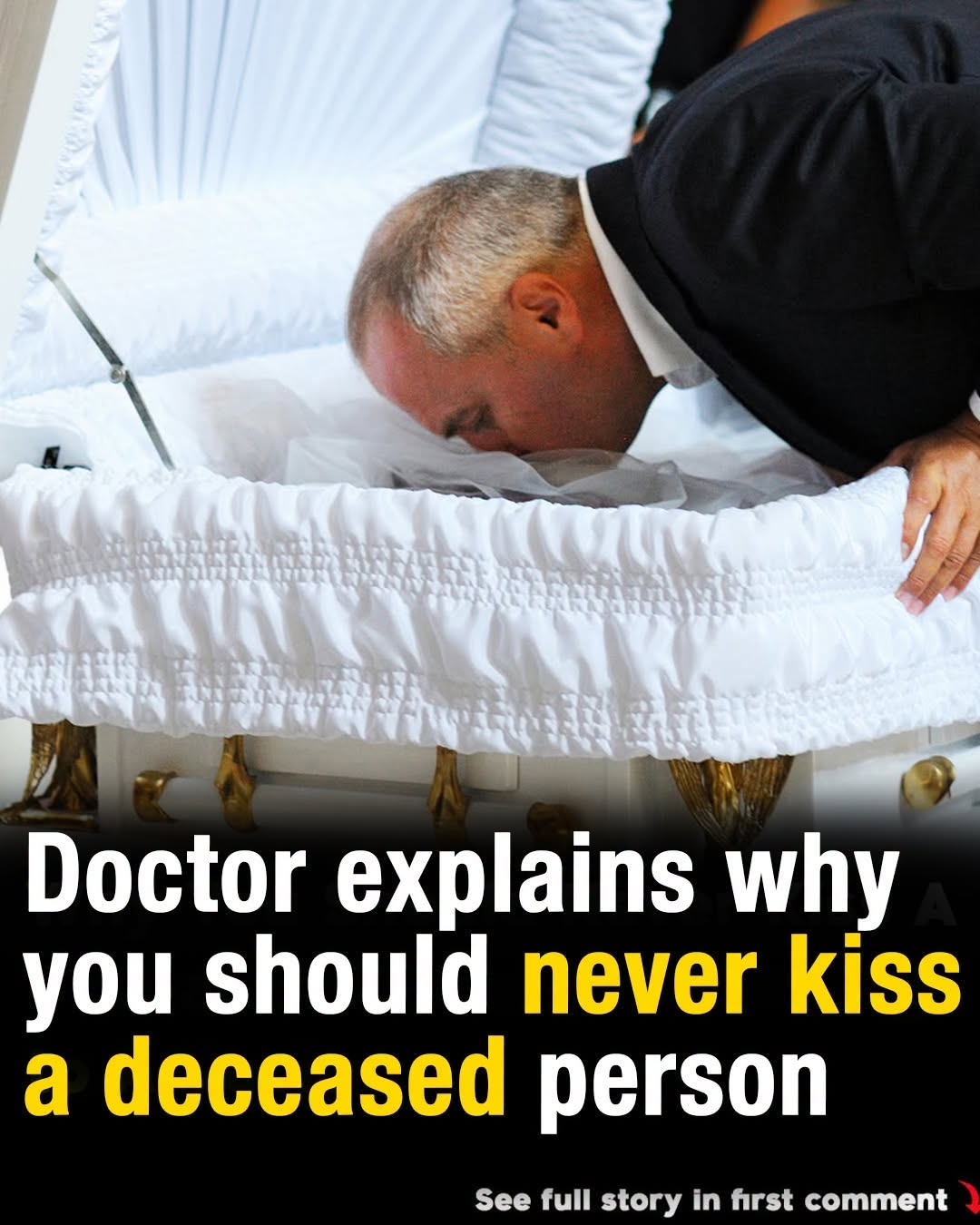
Saying a final goodbye often includes physical gestures that feel essential to the grieving process. For many people, leaning over an open casket and placing a last kiss on a loved one’s forehead or cheek is a natural expression of love and closure. Recently a doctor with a large online following issued a blunt public warning against the practice, arguing that it carries real, if often overlooked, health risks.
The concern centers on the natural process of decomposition. After death the body’s immune system stops functioning, and bacteria that were previously kept in check begin to multiply. Within several hours the body starts releasing gases and microorganisms as tissues break down. Pressing the mouth or face against the skin can, in theory, transfer some of those bacteria into a living person’s respiratory system or mucous membranes.
Most modern funerals involve professional preparation, including embalming and refrigeration, which slow decomposition and reduce bacterial activity. Even so, the warning highlights that the body is no longer a living, self-protecting organism. What was once a familiar face becomes, from a purely biological standpoint, a surface that can harbor organisms the living immune system would rather avoid.
Public reaction to the doctor’s message has been sharply divided. Some people immediately accepted the advice as simple hygiene. Others responded with strong emotion, insisting that the final physical connection outweighs any theoretical risk. Comments reflecting deep personal loss made clear that for many the act is not optional; it is a necessary part of saying goodbye.
Cultural and religious traditions play a major role in how people view contact with the dead. In some communities touching or kissing the body is an expected and meaningful ritual. In others, more distance is already the norm. Any medical recommendation that appears to dismiss these practices can feel like an intrusion into private grief rather than helpful information.
Modern death practices have already created distance for many families. Bodies are usually prepared by professionals, and open-casket viewings are carefully managed. Earlier generations often cared for the dead at home and were more familiar with the physical realities of decomposition. Today’s more sanitized experience can make scientific warnings about bacteria feel abrupt or even disrespectful.
The practical middle ground is awareness rather than absolute prohibition. People who wish to maintain close contact can take simple precautions: washing hands thoroughly afterward, avoiding contact if they have open cuts or compromised immunity, and limiting the duration of any direct touch. Those who prefer greater distance can express love through words, presence, or other non-contact gestures without feeling they have failed the deceased.
Funeral directors and medical professionals generally prioritize both respect for the family and basic infection control. In cases involving known infectious disease at the time of death, stronger restrictions on contact are already standard. The current conversation simply extends a milder version of that caution to ordinary circumstances.
Grief often narrows attention to the emotional need of the moment. In that state, abstract talk of bacterial load can seem cold or irrelevant. At the same time, public health information exists to protect the living, including the very people who are mourning. Balancing those two realities requires sensitivity from both medical voices and the communities they address.
The viral nature of the doctor’s warning has forced a conversation that many would prefer to avoid. Death is already difficult; adding a layer of hygienic calculation can feel like one burden too many. Yet ignoring biological facts does not make them disappear. Informed choice remains possible only when the facts are available.
Ultimately each person and each family will weigh the emotional value of a final kiss against the small but real possibility of transferring bacteria. Some will continue the tradition without hesitation. Others will adapt their goodbyes in light of the information. Both responses can be legitimate when they rest on clear understanding rather than either fear or denial.
The deeper point is not that love must be sanitized, but that love and practical knowledge can exist side by side. A final goodbye does not lose its meaning if it is offered with open eyes about the physical reality of the body. In the end, the living must continue living, and protecting that continuity is also a form of respect for those who are gone.
Most Popular!
-
 The Three-Dollar Miracle: How a Dust-Covered Vase Revealed a Heartbreaking Decades-Old Secret
-
The $80,000 Battle to Erase a Birthmark: Why One Mother Risked Everything for Her Daughter’s Future
-
The Silent Thief: Why Millions of Men Are Living with a Time Bomb They Can’t See
-
The Final Curtain Falls: Beloved Sanford and Son Legend Hal Williams Gone at 91
-
Found at a Yard Sale: This “Useless” Vintage Contraption Is Actually a Forgotten Piece of Human History
-
Behind the Spotlight: The Hidden Illness That Challenged Justin Bieber’s Life and Career
-
The Final Heartbeat: A Mother’s Devastating Goodbye That Will Leave You Shattered
-
The Grocery Store Killer: Is That Bloated Package Hiding a Deadly Secret?