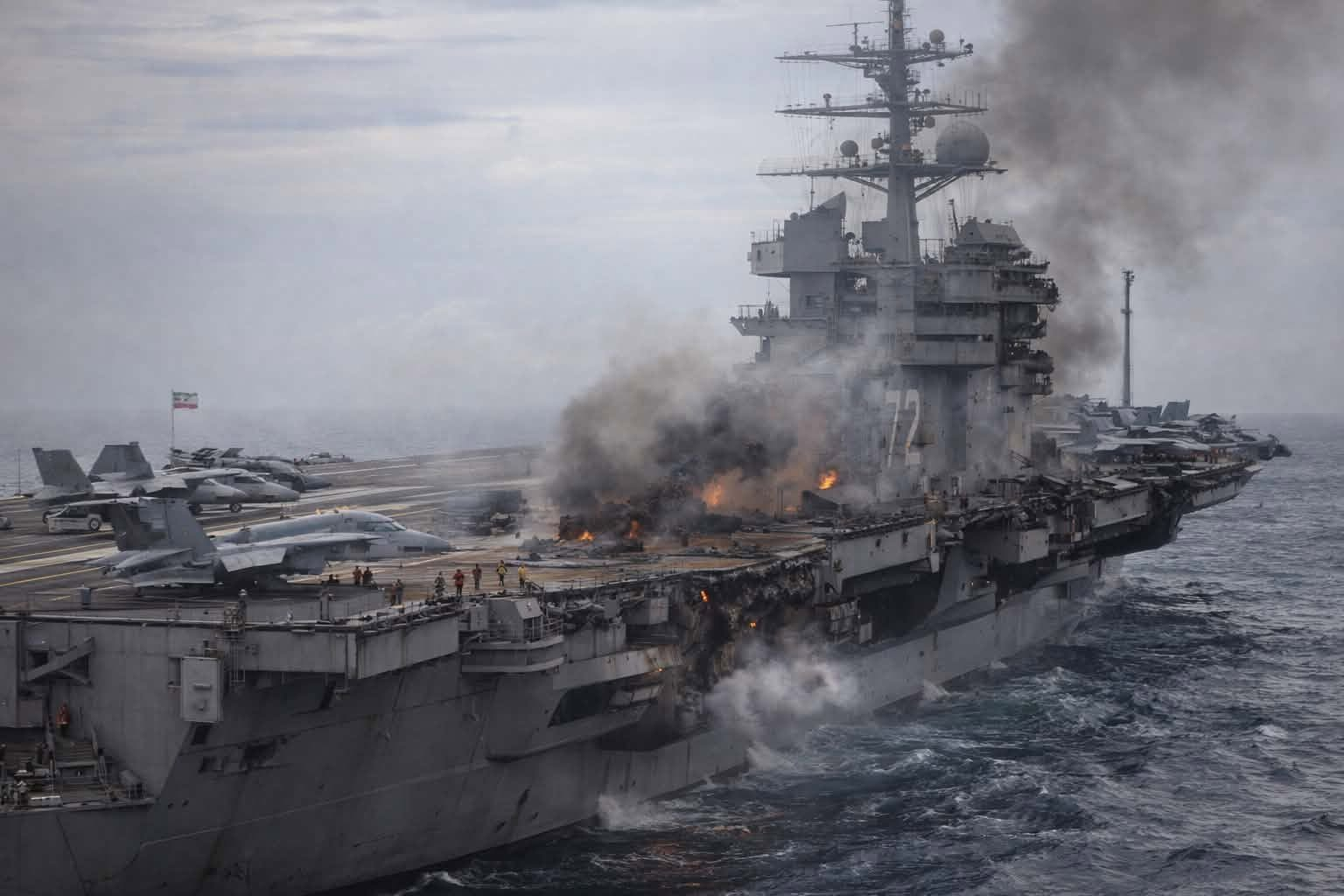
The waters of the Arabian Sea have rarely felt more tense. In a dramatic escalation that has sent shockwaves through global capitals, Iranian officials claimed a direct strike on the USS Abraham Lincoln, one of America’s most powerful aircraft carriers. The announcement, delivered with confidence by Tehran’s state media, painted a picture of a devastating blow to U.S. naval power in the region. Yet almost immediately, American officials pushed back hard, with U.S. Central Command (CENTCOM) calling the claims false and stating that the carrier continues its operations uninterrupted. What began as a war of words now threatens to push an already volatile region toward a dangerous breaking point, raising urgent questions about escalation, deterrence, and the fragile balance of power in the Middle East.
The claim comes amid heightened tensions following a series of strikes and counter-strikes involving Iran, Israel, and U.S. forces. Tehran has long warned that any aggression against its territory or interests would be met with a strong response. The reported targeting of the Abraham Lincoln — a Nimitz-class supercarrier capable of carrying dozens of advanced aircraft — represents a significant symbolic and strategic assertion. If true, it would mark a major escalation in naval confrontation. If exaggerated or fabricated, as the U.S. maintains, it serves as powerful propaganda designed to rally domestic support and project strength to adversaries.
For the United States, the Abraham Lincoln is more than just a warship. It is a floating symbol of American power projection, deterrence, and technological superiority. Its presence in the region has been a key element in reassuring allies and deterring further aggression. Pentagon officials have emphasized that the carrier remains fully operational, continuing to launch aircraft in support of ongoing missions. This swift denial aims to undermine Tehran’s narrative while reassuring partners that U.S. forces maintain dominance at sea. The back-and-forth highlights how modern conflicts often play out as much in the information space as on the battlefield.
The human and strategic stakes could not be higher. A genuine strike on a U.S. carrier would represent one of the most serious attacks on American forces in decades, potentially triggering a massive retaliatory response. Even the claim itself risks miscalculation, with both sides maneuvering to avoid appearing weak while trying to prevent all-out war. Regional allies from Israel to Gulf states are watching closely, calculating their own security needs in light of these developments. The situation underscores the delicate tightrope walked in one of the world’s most volatile regions, where a single incident could rapidly spiral into broader conflict.
This latest escalation also raises important questions about the effectiveness of diplomacy versus military posturing. For years, efforts to contain Iran’s nuclear ambitions and regional influence have involved a mix of sanctions, negotiations, and shows of force. The current crisis suggests that previous approaches have reached their limits, forcing all parties to reassess strategies. U.S. officials have repeatedly stressed the importance of alliances and deterrence, while Iran continues to leverage proxy networks and asymmetric capabilities to challenge superior conventional forces.
For ordinary people in the region and around the world, the news brings anxiety and uncertainty. Families with loved ones serving in the military, oil markets sensitive to any disruption in the Strait of Hormuz, and global economies dependent on stable energy supplies all feel the ripple effects. The possibility of wider conflict serves as a sobering reminder that geopolitical tensions can quickly impact daily life far from the immediate theater of operations. Maintaining peace requires not just military strength but wise leadership and clear communication to prevent misunderstandings from escalating.
As both sides dig in, the coming days and weeks will be critical. Diplomatic channels remain open even amid fiery rhetoric, with international actors urging restraint and de-escalation. The international community watches closely, hoping that cooler heads prevail and that any claims can be verified through independent means rather than propaganda. History shows that naval incidents in the Persian Gulf have often been flashpoints — careful management is essential to avoid repeating past tragedies.
This moment also highlights the evolving nature of modern warfare, where information operations play as critical a role as kinetic strikes. Tehran’s bold claim, whether accurate or not, forces the U.S. to respond publicly and shape the narrative. In the age of instant global communication, perception can be as important as reality when it comes to deterrence and international support. Both nations understand this, making every statement and counter-statement part of a larger strategic game.
For the American service members aboard the USS Abraham Lincoln and their families back home, the situation brings added stress and resolve. The men and women of the U.S. Navy operate in some of the most challenging environments, often far from home, carrying out missions that protect broader national interests. Their professionalism and readiness remain key to stability in the region, even as political leaders navigate complex diplomatic waters.
As tensions simmer, the hope remains that dialogue and deterrence can prevent further escalation. The stakes are enormous — for regional peace, global energy security, and the lives of countless people who would suffer most in any wider conflict. The claim regarding the USS Abraham Lincoln, and the strong U.S. response, serve as a stark reminder of how quickly situations can deteriorate and how important it is for all parties to act with wisdom and restraint.
The world will continue watching developments closely. In moments like these, clear facts, measured responses, and a commitment to preventing unnecessary loss of life must guide decision-making. The special relationship between allies, the security of global shipping lanes, and the hope for a more stable Middle East all hang in the balance. May cooler heads prevail as this latest chapter in a long-running regional drama unfolds.
Most Popular!
-
 Global Tensions Explode as Ceasefire Emerges and Greta Thunberg Fires Back at Trump in Brutal Clash
-
The Court of the 43rd President: Why George W. Bush’s Shocking New WNBA Role Is the Full-Court Press No One Expected
-
Deep Beneath the Earth, Iranian Missile Cities Reveal Shocking New Threat to Global Security
-
Jimmy Kimmel Blows the Whistle on Melania Trump as Late-Night Host Exposes Secret Photo Following Her Shocking White House Denial
-
Donald Trump Threatens to Abandon UK Over Iran War Refusal as Diplomatic Crisis Rocks the Special Relationship
-
Melania Trump Breaks Silence on Epstein Scandal Only to Face Blistering Backlash from Survivors
-
Melania Trump Breaks After Years of Silence to Denounce Epstein Links as Icy New Evidence Surfaces
-
Five Years After Our Divorce, I Took My Triplets to My Ex-Husband’s Wedding — And His Family’s Reaction Was Chilling