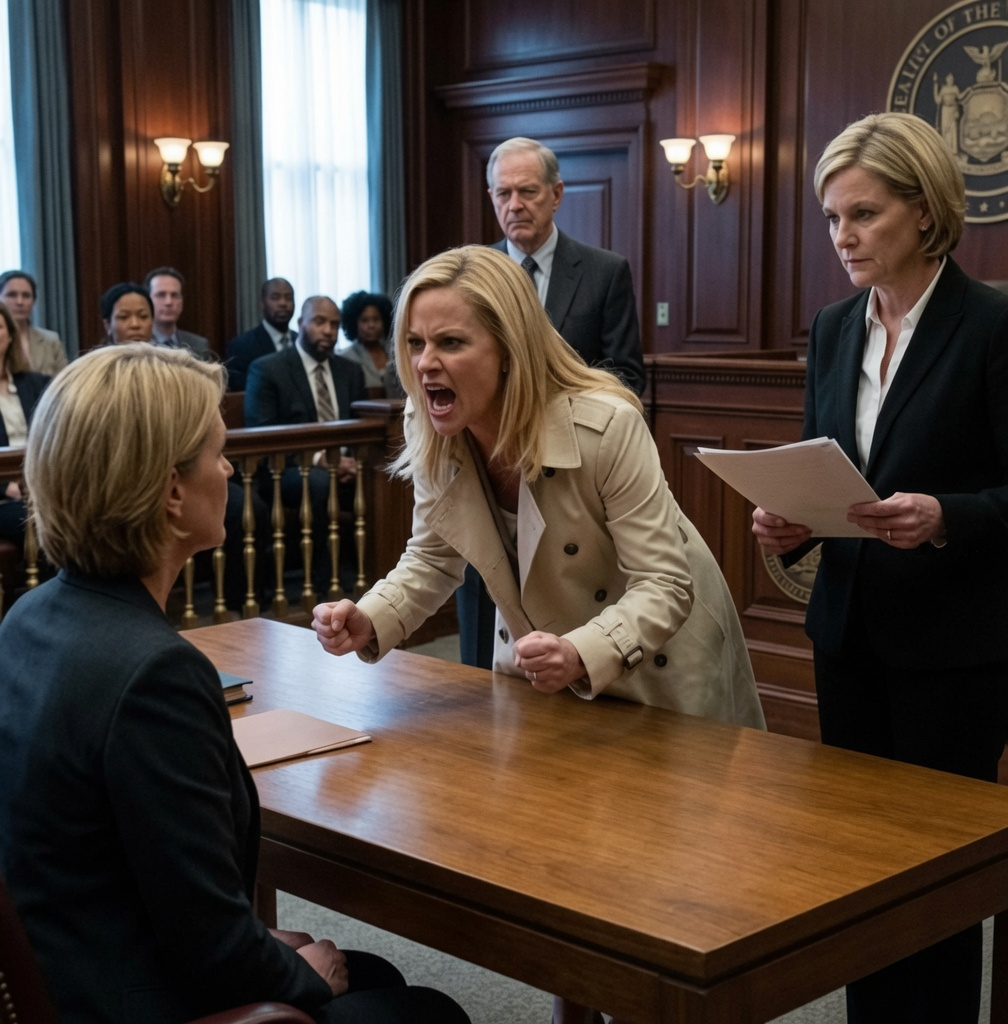
The courtroom felt colder than it should have. My sister Victoria stood at the front in her cream coat like she was accepting an award instead of trying to erase me from our grandfather’s legacy. Behind her, our parents sat perfectly aligned, their faces arranged in the same careful expressions they wore at family dinners when they wanted everyone to know the decision had already been made.
Victoria’s lawyer spoke smoothly, calling me “unfit” and asking the judge to hand over the entire estate that very day. When the judge turned to me and asked if I objected, I didn’t raise my voice. I simply said the one thing they weren’t expecting.
“Wait… until the last person arrives.”
Victoria laughed first. Then our father muttered something about me always making scenes. The judge looked tired, like he had seen too many families tear themselves apart over money. He was about to move forward anyway when the heavy courtroom doors opened.
A man in a plain black suit walked straight down the aisle. He didn’t look at anyone except the judge. In his hands was a thick envelope marked “From the Trustee.” He placed it on the bench without a word and stepped back.
The judge opened it slowly. As he read, the color drained from his face. He removed his glasses, rubbed his eyes, and read again. The entire room had gone still.
Victoria shifted in her seat. Her confident posture cracked for the first time.
Then she blurted it out, loud and desperate: “Elder abuse!”
The word hung in the air like smoke. Before anyone could react, the bailiff leaned toward the judge and whispered something. A moment later, a uniformed deputy stepped inside holding a separate set of papers. He walked directly to our father.
“Sir,” the deputy said quietly, “these are from another court. You’ll need to come with me.”
Our father’s face went rigid. Our mother’s hands, which had been folded so neatly, now gripped the bench in front of her. Victoria’s head whipped around, her mouth opening and closing without sound.
The judge finally spoke, his voice low and serious.
“This envelope contains your grandfather’s updated trust documents and a letter he wrote three months before he passed. It also includes medical records and witness statements showing repeated attempts by certain family members to pressure him into changing his wishes. The court will not be transferring anything today.”
He looked directly at Victoria.
“In fact, this court is ordering a full investigation into the claims made in this motion. And it appears there are separate proceedings already underway regarding financial matters involving the respondent’s father.”
Victoria’s lawyer tried to speak, but the judge raised a hand.
“Counsel, your motion is denied. And I suggest you advise your client carefully going forward.”
I stayed seated, hands folded in my lap, exactly as I had been the entire time. I hadn’t needed to argue or present evidence. My grandfather had already done that for me.
After the judge dismissed everyone, Victoria stormed out without looking at me. Our parents were escorted out through a side door. I walked out the front, into the bright afternoon light, feeling strangely light for the first time in months.
My grandfather had always been careful with his words. He used to say, “Properly means with proof.” He must have known what was coming. The envelope he left behind wasn’t just a will — it was protection. It showed that he had seen the pressure, the manipulation, and the attempts to isolate him. And he had made sure the truth would speak even when he no longer could.
That day in court didn’t just stop my sister from taking everything. It revealed how far some people in my family were willing to go once they thought no one was watching. The coordinated effort, the false claims, the attempt to paint me as unstable — all of it collapsed the moment the real documents arrived.
I still don’t know exactly what will happen with the estate. There will be investigations, hearings, and probably more uncomfortable truths. But I no longer feel like the afterthought in my own family story.
My grandfather left me something far more valuable than money that day. He left me the knowledge that he had seen me clearly. He had trusted me enough to make sure I wouldn’t be erased. And in the end, that quiet trust was stronger than any cream coat or practiced performance in a courtroom.
Sometimes the people who try hardest to control the narrative are the ones most afraid of the truth catching up to them. And sometimes, the strongest objection you can make is simply refusing to let them rush the ending before the full story has arrived.
Most Popular!
-
 Eggs, Cholesterol, and Timing: What Actually Matters for Most People
-
When a Partner Leaves With More Than a Suitcase: Protecting Yourself From Financial Betrayal
-
When Financial Support Meets Contempt: Recognizing Exploitation Inside a Marriage
-
Why Some Sensory Toys and Household “Hacks” Do Not Belong in the Microwave
-
When Grief Clouds Judgment: Misreading Silence and the Quiet Ways People Show Care
-
When One Partner Does All the Hosting: Recognizing Imbalance Before Resentment Takes Over
-
How Many Holes Are in a T-Shirt? What a Simple Puzzle Reveals About How We See
-
The Quiet Stories Inside Secondhand Objects: When a Thrift-Store Find Carries Someone Else’s History