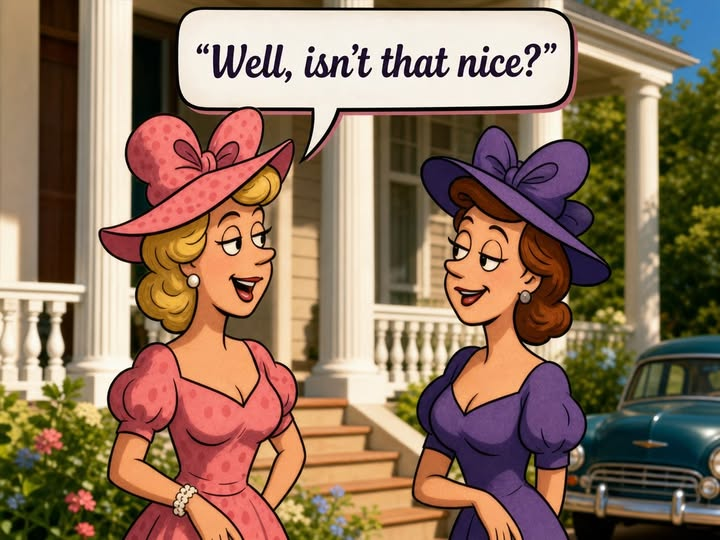
On warm afternoons in certain parts of the South, front porches have long served as stages for conversations that reveal more than the speakers sometimes intend. Two women once sat sipping sweet tea while cicadas hummed in the background. One spoke proudly about the gifts her husband had given her after each child was born — a grand house after the first, a new car after the second, and fine jewelry after the third. The other woman listened politely, offering the expected responses of admiration.
The conversation took a revealing turn when the topic shifted to their grown children’s marriages. The second woman expressed clear disapproval of her son’s wife, describing her as someone who contributed little to the household and was waited on by her husband. She found it unfortunate that her son carried so much of the daily load. Yet when speaking of her daughter, the same woman described her son-in-law’s attentive care — bringing breakfast in bed and encouraging his wife to rest — as a blessing and a sign of a good marriage.
The contrast was striking, though neither woman seemed to notice the inconsistency in the moment. What was viewed as laziness in one situation became thoughtful partnership in another. The judgment appeared to shift depending on whether the person being discussed was a daughter-in-law or a son-in-law. This subtle difference exposed a deeper pattern that many families quietly carry across generations.
Double standards in marriage expectations often hide in plain sight. Society has traditionally placed heavier emphasis on women’s domestic contributions while viewing men’s emotional or household labor as optional or exceptional. When a husband takes on more at home, it can be praised as progressive or caring. When a wife receives similar support, it is sometimes questioned or criticized as taking advantage. These inconsistencies create confusion for couples trying to build fair partnerships.
Parents can unintentionally reinforce these patterns when evaluating their children’s marriages. A daughter who is supported by her husband may be seen as fortunate, while a son in a similar position may be viewed as being taken advantage of. The same behaviors receive different labels depending on gender. This selective lens can strain family relationships and place unfair pressure on both the young couples and the parents offering commentary.
Modern marriages are slowly moving toward more balanced expectations. Many couples today discuss roles openly rather than assuming traditional divisions of labor. Shared responsibilities around work, childcare, and household tasks have become more common, especially as economic realities and personal values shift. Yet old frameworks still surface in casual conversations, revealing how deeply some double standards are rooted.
The porch conversation also highlights how politeness can mask judgment. Responses like “Well, isn’t that nice?” often serve as neutral placeholders while deeper opinions remain unspoken. These small moments of social courtesy can prevent honest dialogue about what people truly value in marriage and family life. When left unexamined, they allow inconsistent standards to persist across generations.
Recognizing these double standards does not require rejecting tradition entirely. Many couples find comfort and strength in clearly defined roles that work for their specific relationship. The issue arises when expectations are applied unevenly — praised in one context and criticized in another based solely on gender. True family values tend to hold up better when they remain consistent regardless of whether they apply to sons or daughters.
Younger generations are increasingly aware of these inconsistencies. Many are choosing partners and defining their own marriages with greater intentionality, seeking mutual respect rather than inherited scripts. This shift can create tension with older family members who still view roles through a more traditional lens. Bridging that gap often requires patience and open conversations about why certain expectations feel unfair.
Ultimately, healthy marriages thrive when both partners feel seen, supported, and respected without rigid gender-based scorekeeping. The most enduring family values are often the ones that adapt while still honoring kindness, responsibility, and fairness. When we notice double standards in casual conversations — whether on a porch or around a dinner table — we have an opportunity to question them rather than repeat them.
Those two women on the porch may never have realized the irony in their exchange. Yet their words captured something many families still navigate: the quiet ways expectations can bend depending on whose marriage is being discussed. Paying closer attention to these moments can help us build more consistent and compassionate standards for the relationships we value most. In the end, the strongest families are often those willing to examine their own inconsistencies and choose fairness over habit.
Most Popular!
-
 Eggs, Cholesterol, and Timing: What Actually Matters for Most People
-
When a Partner Leaves With More Than a Suitcase: Protecting Yourself From Financial Betrayal
-
When Financial Support Meets Contempt: Recognizing Exploitation Inside a Marriage
-
Why Some Sensory Toys and Household “Hacks” Do Not Belong in the Microwave
-
When Grief Clouds Judgment: Misreading Silence and the Quiet Ways People Show Care
-
When One Partner Does All the Hosting: Recognizing Imbalance Before Resentment Takes Over
-
How Many Holes Are in a T-Shirt? What a Simple Puzzle Reveals About How We See
-
The Quiet Stories Inside Secondhand Objects: When a Thrift-Store Find Carries Someone Else’s History