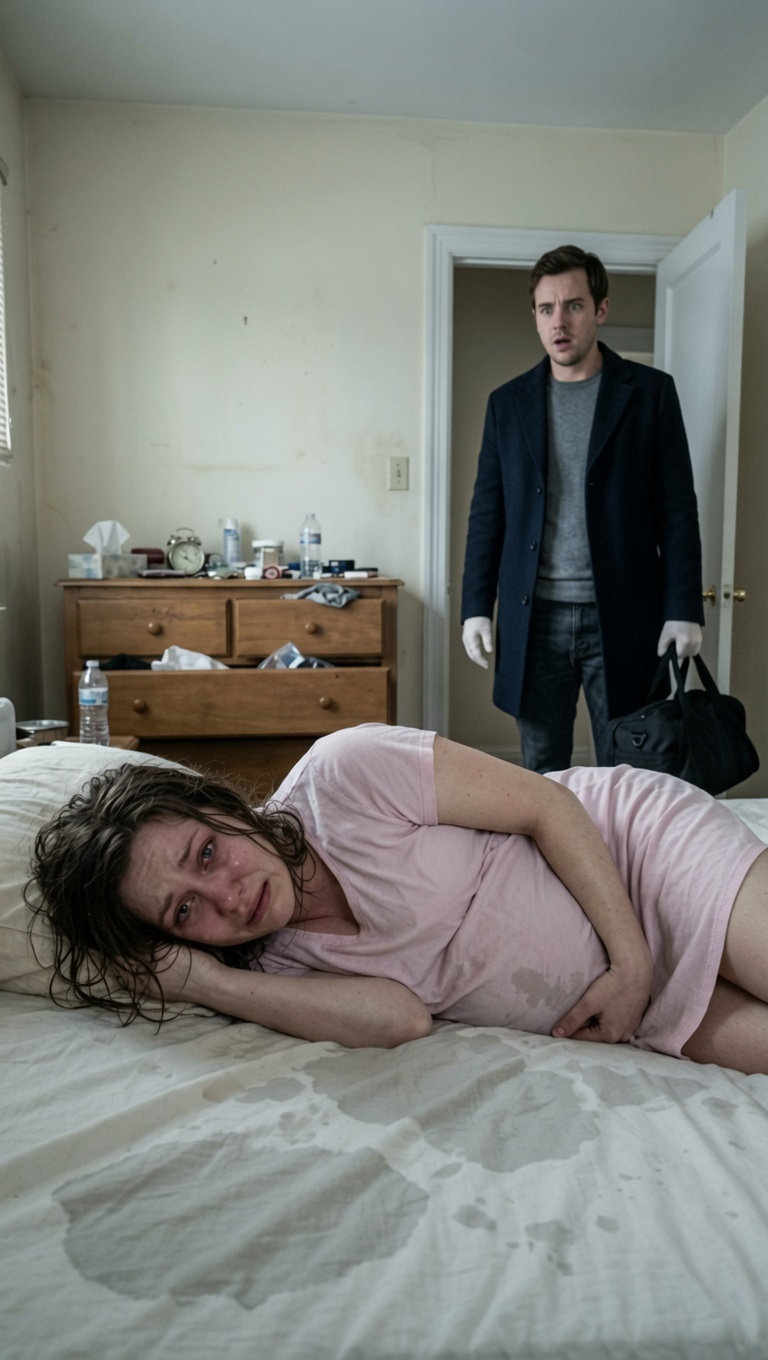
I had been away on a short work trip and decided to come home a day early to surprise my pregnant wife, Clara. I imagined walking through the door with her favorite takeout and watching her face light up. Instead, I found her curled on our bed in obvious pain, her face pale and damp with sweat. A dark stain marked the floor near the bathroom, and her silk nightgown was twisted awkwardly around her body. My first thought wasn’t concern for her health. It was something much darker, planted by months of quiet suggestions from my mother.
Clara had been having cramps on and off for days, but she had downplayed them, not wanting to worry me while I was traveling. That afternoon the pain had become unbearable. She had tried calling me several times and even dialed 911 before hanging up, convinced she was overreacting. By the time I walked in, she was terrified she was losing our baby and too disoriented to get help on her own.
Instead of rushing to her side, I stood frozen, my mind replaying every offhand comment my mother had made over the past few months. She had questioned whether the pregnancy was “really” mine, suggested Clara might be “trapping” me, and even floated the idea of a paternity test “just to be sure.” Those seeds of doubt had taken root without me fully realizing it. In that moment of shock, I looked at my wife in pain and wondered if someone else had been in our home.
Clara saw the suspicion on my face before I could hide it. Through her tears she asked the question that cut straight through me: “Did you think I was with someone else?” The hurt in her voice was worse than any physical pain she was already enduring. In that single moment, I saw how deeply my mother’s words had damaged the trust between us — trust I had allowed to erode by staying silent instead of shutting the comments down.
We made it to the hospital in a blur. Doctors confirmed Clara was experiencing a threatened miscarriage caused by a subchorionic hematoma. The baby’s heartbeat was still there, but she would need strict bed rest and close monitoring. While we waited for test results, Clara told me about the phone call she had received from my mother earlier that week — the same call that had planted fresh doubts and left her feeling isolated and judged during an already terrifying time.
Sitting in that hospital room, holding her hand while machines monitored our child, I finally understood the real threat to our family. It wasn’t some imagined affair. It was the steady, corrosive influence of someone who claimed to love me but couldn’t accept the life I had chosen. My mother’s need to control and undermine had nearly cost me everything that actually mattered.
I made a decision in that sterile room that I should have made months earlier. I turned off my phone and told Clara that from now on, my loyalty belonged to her and our child first. I stopped answering my mother’s calls and blocked the stream of messages that kept coming. It wasn’t an easy choice, but it was necessary. Some relationships cannot survive when one person refuses to respect the boundaries of another.
Clara didn’t ask me to cut my mother out completely, but she did ask for something more important: that I never again let outside voices question what we were building together. She needed to know that when things got hard — and pregnancy and new parenthood are always hard — I would stand with her instead of entertaining doubt. That conversation, painful as it was, became the turning point.
In the weeks that followed, we focused on protecting the fragile new life we were bringing into the world. Clara stayed on bed rest while I took over everything at home. We talked more honestly than we had in a long time about the pressure my family had placed on our marriage and how easy it had been for me to absorb their doubts without realizing the damage. Naming the problem out loud made it smaller and more manageable.
The dark secret wasn’t some dramatic affair or hidden double life. It was the quiet way suspicion had been allowed to grow in the spaces between us. My mother’s words had created distance at the exact moment we needed closeness most. Once I saw it clearly, I could finally choose differently.
Today our baby is healthy, and so is our marriage — though both required active protection. I still speak to my mother occasionally, but the conversations are shorter and the boundaries are firm. I no longer entertain questions about my wife’s character or our child’s paternity. Those topics are closed, and they will stay closed.
Coming home early that day didn’t uncover the betrayal I feared. It revealed something far more dangerous: how easily love can be poisoned when we fail to protect it from outside influence. The real work of marriage isn’t just loving each other when things are easy. It’s choosing each other, clearly and without hesitation, when doubt tries to creep in. That choice, made in a hospital room under fluorescent lights, saved our family more than any grand gesture ever could.
Most Popular!
-
 Eggs, Cholesterol, and Timing: What Actually Matters for Most People
-
When a Partner Leaves With More Than a Suitcase: Protecting Yourself From Financial Betrayal
-
When Financial Support Meets Contempt: Recognizing Exploitation Inside a Marriage
-
Why Some Sensory Toys and Household “Hacks” Do Not Belong in the Microwave
-
When Grief Clouds Judgment: Misreading Silence and the Quiet Ways People Show Care
-
When One Partner Does All the Hosting: Recognizing Imbalance Before Resentment Takes Over
-
How Many Holes Are in a T-Shirt? What a Simple Puzzle Reveals About How We See
-
The Quiet Stories Inside Secondhand Objects: When a Thrift-Store Find Carries Someone Else’s History







