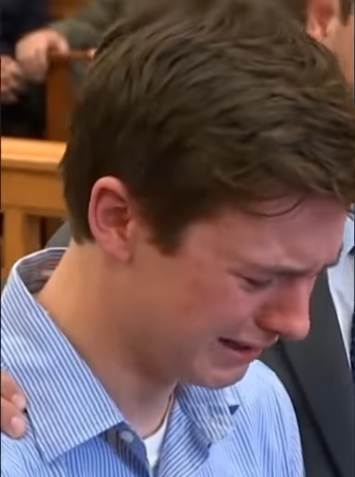
I sat in the courtroom clutching my hands so tightly my nails left marks in my palms. My seventeen-year-old son, Marcus, stood before the judge looking small and terrified in his orange jumpsuit. When the judge read the sentence — four hundred and fifty-two years in prison — the courtroom gasped. Marcus didn’t cry. He just stared straight ahead with empty eyes, like something inside him had already died. In that moment, I realized the justice system hadn’t just punished my son. It had erased his entire future.
Marcus was never a perfect kid. He grew up in a tough neighborhood where choices were limited and consequences came fast. Like many boys his age, he fell in with the wrong crowd. What started as petty theft and skipping school slowly escalated into more serious trouble. At sixteen, he was involved in a string of armed robberies with older teens. No one was killed, but several victims were traumatized. I begged him to stop. I got him into counseling. I even moved us to a new apartment across town. But the streets have a way of pulling kids back in, and Marcus wasn’t strong enough to break free.
The trial was swift and merciless. The prosecutor painted Marcus as a hardened criminal instead of a scared, misguided boy. The judge, known for tough sentencing, threw the book at him. Each count carried decades. Enhancements for using a weapon and committing crimes as part of a group multiplied the years. Four hundred and fifty-two years. The number still doesn’t feel real. Marcus will be dead long before he ever becomes eligible for parole. In the eyes of the law, his life effectively ended at seventeen.
Watching my son be led away in chains while his little sister screamed for him was the worst moment of my life. I kept thinking about all the times I had failed him. The nights I worked double shifts and left him unsupervised. The conversations we never had. The warnings I gave too late. A mother’s guilt is a heavy thing, but this felt like carrying the weight of the world.
What makes this sentence so shocking isn’t just the length — it’s what it says about how we treat young offenders in this country. Marcus made terrible choices, and he deserved punishment. But four centuries behind bars? That isn’t justice. It’s vengeance disguised as accountability. Other countries focus on rehabilitation for juveniles. Here, we throw away the key and call it protection for society.
In the months since the sentencing, I’ve learned more about the justice system than I ever wanted to know. I’ve joined support groups for mothers of incarcerated children. I’ve spoken with lawyers fighting for sentencing reform. I’ve watched other families go through similar pain. So many young lives discarded before they ever had a real chance to change.
Marcus writes me letters from prison. His handwriting is getting smaller, like he’s trying to take up less space in the world. He says he’s sorry. He asks about his sister. He tells me he dreams about the day he’ll come home, even though we both know that day will never arrive. Reading those letters breaks me every single time.
I’ve started advocating for change. Not to excuse what Marcus did, but to fight for a system that sees teenagers as people capable of redemption instead of monsters who must be locked away forever. No child is beyond hope. No mistake at seventeen should define the rest of someone’s existence.
The justice system took my son’s future, but it can’t take my voice. I will spend the rest of my life making sure other mothers don’t have to watch their babies disappear behind bars for centuries. Marcus’s story isn’t over just because the judge said it was. His life still matters. His story still deserves to be told.
If you have a child who is struggling, please hold them closer tonight. Love them harder. Get them help before the streets or bad decisions take them away. And if you believe in justice, fight for a system that punishes wrongdoing without destroying young lives completely.
My son received four hundred and fifty-two years. But the real sentence was handed down to me too — a lifetime of missing him, wondering what could have been, and carrying the weight of a boy who never got the chance to become the man I know he could have been. Some punishments don’t just break the guilty. They break entire families. And that is a truth our justice system still refuses to face.
Most Popular!
-
 Eggs, Cholesterol, and Timing: What Actually Matters for Most People
-
When a Partner Leaves With More Than a Suitcase: Protecting Yourself From Financial Betrayal
-
When Financial Support Meets Contempt: Recognizing Exploitation Inside a Marriage
-
Why Some Sensory Toys and Household “Hacks” Do Not Belong in the Microwave
-
When Grief Clouds Judgment: Misreading Silence and the Quiet Ways People Show Care
-
When One Partner Does All the Hosting: Recognizing Imbalance Before Resentment Takes Over
-
How Many Holes Are in a T-Shirt? What a Simple Puzzle Reveals About How We See
-
The Quiet Stories Inside Secondhand Objects: When a Thrift-Store Find Carries Someone Else’s History