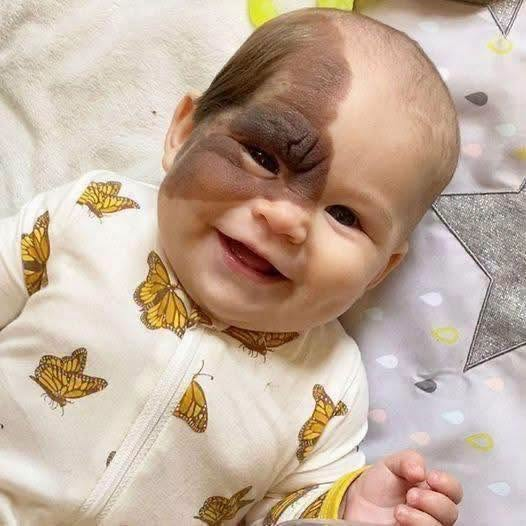
When Vienna Brookshaw was born in April 2021, the first thing many people noticed was the dark birthmark centered between her eyebrows. Doctors identified it as a congenital melanocytic nevus, a rare clustering of pigment cells that is present at birth and tends to grow as the child grows. Medically it was considered benign. To her mother, Celine Casey, the mark represented something more complicated: a visible difference that would invite stares, questions, and possibly years of self-consciousness.
Celine watched the way strangers’ eyes lingered on her daughter’s face. What began as polite curiosity often shifted into longer, more awkward attention. She noticed Vienna becoming quieter in public settings and began to project forward to the day when playground comments or schoolyard comparisons might land. The fear was not of the birthmark itself but of the emotional weight it might eventually carry.
When she approached the National Health Service for help removing the mark, the request was declined. The procedure was classified as cosmetic rather than medically necessary, and therefore not eligible for coverage. To the clinical system it was an aesthetic preference. To Celine it was a preemptive act of protection, an attempt to spare her daughter a future struggle with feeling different.
Refusing to accept the rejection as final, she turned to crowdfunding. She posted her story online, explaining both the medical details and her personal concerns about bullying and self-image. Within twenty-four hours the campaign raised more than fifty thousand dollars. The response demonstrated how quickly a clear parental fear can resonate with strangers, yet the total cost of the planned surgeries had climbed higher than expected because of rising hospital expenses in the post-pandemic period.
A shortfall of roughly twenty-seven thousand dollars remained. Celine returned to the campaign with updates, reiterating her belief that early intervention could prevent deeper insecurities later. She argued that children notice differences sooner than many adults assume and that waiting until Vienna was old enough to request the surgery herself would mean allowing years of potential discomfort to accumulate first.
The treatment ultimately involved three specialized surgeries. Each one carried the ordinary risks of anesthesia and recovery in a very young child. Celine documented the process publicly, sharing both the medical progress and the emotional strain of watching her daughter move repeatedly through clinical environments. The family made multiple trips to London to consult experienced surgeons and to monitor healing, watching carefully for infection or excessive scarring.
Recovery required patience. The forehead is a prominent and sensitive area, and the goal was not only removal of the pigmented tissue but a result that would leave the smallest possible lasting mark. Over time the surgical site faded into a thin, pale line that became less noticeable with each passing month. Vienna, once defined in public by the birthmark between her brows, began to move through the world without that immediate visual distinction.
Today she is a healthy, active toddler. The birthmark that once dominated the center of her face exists only in earlier photographs and in her mother’s memory of the decision. Celine continues to share occasional updates, often emphasizing that she always considered her daughter beautiful and that the surgeries were never about correcting a flaw but about reducing a possible future burden.
The story raises difficult questions about parental responsibility, medical necessity, and the social weight placed on appearance. Some observers view the decision as an overreach, arguing that children should be allowed to grow into their own faces without early surgical intervention. Others see it as a clear-eyed response to a culture that still judges visible difference harshly, especially on the face.
What remains unambiguous is the intensity of the mother’s commitment. Celine spent money she did not have, navigated institutional refusals, and accepted the risks of repeated procedures on a small child because she believed the alternative carried its own long-term costs. Whether that calculation proves correct will be known only as Vienna grows older and forms her own relationship with her appearance and her history.
In the end the $80,000 figure is only the most measurable part of the effort. The larger investment was time, advocacy, and the willingness to act on a fear that many parents feel but few pursue to such lengths. Vienna now carries a faint scar instead of a prominent birthmark. The scar tells a story of medical intervention; the decisions behind it tell a story of a mother who refused to leave her daughter’s future comfort to chance.
Most Popular!
-
 The Three-Dollar Miracle: How a Dust-Covered Vase Revealed a Heartbreaking Decades-Old Secret
-
The Silent Thief: Why Millions of Men Are Living with a Time Bomb They Can’t See
-
The Final Curtain Falls: Beloved Sanford and Son Legend Hal Williams Gone at 91
-
Found at a Yard Sale: This “Useless” Vintage Contraption Is Actually a Forgotten Piece of Human History
-
The Hidden Danger at the Funeral: Why a Viral Doctor Is Asking People to Rethink Kissing the Deceased
-
Behind the Spotlight: The Hidden Illness That Challenged Justin Bieber’s Life and Career
-
The Final Heartbeat: A Mother’s Devastating Goodbye That Will Leave You Shattered
-
The Grocery Store Killer: Is That Bloated Package Hiding a Deadly Secret?