Three weeks after burying my newborn son, I emptied his entire nursery. The pale morning light that filtered through the dusty blinds had turned the room into a quiet tomb. The crib had never held the warmth of a sleeping child. Tiny outfits remained folded exactly where I had placed them, and the unopened packages of diapers stood as silent reminders of a future that would never arrive. My husband Thomas could not bear the weight of the silence. He left, unable to live with the ghost of the nursery, leaving me alone in a house that felt more like a burial ground than a home.
For weeks I existed in a fog, barely functioning, until I drove past a strip mall and saw a young woman sitting on the curb with a baby pressed against her chest. The child’s carrier straps were frayed and dangerously thin. Something desperate and irrational took hold of me. My heart was not ready, but my mind had already decided. I returned home, forced myself into the nursery, and whispered a tearful apology to the empty air. I packed almost everything Noah had ever owned into boxes, keeping only a small knitted hat and the dinosaur onesie he had worn in the hospital. I needed his short life to mean something. I needed it to become a bridge for someone else.
When I found the woman again, I pulled up and offered the boxes. Her eyes were hard at first, guarded by the exhaustion of poverty, but they softened as I explained who Noah was and why this mattered. We wept together on the pavement, a stranger and a grieving mother bonded by a shared, insurmountable ache. She promised to tell her son Mateo about the boy who had provided his first ride. I drove home believing the chapter was closed, never suspecting that my small act of charity had already set larger wheels in motion.
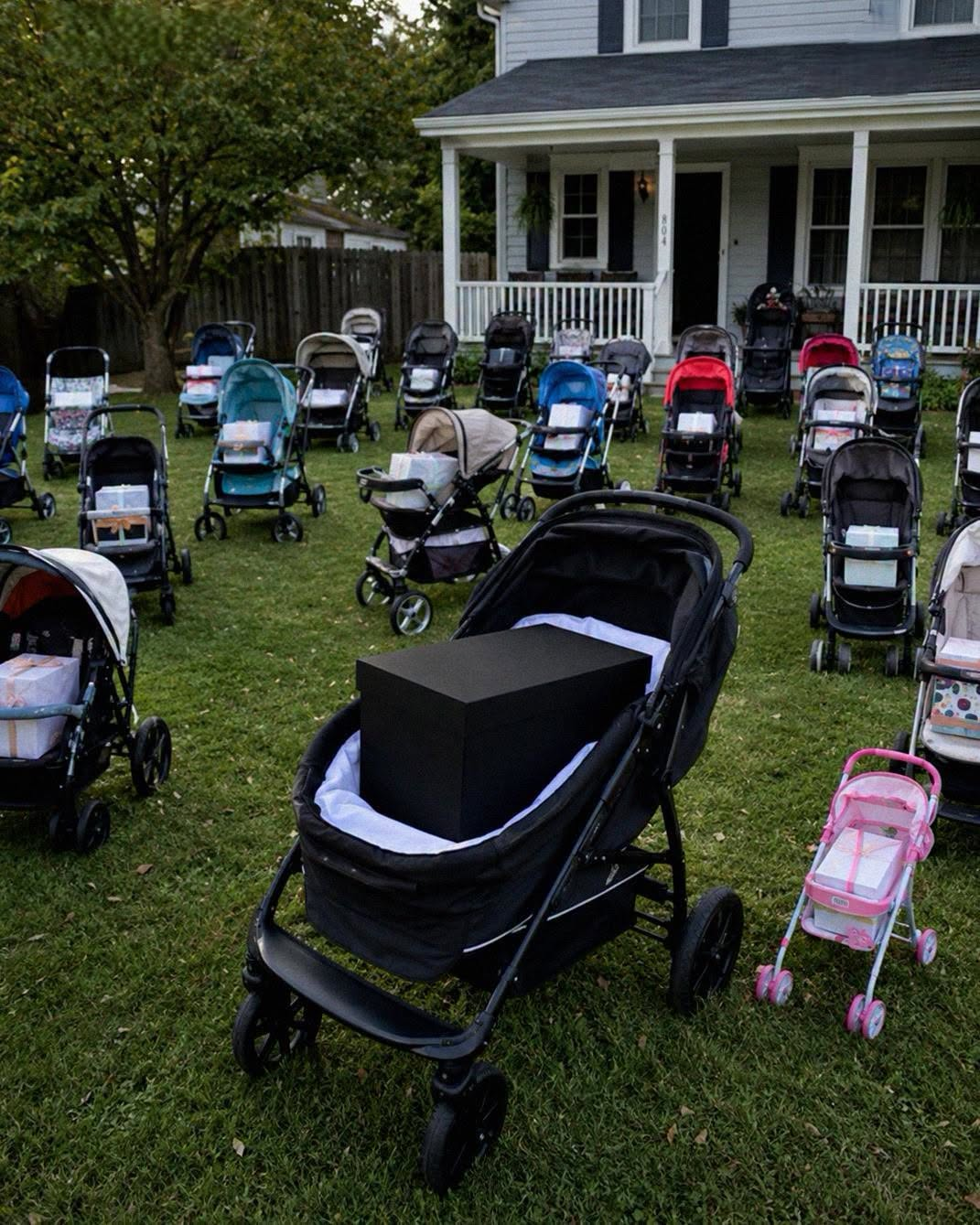
The doorbell rang shortly after dawn the next morning. I stumbled to the door expecting a neighbor or a delivery, but the porch was empty. Stepping outside into the cool air, I froze. My front lawn was covered in strollers — dozens of them arranged in neat, silent rows across the dew-slicked grass. It felt like an impossible dream, yet there they stood like sentinels of shared grief.
My heart hammered as I wandered into the yard, weaving through the maze of metal and fabric. In the center of the display stood a large matte-black stroller topped with a black envelope that bore my name. Fear surged through me, but as I touched the surrounding carriages I realized they were filled with boxes and handwritten notes. One contained a soft blanket and a pair of tiny socks. The letter inside told the story of Emma, who had lived for nineteen hours. Another held a knitted elephant and the story of a stillborn son named Owen.
As the sun climbed higher, neighbors began to gather at the edge of the property. An older woman with tired, kind eyes stepped forward and introduced herself as Linda. She explained that the young mother I had helped had visited the local community center and shared the story of the woman who had emptied her nursery. In that moment I realized I was not alone. This was not a collection of discarded items. It was an act of communal healing. These parents, all members of a support group, had finally found the courage to pass on their own tokens of love so that the next family would never have to start with nothing.
Thomas arrived shortly afterward, pulling up to the curb to finalize our separation. He stopped dead, staring at the rows of strollers, his face pale with confusion. When he demanded to know what was happening, Linda answered softly that it was a beginning. I walked toward the black stroller in the center. Inside there was no donation, only a wooden plaque that read: Noah’s Strollers. When one family is ready to let go, another family should never have to start with nothing. Beneath it lay a note thanking me for giving their pain a purpose.
I looked at the house, at the nursery window, and at the neighbors who had gathered to turn our collective tragedy into a legacy of support. In that moment I understood that my son had finally come home, not in the way I had prayed for, but in a way that ensured his memory would never remain empty. The lawn that had once felt like ordinary grass had become a quiet field of shared remembrance.
In the weeks that followed, the strollers were carefully distributed to families in need through the same community center. Each one carried not only practical items but also the story of the child who had once been loved. The plaque stayed with me. It rests now on a shelf in the room that used to be the nursery, a reminder that grief can become something larger than itself when it is allowed to connect people instead of isolating them.
Thomas and I completed our separation, but the morning of the strollers changed the way we spoke about Noah. For the first time we were able to talk about him without the conversation collapsing into silence or blame. The public display of other parents’ losses had somehow made our private loss feel less solitary. We still carry the weight of that empty crib, but we no longer carry it alone.
Looking back, the decision to give away Noah’s things felt at the time like an act of desperation. I now see it as the first step toward a different kind of survival. By releasing the physical reminders of a future that never arrived, I created space for other families to receive what they needed and for other parents to finally let go of what they had been holding. The empty strollers on my lawn were never really empty. They were filled with the courage of people who had chosen to turn their deepest pain into practical help for strangers.
Some mornings I still walk out onto the front lawn and remember how it looked covered in those silent rows. The grass has long since recovered, but the memory remains. It reminds me that miracles do not always arrive as restored life or reversed loss. Sometimes they arrive as a community of strangers who show up before sunrise to prove that no parent has to face the emptiness alone. Noah’s short life became the quiet center of that proof, and for that unexpected grace I remain forever grateful.
Most Popular!
-
 My Husband Abandoned Me 300 Miles From Home as a Joke — Then He Showed Up Five Years Later to Destroy Everything I Built
-
The Mystery Gear: Why Your Old Car Had a Secret “E” Button That Could Save Your Life and Your Wallet
-
The Brutal Truth: My Husband Tried to Control Me on Our Third Day of Marriage — He Didn’t Know Who He Was Dealing With
-
The Midnight Trap: Why One Single Ring Could Cost You Your Entire Life Savings
-
Deadly Garnish: Why Your Innocent Kitchen Staple Is Actually a Silent Risk Lurking in Your Fridge
-
The Illegal Tag Myth: Why You’ve Been Living in Fear of Your Own Mattress
-
The BBQ Bomb: My Father-in-Law Treated My Home Like His Personal Five-Star Restaurant — Until I Served Him an $1,800 Reality Check
-
I Discovered My Mother-in-Law Selling My Priceless Wedding Dress at a Garage Sale — Then I Realized Why She Was Really Doing It