The rain came down in sheets that night, turning the highway into a river of black mirrors reflecting red taillights. I was driving home from a late shift at the hospital, exhausted after twelve hours on my feet, when my old sedan finally gave up. The engine sputtered, coughed, and died right there on the shoulder of a deserted stretch of road miles from the nearest town. No cell service. No passing cars for what felt like forever. Just me, the storm, and the growing fear that I might spend the night stranded and alone. At 34 years old, with two kids waiting at home with my sister, I had never felt more vulnerable. Then, through the downpour, I heard it — the deep rumble of a motorcycle cutting through the rain.
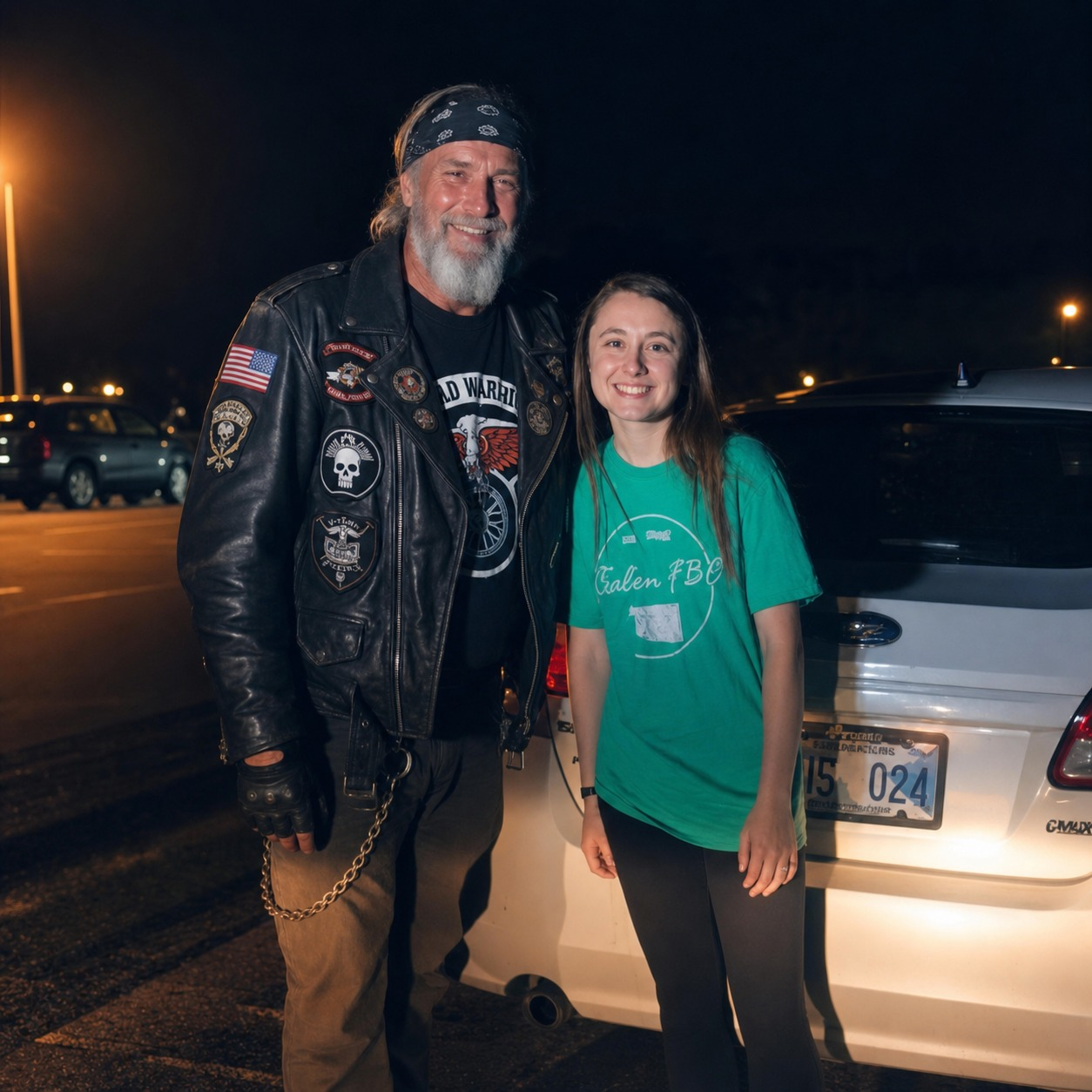
He pulled up beside my car, a massive figure in black leather and a helmet that hid his face. Tattoos covered what little skin I could see. The kind of man most people would lock their doors against on a night like this. My heart raced as he killed the engine and approached my window. I cracked it just enough to hear him over the rain.
“Car trouble?” His voice was surprisingly gentle, low and steady.
I nodded, too scared to say much. He didn’t push. Instead, he asked me to pop the hood and spent the next ten minutes in the pouring rain trying to diagnose the problem. Water streamed off his leather vest, but he never complained. When it became clear the car wasn’t starting anytime soon, he didn’t offer empty promises or leave me there. He simply said, “I’ll take you home. My bike’s got a spare helmet.”
Most people would have called a tow truck and waited. But I had no choice and something in his calm demeanor told me I could trust him. I climbed on the back of his Harley, holding on tight as we cut through the storm. The ride was terrifying and strangely peaceful all at once. Rain stung my face, but his broad back blocked the worst of it. He drove carefully, never taking unnecessary risks, and when we finally pulled up to my sister’s house, he waited until I was safely inside before riding off into the night.
I never got his name that evening. He simply tipped his helmet, said “Stay safe, ma’am,” and disappeared into the darkness. My kids ran to hug me, my sister cried with relief, and I sat on the couch processing what had just happened. A stranger — a biker who looked like he belonged in every mother’s nightmare — had stopped in the middle of nowhere to help a scared woman in the rain. He didn’t ask for money. He didn’t make me feel foolish. He just helped.
The next morning, I posted about the experience on social media, hoping to thank the mystery biker publicly. The post spread faster than I expected. Within hours, people were sharing their own stories of bikers who had stopped to help. One woman told how a group of riders changed her flat tire on a deserted road at midnight. Another shared how a motorcycle club raised money for her sick child after a member witnessed her breakdown in a parking lot. The comments filled with gratitude and surprise. It seemed the stereotype of the dangerous biker was being challenged by real acts of quiet heroism.
Two days later, my phone rang. A deep voice I recognized immediately said, “This is Marcus. I heard you were looking for me.” The biker from that stormy night had seen the post through a friend. We met for coffee the following week, and I finally got to thank him properly. What I learned about Marcus that day humbled me completely. He was a retired Marine who had served multiple tours overseas. The tattoos told stories of battles and brothers lost. The leather vest represented a motorcycle club made up mostly of veterans who had seen too much and now dedicated their time to helping others. They escorted funerals for fallen soldiers, raised money for children’s hospitals, and yes — stopped on rainy highways to help stranded mothers.
Marcus didn’t see himself as a hero. He told me simply, “Someone stopped for me once when I was at my lowest. Figured it was time to pay it forward.” His club lived by a code most people never see — loyalty, service, and the belief that stopping to help isn’t optional when you have the ability. They had lost brothers to isolation and untreated trauma after returning home. Helping strangers wasn’t just kindness to them. It was healing.
That single act of stopping on a rainy night didn’t just get me home safely. It restored my faith in humanity at a moment when I needed it most. It taught my children that you can’t judge a book by its cover — or a man by his tattoos and motorcycle. Most importantly, it showed me the incredible ripple effect of one person choosing compassion over convenience. Marcus and his brothers continue their quiet work, showing up when others drive past. They remind us that real strength isn’t loud or intimidating. Sometimes it rumbles up on two wheels in the middle of a storm and offers a hand without expecting anything in return.
This experience changed how I see the world. I no longer cross the street when I see a group of bikers. I smile and nod instead. I’ve started looking for opportunities to help strangers in small ways — offering to change a tire, buying a meal for someone struggling, or simply listening when someone needs to talk. The power of stopping — really stopping — when someone needs help cannot be overstated. In our busy lives, it’s easy to keep driving. But Marcus taught me that sometimes the most important thing you can do is pull over.
For parents raising children in a world that often feels divided, stories like this one matter. They show our kids that courage comes in many forms. That compassion isn’t weakness. That the people who look the most intimidating on the outside often carry the biggest hearts. My son now talks about wanting to ride motorcycles one day — not to be tough, but to be like Marcus and help people when they need it most.
If you’ve ever been helped by a stranger in your moment of need, you know the feeling of gratitude that stays with you forever. If you’ve ever been the one to stop and help, you know the quiet satisfaction that comes from making a difference. In a world that can feel increasingly cold and self-centered, choosing to stop — to see someone, to help them — becomes a radical act of humanity.
Marcus didn’t just give me a ride home that night. He restored my faith that good people still exist and that sometimes they ride motorcycles and wear leather vests. He showed me that real angels don’t always have wings. Sometimes they have engines and the courage to pull over when everyone else keeps driving.
The next time you see someone stranded on the side of the road, remember this story. Remember that stopping might be inconvenient. It might make you late. It might feel uncomfortable. But it might also be the moment someone remembers for the rest of their life. The moment they learn that kindness still exists. The moment a stranger becomes an angel in their story.
My family is safe because one biker chose to stop. Your choice to do the same might change someone’s life in ways you’ll never fully know. In the end, that’s what makes us truly human — the willingness to pull over when the world needs us most. And in that simple act, we become the light someone else is desperately searching for in their darkest moment.
Most Popular!
-
 The Woman at the Cafe: How a Simple Breakfast Became a Lifeline for a Lonely Boy
-
I’ve Made This Comfort Meal Countless Times — But Never This Delicious
-
The Day a 68-Year-Old Rider Turned a Hospital Ward Into a Family: Compassion, Patient Advocacy, and a Legacy That Keeps Rumbling
-
My Date Picked Up the Tab — Then Sent Me an Invoice: A Modern Dating Red Flag You Shouldn’t Ignore
-
12 Common Traits Seen in Adults Who Grew Up Without Steady Emotional Support — And How Healing Is Still Possible
-
5 Subtle Signs an Older Loved One Needs More Care and Attention — And How to Respond Before It’s Too Late
-
He Fired 37 Nannies in Two Weeks — Then One Domestic Worker Changed Everything for His Six Daughters
-
Healthy Active Mom Shares the Subtle Warning Signs She Ignored Before Her Bowel Cancer Diagnosis — And Why You Shouldn’t Make the Same Mistake