Most of us move through our neighborhoods with a mixture of politeness and efficiency. We wave when it is convenient, exchange brief comments about the weather, and return to the demands of our own schedules. The people living closest to us often remain largely unknown. This arrangement feels practical until something forces a closer look—an ambulance on the street, a house that stays dark for too long, or the sudden discovery that a neighbor has died alone. In those moments the ordinary distance between households can feel like a moral failure, even when no single person is solely responsible.
Loneliness among older adults is not a rare or hidden problem. Studies and public health data have repeatedly shown that social isolation increases risks for a range of physical and mental health issues, including depression, cognitive decline, and earlier mortality. The causes are often structural as much as personal. Adult children live in other cities. Friends and spouses die. Mobility decreases. Hearing loss or other health changes make conversation more effortful. The same independence that once felt like strength can gradually become isolation when there is no longer a reason to leave the house or a person expecting a daily check-in.
Neighbors occupy a unique position in this landscape. They are close enough to notice changes—uncut grass, uncollected mail, lights that stay on at odd hours—yet they rarely have formal responsibility or deep personal history. Many people feel uncertain about the boundary between helpful concern and intrusion. Knocking on a door can feel awkward. Offering help risks rejection or the appearance of pity. As a result, small opportunities for connection are frequently postponed until they disappear.
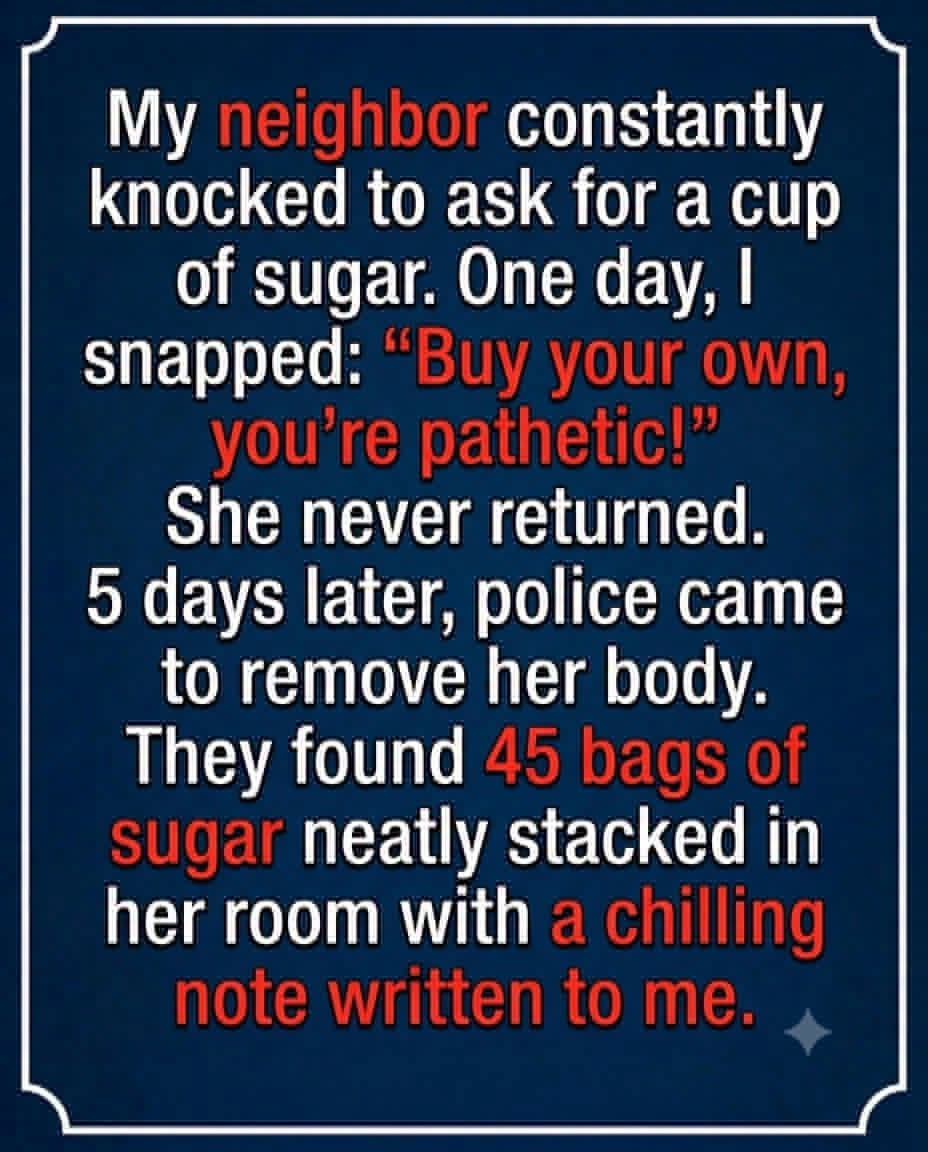
The objects left behind in an empty house sometimes tell a clearer story than the person ever did. A stockpile of a single ingredient, a stack of unused greeting cards, or a calendar marked with appointments that were never kept can reveal a life organized around habits that once involved other people. Baking for neighbors, for instance, is a common form of quiet outreach. When the recipients stop responding or the baker loses the energy to continue, the ingredients may still accumulate out of habit or hope. These details are easy to miss while the person is alive and impossible to ignore after they are gone.
Guilt is a common reaction when someone realizes too late that a neighbor was struggling. It is also an incomplete response. Most people are not indifferent by character; they are occupied. Work, family obligations, personal stress, and the sheer volume of daily decisions leave limited surplus attention. The challenge is not to demand constant emotional availability from everyone, but to create lower-friction ways for ordinary kindness to occur. A brief conversation on the porch, an offer to collect mail during a trip, or a simple invitation to sit outside for ten minutes can matter more than elaborate gestures precisely because they are sustainable.
Communities that reduce isolation tend to do so through repeated, low-intensity contact rather than dramatic interventions. Neighborhood groups that organize occasional check-ins for older residents, faith communities that notice absences, and local businesses that become informal observation points all contribute. Technology can help—shared phone trees, simple messaging apps for nearby residents—but it works best when paired with occasional face-to-face presence. The goal is not to turn every neighbor into a close friend. It is to ensure that fewer people reach the point where their only remaining human contact is transactional.
There is also value in examining the stories we tell ourselves about busyness. Productivity culture often frames available time as a resource to be protected rather than shared. Saying no to an unscheduled conversation can feel like necessary boundary-setting. Sometimes it is. At other times it is simply the path of least resistance. Distinguishing between the two requires a degree of self-awareness that is difficult to maintain under pressure. Still, the cost of permanent distance becomes visible only in hindsight, when the chance to have chosen differently has already closed.
Children and younger adults can play a quiet role as well. A teenager willing to shovel a walk or carry groceries, a young family that includes an older neighbor in an occasional meal, or a simple habit of greeting people by name all reinforce the idea that the neighborhood is a shared environment rather than a collection of private fortresses. These actions do not require special training. They require noticing.
The most useful response to stories of isolation is not prolonged self-recrimination but adjusted attention going forward. Learning a neighbor’s name, registering when their routines change, and accepting that small interactions have value even when they feel inefficient are practical starting points. Not every overture will be welcomed. Some people prefer privacy. Others have become so accustomed to solitude that connection feels threatening. Respecting those boundaries remains important. What changes is the default assumption that silence equals contentment.
In the end, the distance between households is both a modern convenience and a quiet risk. We gain privacy and autonomy. We lose the ambient awareness that once made it harder for people to disappear while still living next door. Recovering some of that awareness does not require heroic effort. It requires the willingness to treat the people living nearest to us as real, and to act on that recognition before the chance to do so becomes a source of lasting regret. The sugar left in a quiet kitchen is only a symbol. The real substance is the human need for ordinary acknowledgment—and the ordinary opportunities we still have to provide it.
Most Popular!
-
 When an Absent Parent Returns: Boundaries, Time, and the Limits of Making Amends
-
When Secrets in the Home Become Dangerous: Recognizing Control, Betrayal, and the Path Back to Safety
-
When a Community Refuses to Forget: Memorials, Missing Children, and the Complicated Search for Meaning
-
High School Cruelty, Body Shame, and the Quiet Work of Reclaiming Your Place
-
James Spader’s Quiet Rebellion: Why One of Hollywood’s Most Private Actors Still Fascinates Us
-
Shared Spaces, Small Cruelties, and the Quiet Power of Choosing Kindness on Vacation
-
When a False Accusation Echoes Across Decades: Trust, Silence, and the Long Path Back to Truth
-
Love, Loyalty, and the Quiet Strength of Choosing Family When It Matters Most