Some families are bound by blood, love, and shared memories. Others are held together by secrets, lies, and the fear of what happens when the truth finally comes out. For most of my adult life, I believed I belonged to the first kind. I was wrong. The moment my family decided I was no longer worthy of saying goodbye to the man who had raised me, the illusions shattered. What followed wasn’t just a confrontation. It was the unraveling of decades of carefully constructed stories that had kept our family together — and the beginning of a new chapter built on truth instead of convenience.
My grandfather, Harold “Pop” Thompson, was the strongest man I had ever known. He served in Vietnam, came home with scars both visible and invisible, and still managed to raise three children while working two jobs. When I was a boy, he taught me how to change a tire, how to stand up for what’s right, and how to carry yourself with quiet dignity even when the world tries to break you. Pop was the one who encouraged me to join the military after high school. He said it would make a man out of me, the same way it had for him. I took his words to heart. I enlisted in the Army, served two tours in Afghanistan, and came home with my own set of scars — both physical and the kind that don’t show on the outside. I was proud of my service. I still am. But to my own family, that pride became a threat.
The trouble started years before Pop’s final illness. My cousin Jason had always been the golden child. He stayed close to home, worked in the family construction business, and made sure everyone knew how dedicated he was to “carrying on Pop’s legacy.” I was the one who left, served overseas, and built a life that didn’t revolve around Sunday dinners and small-town expectations. While I was deployed, Jason quietly positioned himself as the favorite grandson. He visited Pop every weekend, helped with chores, and made sure everyone knew about it. I sent letters, called when I could, and came home on leave whenever possible. But distance is a hard thing to compete with when someone is physically present and willing to rewrite history.
When Pop got sick, the family closed ranks. Cancer moved fast, and within months he was in hospice care at home. I flew back immediately, arranging leave and canceling work commitments. But when I arrived at the house, my mother met me at the door with cold eyes. “Pop doesn’t want to see you,” she said. Behind her, I could hear voices — my aunts, uncles, and cousins all gathered like they were protecting something precious. Jason stood in the background with his arms crossed, a satisfied look on his face. They told me I was no longer welcome. That my military service had “changed me,” that I had become “too aggressive” and “unstable.” They called me a fake soldier, claiming I had exaggerated my deployments and used the military as an excuse to avoid real responsibility. The words cut deeper than any battlefield injury ever could. These were the same people who had celebrated my enlistment, who had hung yellow ribbons when I deployed, and who had cried at my homecoming. Now they were using my service against me to keep me from saying goodbye to the man who had inspired it.
I left that day with a broken heart and a quiet resolve. I didn’t argue or beg. I simply walked away, drove to a hotel, and sat in the dark room trying to make sense of what had just happened. That night, I made the call that would change everything. I contacted an old Army buddy who now worked in military records and background verification. I asked him to pull everything he could on Jason — employment history, financial records, anything that might explain why my family was so determined to keep me away. What he found wasn’t just surprising. It was devastating.
Jason had been stealing from Pop for years. Small amounts at first — cash from the business, tools sold on the side, even checks written from Pop’s account under the guise of “helping with bills.” As Pop’s health declined, the theft grew bolder. Jason had convinced the family that I was unreliable and potentially dangerous, painting me as a troubled veteran with PTSD who might upset Pop in his final days. The real reason was simpler and uglier: he needed me out of the way so he could finish draining what was left of Pop’s savings and position himself as the sole heir to the family business and property. My mother and aunts had gone along with it, either out of denial or because they benefited from Jason’s schemes. They had chosen money and convenience over truth and family.
Armed with the documentation, I returned to the house the next morning. This time I didn’t come alone. I brought my attorney and printed copies of bank statements, forged signatures, and transfer records. When my mother opened the door, I didn’t raise my voice. I simply handed her the folder and said, “Let me see Pop. Now. Or we do this the hard way.”
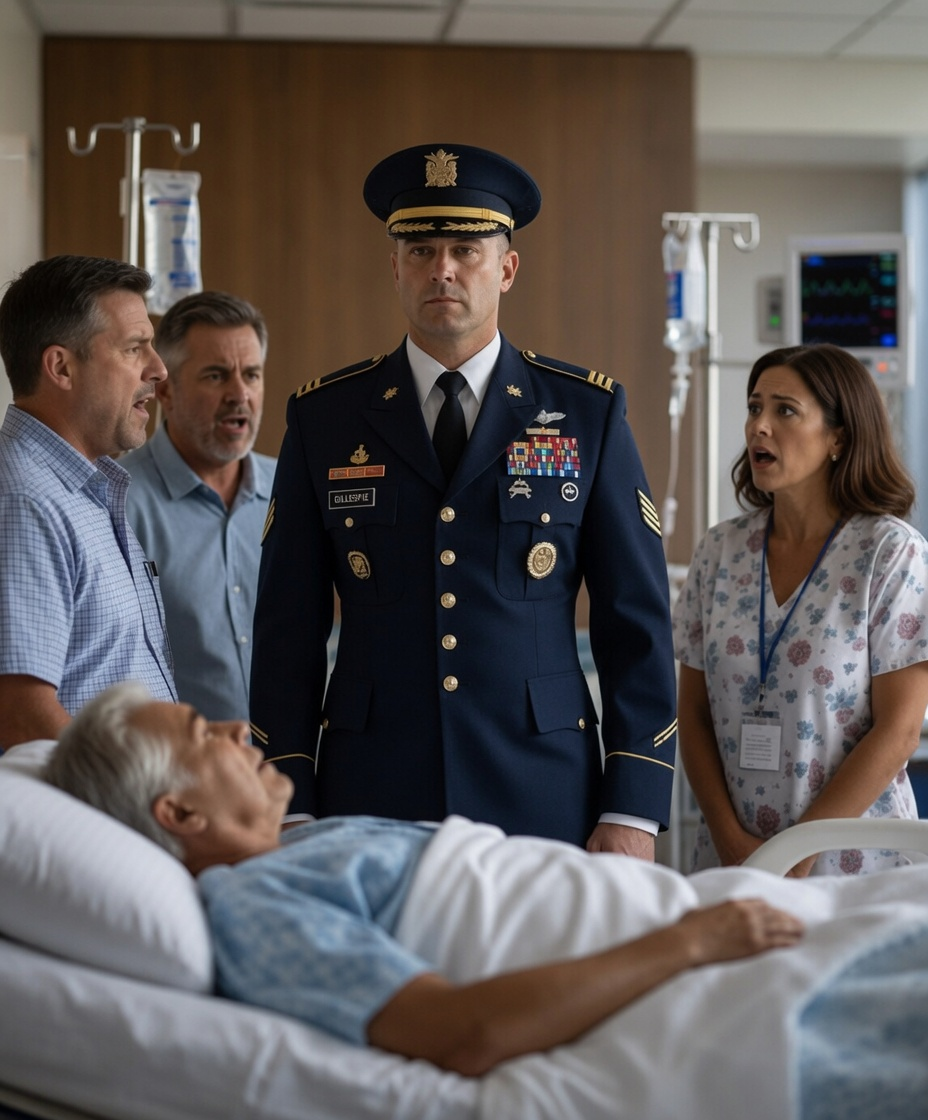
The confrontation that followed was painful but necessary. Jason tried to deny everything at first, but the evidence was overwhelming. My mother broke down in tears, admitting she had known something was wrong but had looked the other way because confronting Jason meant admitting she had failed as a parent. The aunts and uncles scattered like leaves in the wind, suddenly remembering urgent appointments. In the end, I was allowed into Pop’s room. He was weak but conscious, and when he saw me, his eyes filled with recognition and love. We spent the next several hours talking — really talking — about life, regrets, and the importance of truth. He passed peacefully two days later, holding my hand and whispering that he was proud of the man I had become.
The funeral was a quiet affair. Jason didn’t attend. The family that had once been so united against me began to fracture under the weight of exposed lies. Some relationships mended over time. Others never recovered. I sold my share of the family business and used the proceeds to create a scholarship fund in Pop’s name for veterans’ children pursuing education. It felt like the right way to honor his memory and turn pain into purpose.
This experience taught me lessons I carry with me every day. Family is not defined by blood alone. It is defined by loyalty, honesty, and the willingness to choose truth even when it’s uncomfortable. I also learned that protecting your peace sometimes means walking away from people who only want what you can give them. Most importantly, I discovered that the strongest love is the kind that survives betrayal and still chooses integrity over revenge.
My relationship with my mother has slowly improved. She has apologized many times, and we are working on rebuilding trust. The children — my nieces and nephews — still visit me regularly. They are learning that love isn’t about perfection but about showing up when it matters. Jason remains distant, but that distance has brought me peace rather than pain. I no longer carry the weight of trying to earn approval from people who never truly saw my worth.
Standing on that dirt road years earlier, watching my children drive away, I felt abandoned. But on the day I stood up for myself and for Pop’s memory, I felt something stronger: freedom. The freedom to live without the constant need to prove myself. The freedom to honor my grandfather’s legacy in my own way. And the freedom to build a life based on truth rather than convenient lies.
If you’re facing your own family struggles — whether it’s financial manipulation, emotional abuse, or the pain of being pushed aside — please remember this: you are allowed to protect yourself. You are allowed to demand respect. And sometimes the most loving thing you can do is walk away from people who only value you for what you can give them.
My story didn’t end with bitterness. It ended with peace. The children who left me on that road eventually learned that actions have consequences. The family that betrayed Pop’s memory had to face the truth of what they had done. And I learned that sometimes the greatest inheritance isn’t money or property. It’s the strength to stand up for what’s right even when it costs you everything you thought you wanted.
Pop would be proud. And that knowledge is worth more than any fortune my family tried to steal.
The dirt road wasn’t the end of my story. It was the beginning of a life lived on my own terms — honest, dignified, and finally free. And for that, I will always be grateful.
Most Popular!
-
 The 5 That Changed Everything: How a Pair of Baby Shoes Brought Two Mothers Back to Life
-
Why Charlie Kirk and His Wife Are Being Targeted by an Online “Transvestigation” Hoax — And What This Dangerous Trend Really Means
-
The Flight Attendant Scolded a Struggling Mother — Until the Pilot’s Voice Came Over the Intercom and Changed Everything
-
I Adopted a Little Girl — Thirteen Years Later, One Phone Screen Brought Everything to a Stop
-
Swollen Feet: The Silent Warning Sign Your Body Is Trying to Send You — And What to Do About It Before It Gets Worse
-
Everyone Misjudged This Tattooed Biker — Until the Truth Came Out and Changed How We See People
-
8 Subtle Signs Someone Secretly Resents You — And How to Protect Your Peace Without Losing Yourself
-
I Found Strange Black Grains Under My Mattress — What I Thought Were Insect Eggs Turned Out to Be Something Beautiful