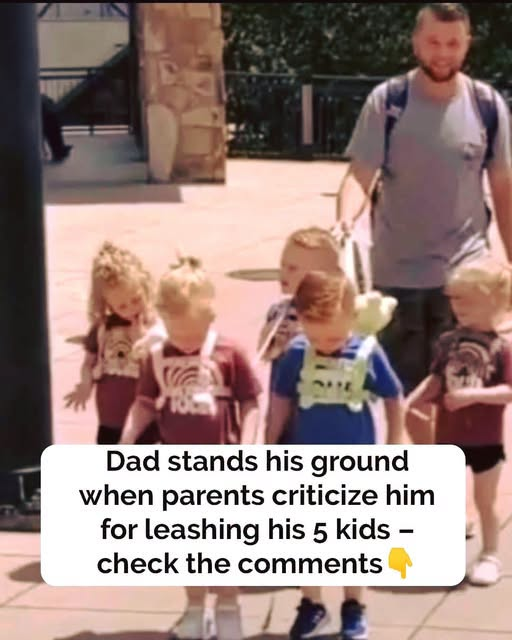
Parenting multiple young children simultaneously presents unique challenges that often require creative solutions. One father recently found himself at center of heated debate after photos surfaced showing him using child safety leashes with his five-year-old quintuplets during an outing. The images quickly went viral, sparking intense discussion about appropriate parenting methods, child safety, and boundaries of public judgment toward different family choices. While some praised his practical approach to managing active toddlers, others criticized the practice as potentially harmful to children’s development and dignity. This controversy highlights complex questions about balancing safety with independence in modern parenting.
The father explained that managing five energetic five-year-olds in public spaces required strategies ensuring everyone’s safety while allowing some freedom of movement. Child leashes, designed specifically for this purpose, provided security in crowded environments where children could easily become separated or wander into dangerous situations. He emphasized that the leashes allowed children some autonomy to explore within safe parameters while preventing potential accidents that could occur with traditional hand-holding methods when multiplied by five active kids. His approach reflected practical considerations of parenting multiples rather than desire to restrict children’s natural curiosity and movement.
Critics argued that using leashes on children, even young ones, treats them like pets rather than developing individuals deserving respect and dignity. Child development experts offered varied perspectives on appropriateness of such devices, with some suggesting they can be useful safety tools in specific situations while others worried about potential psychological impacts on children’s sense of autonomy and self-worth. The debate extended beyond this particular family to broader conversations about helicopter parenting, free-range approaches, and finding appropriate balance between protection and independence for young children.
Social media reactions revealed deep divisions in parenting philosophies and willingness to judge others’ choices publicly. Supportive comments focused on practical challenges of raising multiples and understanding that different families require different strategies based on their specific circumstances. Critical responses often came from people without personal experience raising multiple children simultaneously, highlighting gap between theoretical ideals and real-world demands of parenting quintuplets. The intensity of online discussion demonstrated how quickly parenting decisions become subjects of public scrutiny in age of social media sharing.
Parenting experts emphasize importance of considering individual family dynamics and children’s specific needs rather than applying universal standards to all situations. What works effectively for one family may prove impractical or inappropriate for another based on various factors including children’s personalities, family resources, and environmental considerations. Professional guidance from child psychologists and pediatricians can help parents make informed decisions about safety strategies while promoting healthy development and emotional well-being. The key lies in balancing protection with opportunities for growth and independence appropriate to children’s developmental stages.
The father’s decision to use leashes reflected common practice among parents of multiples who face unique logistical challenges in public spaces. Many families with twins or triplets employ similar safety measures during outings to crowded locations where maintaining constant visual contact proves difficult. Safety experts generally support use of appropriate child restraints in high-risk environments while encouraging gradual transition toward greater independence as children develop better self-regulation and awareness of dangers. The controversy surrounding this particular case highlighted tension between practical safety concerns and philosophical objections to restricting children’s movement.
Broader societal conversations about parenting choices reveal evolving expectations and persistent judgment toward different approaches to raising children. Modern parents face unprecedented scrutiny through social media and public commentary that can amplify both praise and criticism of everyday decisions. Finding balance between seeking helpful advice and protecting family autonomy represents ongoing challenge for many families navigating complex landscape of child-rearing in contemporary society. The quintuplets’ father case served as reminder that behind viral images and heated debates exist real families making difficult choices based on their specific circumstances and best judgment.
As discussion continues about appropriateness of child leashes and similar safety tools, focus should remain on children’s well-being and supporting parents who face exceptional challenges like raising multiples. Professional guidance, community resources, and non-judgmental dialogue help create environments where families can make informed decisions without facing unnecessary public shaming or unrealistic expectations. Every family’s situation differs based on various factors, making blanket judgments about specific parenting methods both unfair and unhelpful for promoting positive child development and family well-being.
The father who faced backlash for using leashes with his quintuplets ultimately demonstrated commitment to keeping his children safe in challenging circumstances while navigating public scrutiny that comes with raising large family in spotlight. His experience highlights complex realities of modern parenting where practical solutions sometimes conflict with idealized notions of child-rearing. Rather than focusing solely on controversy, society benefits from supporting families through resources, understanding, and recognition that different approaches may work best for different situations. The safety and well-being of children should remain central concern guiding discussions about appropriate parenting methods in all circumstances.
Most Popular!
-
 Eggs, Cholesterol, and Timing: What Actually Matters for Most People
-
When a Partner Leaves With More Than a Suitcase: Protecting Yourself From Financial Betrayal
-
When Financial Support Meets Contempt: Recognizing Exploitation Inside a Marriage
-
Why Some Sensory Toys and Household “Hacks” Do Not Belong in the Microwave
-
When Grief Clouds Judgment: Misreading Silence and the Quiet Ways People Show Care
-
When One Partner Does All the Hosting: Recognizing Imbalance Before Resentment Takes Over
-
How Many Holes Are in a T-Shirt? What a Simple Puzzle Reveals About How We See
-
The Quiet Stories Inside Secondhand Objects: When a Thrift-Store Find Carries Someone Else’s History