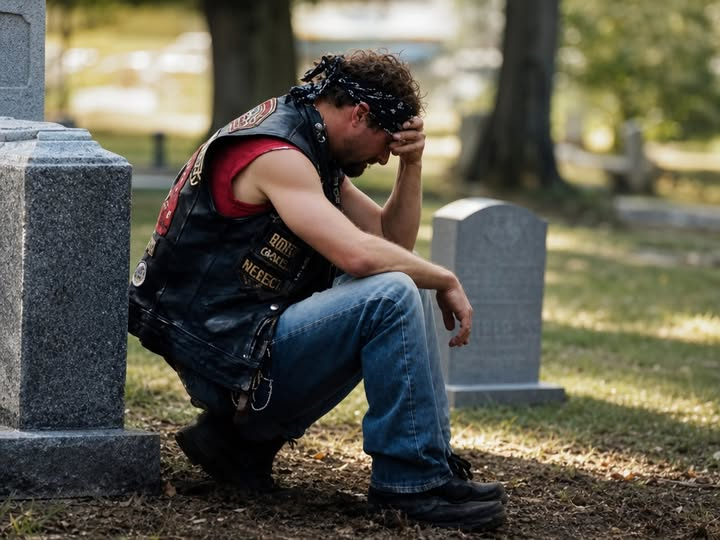
Some grief feels like it will never loosen its grip. For three years after losing my wife, Laura, I visited her grave every Sunday morning like clockwork. The small cemetery on the edge of town became my sanctuary and my prison all at once. I would sit on the cold stone bench, talk to her about our children, our memories, and the emptiness her absence left behind. I thought I knew everything about the woman I had loved for twenty-two years. I was wrong. One rainy Sunday, everything I believed about our marriage, our life together, and the woman I thought I knew so well was turned upside down by a stranger standing at her graveside.
I arrived earlier than usual that morning, the sky heavy with storm clouds. As I walked the familiar path toward Laura’s plot, I saw him — an older man in a worn navy coat, standing with his head bowed and a small bouquet of white roses in his hands. He wasn’t just passing through. He stood there for a long time, speaking softly as if he were having a conversation with her. My stomach twisted with confusion and something sharper — a protective anger I hadn’t felt in years. Who was this man, and what right did he have to be at my wife’s grave?
I waited at a respectful distance until he finished. When he turned to leave, our eyes met. He looked startled for a moment, then offered a sad, knowing smile. “You must be Michael,” he said quietly. The fact that he knew my name sent a chill through me. Before I could respond, he introduced himself. “My name is Robert. Laura was… my daughter.”
The world tilted beneath my feet. Laura had told me both her parents died when she was young. She had no siblings, no living family except distant cousins she rarely mentioned. That was the story she had carried into our marriage, the one I had never questioned because I trusted her completely. Now this stranger stood before me claiming to be her father, and something in his eyes told me he was telling the truth.
We ended up sitting on the bench together as the rain began to fall. Robert told me a story I never could have imagined. Laura had run away from home at seventeen after years of emotional abuse and neglect. Robert admitted he had been a difficult, distant father consumed by his own demons after losing his wife to illness. He had tried to find Laura for years but respected her wish to stay hidden when she finally sent a single letter asking him to stop looking. He had watched from afar as she built a beautiful life with me and our children, never wanting to disrupt the peace she had found. He only came to her grave after her passing, needing a place to mourn the daughter he had lost long before cancer took her.
As he spoke, pieces of Laura’s life that had never quite fit suddenly clicked into place. The way she sometimes withdrew when family was mentioned. The nightmares she would never fully explain. The quiet determination to be the kind of parent our children could always count on. She had carried deep wounds from her childhood and had chosen to protect me and our family from them. The love I thought I fully understood suddenly felt even deeper — and more complicated.
That conversation at the graveside didn’t erase my grief, but it transformed it. I invited Robert to meet our children the following weekend. Watching him hold his grandchildren for the first time brought both joy and sorrow. Our daughter saw her mother’s eyes in his face and cried. Our son asked questions about the grandmother he would never know. Through tears and stories, a new kind of family began to form from the broken pieces of the past.
Over the following months, Robert became a quiet but steady presence in our lives. He never tried to replace the father figure our children already had in me. Instead, he offered gentle wisdom, shared memories of Laura as a little girl, and helped us fill in the gaps of her story that she had kept hidden to protect us. I learned that her strength and kindness had been forged in fire, and that protecting our family from her painful past had been an act of profound love.
This experience taught me several painful but necessary truths about marriage, secrets, and healing. First, even the deepest love can carry hidden chapters. Laura’s decision to distance herself from her past wasn’t about distrusting me — it was about creating something beautiful free from old shadows. Second, forgiveness and understanding can emerge even after loss. Robert and I built a respectful relationship not because we had to, but because love for Laura connected us in ways we never expected. Third, children are far more resilient than we often give them credit for. Sharing the truth with them, age-appropriately, helped them understand their mother more fully and strengthened our bond as a family.
Today, our home holds new traditions that honor both Laura’s memory and the expanded family we’ve discovered. We visit her grave together, sometimes with Robert. The children place flowers and talk to their mother about their lives. I’ve learned to carry both the love and the unanswered questions with more peace. Grief doesn’t disappear, but it can transform into something gentler when we allow truth and compassion to guide us through it.
If you’re navigating complicated family dynamics, hidden secrets, or unexpected revelations after loss, please know you’re not alone. The path through pain is rarely straight or simple, but it can lead to deeper understanding and unexpected connections. Give yourself permission to feel everything. Seek support when the weight feels too heavy. And remember that love, even when imperfect or incomplete, remains one of the most powerful forces we have.
Laura’s story didn’t end with her passing. It continued through the children she loved fiercely, the husband who still carries her in his heart, and the father who finally found a way to show up when it mattered most. The stranger at her grave wasn’t an intruder. He was a missing piece of a larger story — one that taught me that family can grow even after loss, and that the heart has an incredible capacity to heal when given truth, time, and grace.
The man who once stood alone at his wife’s grave now stands with others who loved her too. The pain remains, but so does the love — deeper, more complicated, and more precious because we finally understand how hard she fought to protect it. And in that understanding, we’ve all found a measure of peace.
Sometimes the hardest truths lead to the most beautiful second chapters. I’m grateful every day for the stranger who helped me write mine.
Most Popular!
-
 Hidden PFAS in Toilet Paper Linked to Cancer Risk — 6 Types You Need to Be Aware Of Right Now
-
7 Subtle Signs You’re Going Through a Deep Inner Shift (And Why It’s a Beautiful Thing)
-
My Husband Had a Vasectomy But When I Got Pregnant Two Months Later He Accused Me of Cheating — I Thought That Was the Worst Part Until the Ultrasound
-
Doctors’ Chilling Warning About Kissing a Dead Person — The Hidden Risks You Need to Know Before It’s Too Late
-
A Legacy of Health: Soong Mei-ling’s Remarkable Longevity and Inspiring Fight Against Cancer
-
The Benefits of Eating Bananas and the Myths You Should Stop Believing
-
I Was Paid to Pretend I Was an Elderly Woman’s Son After She Died — The Nursing Home Said She Left Something Behind for Me
-
My Daughter Went Missing in Egypt 20 Years Ago — Then One Day a Postcard Arrived That Brought Me to My Knees