I was thirty-two years old when I finally admitted to myself that something had always felt wrong in my relationship with my mother. It wasn’t the big dramatic fights you see in movies. It was the little comments that chipped away at me for decades. “You’re too sensitive.” “I sacrificed everything for you.” “Why can’t you be more like your sister?” Those words followed me into adulthood, shaping how I saw myself, how I loved, and how I showed up in the world. It took years of therapy and honest conversations with friends who had similar experiences to realize these weren’t just “mom things.” They were classic signs of narcissistic behavior — and they had done more damage than I ever wanted to admit.
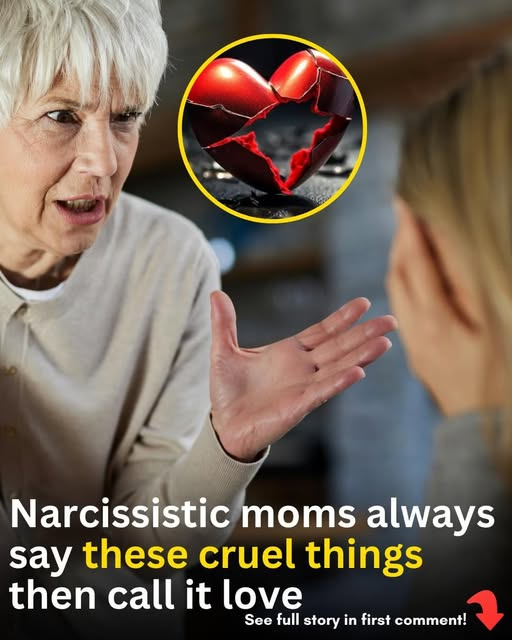
Narcissistic mothers often hide behind the image of the devoted parent. On the outside, they may seem caring, successful, or even sacrificial. But their words reveal a pattern of emotional manipulation, control, and self-centeredness that can leave deep wounds in their children. These comments aren’t always said with malicious intent, but the impact is the same: they erode self-worth, create confusion, and make it incredibly difficult for adult children to form healthy boundaries and relationships.
One of the most common phrases is “I did everything for you.” On the surface, it sounds like love. But it’s often used as a weapon to induce guilt. Narcissistic mothers keep score, reminding their children of every sacrifice, every late night, every opportunity they claim to have given up. This creates a debt that can never be repaid, keeping the child emotionally chained well into adulthood. The hidden message is clear: you owe me your life, your loyalty, and your happiness.
Another frequent line is “You’re too sensitive” or “You’re overreacting.” When a child expresses hurt, disappointment, or needs, these phrases dismiss their emotions and make them question their own reality. Over time, this teaches children to suppress their feelings, doubt their perceptions, and prioritize the mother’s comfort over their own truth. Many adult children of narcissistic mothers struggle with anxiety, people-pleasing, and difficulty trusting their instincts because they were taught that their emotions were invalid.
“You never appreciate me” is another classic. No matter how much love, success, or effort the child shows, it’s never enough. This keeps the child in a constant state of striving for approval that rarely comes. The mother maintains power by staying just out of reach emotionally, ensuring the child remains focused on pleasing her rather than building their own life.
Some narcissistic mothers use comparison as a weapon: “Why can’t you be more like your cousin/sister/friend?” This plants seeds of insecurity and competition within the family. It teaches the child that love is conditional and that they must outperform others to be worthy. Siblings raised this way often carry rivalry and resentment into adulthood, struggling to form close bonds even after they leave home.
The phrase “I’m your mother, you owe me respect” is often used to shut down any criticism or boundary-setting. It confuses respect with obedience and silence. Healthy respect is earned through consistent love and empathy. Narcissistic mothers demand it as a right while offering little in return, creating relationships built on fear and obligation rather than mutual care.
Many adult children also hear “After everything I’ve done for you, this is how you treat me?” whenever they try to assert independence. This guilt-tripping technique makes setting boundaries feel like betrayal. It keeps the child emotionally entangled, making it difficult to make decisions based on their own needs and values.
The long-term damage from these patterns can be profound. Adult children of narcissistic mothers often struggle with self-worth, codependency, anxiety, and difficulty forming healthy romantic relationships. They may attract partners who mirror the same emotional unavailability or control they experienced growing up. Healing requires recognizing that these phrases were never about the child’s shortcomings — they were about the mother’s inability to love without conditions or see her children as separate individuals with their own needs.
Recovery isn’t easy, but it is possible. It begins with acknowledging the pain without minimizing it. Therapy, particularly approaches that focus on childhood emotional neglect and narcissistic family dynamics, can be incredibly helpful. Learning to reparent yourself — offering the love, validation, and safety you didn’t receive — is often a crucial part of the journey. Setting firm boundaries, even when it feels uncomfortable, is essential. And surrounding yourself with people who respect and value you helps rebuild the self-esteem that was slowly eroded over years.
If you recognize these patterns in your own mother, know that you’re not alone and you’re not crazy. The confusion, guilt, and grief you feel are normal responses to growing up in an emotionally manipulative environment. Your feelings are valid. Your needs matter. And your worth was never dependent on how well you performed for someone else’s ego.
The women who break free from these cycles often become incredibly strong, empathetic, and self-aware. They learn to love without losing themselves. They create the kind of families they always wished for. And they turn their pain into purpose — whether through their own parenting, their work, or simply by living as examples of what healing looks like.
If you’re still in the middle of this struggle, be gentle with yourself. Healing doesn’t happen overnight. Some days you’ll set boundaries perfectly. Other days you’ll fall back into old patterns. That’s okay. Progress isn’t linear. What matters is that you keep choosing yourself, little by little, until your life reflects the respect and love you’ve always deserved.
Your mother’s words may have shaped your past, but they don’t have to define your future. You have the power to write a new story — one where your voice matters, your feelings are valid, and your worth is never up for negotiation. The journey isn’t easy, but it’s worth every step. Because on the other side is a life where you no longer shrink yourself to make someone else feel big. And that freedom is one of the most beautiful things you can ever give yourself.
Most Popular!
-
 Eggs, Cholesterol, and Timing: What Actually Matters for Most People
-
When a Partner Leaves With More Than a Suitcase: Protecting Yourself From Financial Betrayal
-
When Financial Support Meets Contempt: Recognizing Exploitation Inside a Marriage
-
Why Some Sensory Toys and Household “Hacks” Do Not Belong in the Microwave
-
When Grief Clouds Judgment: Misreading Silence and the Quiet Ways People Show Care
-
When One Partner Does All the Hosting: Recognizing Imbalance Before Resentment Takes Over
-
How Many Holes Are in a T-Shirt? What a Simple Puzzle Reveals About How We See
-
The Quiet Stories Inside Secondhand Objects: When a Thrift-Store Find Carries Someone Else’s History