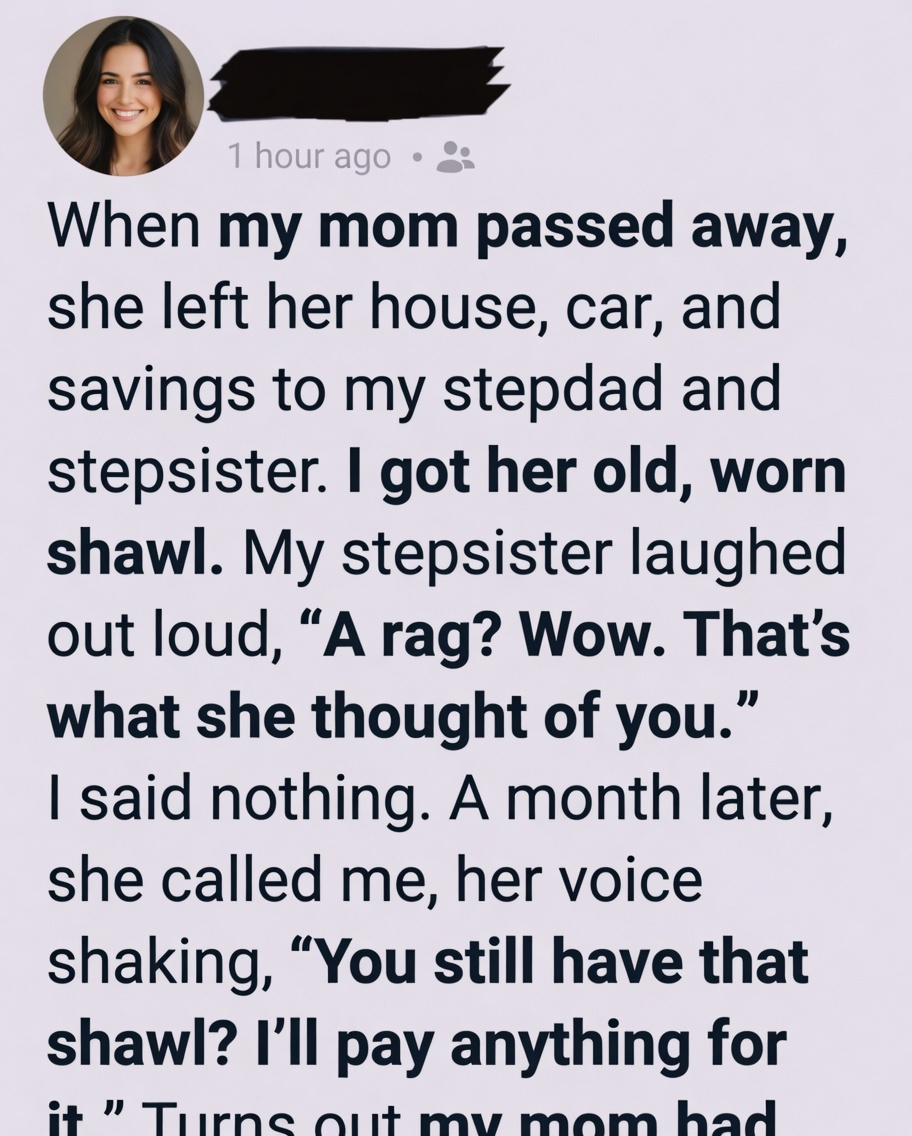
Losing a parent is never easy, but when the only thing you inherit is something your own family laughs at, the grief cuts twice as deep. After my mother passed, the lawyer slid a faded, threadbare shawl across the table and said those were my only listed possessions. The house went to my stepfather. The savings were split among my stepsiblings. The car was claimed by my brother. And there I sat, holding a soft piece of fabric that still carried the faint scent of her favorite lavender lotion. My family’s reaction was immediate and cruel. “That’s it?” my stepsister snorted. “You got the laundry?” Awkward laughs rippled around the room. In their eyes, I had been given nothing. In mine, I had been given everything that truly mattered.
The shawl wasn’t valuable in any traditional sense. It was old, slightly frayed at the edges, and had a small coffee stain near the fringe that my mother could never quite get out. She had worn it on quiet evenings while reading by the window, wrapped it around her shoulders on cold mornings while making tea, and pulled it over both of us during thunderstorms when I was small enough to fit on her lap. It wasn’t expensive or designer. It was simply hers — and that made it irreplaceable.
I took the shawl home that day and folded it carefully on the back of my couch. Every time I walked past it, a wave of memories would wash over me. I remembered her humming old songs while she cooked, the way she would drape the shawl over me when I was sick, and how she would pull it tighter around herself whenever life felt heavy. Those memories weren’t in the bank accounts or the house title. They lived in that piece of fabric. My family saw an old rag. I saw my mother’s presence stitched into every thread.
Weeks after the funeral, my stepsister called me. Her voice was different this time — quieter, almost hesitant. She asked if she could have the shawl. At first I thought she was joking. This was the same woman who had laughed the loudest at the will reading. But she wasn’t joking. She explained that after the meeting, she had started thinking about all the times she had seen our mother wearing that shawl. Family holidays. Hospital waiting rooms. Ordinary Tuesday evenings on the couch. The more she thought about it, the more the shawl transformed in her mind from something worthless to something she suddenly couldn’t stop thinking about.
I didn’t give it to her. Not because I wanted to be petty, but because I finally understood something profound. Some inheritances cannot be measured in dollars or divided equally at a lawyer’s office. Some are stitched together from memory, love, and the quiet moments that survive long after everything else is gone. The shawl wasn’t valuable because of what it was made of. It was valuable because of what it carried — presence, continuity, and the kind of love that doesn’t need a price tag.
My family’s initial reaction wasn’t really about the shawl itself. It was about value — the kind they could see and touch and spend. In their eyes, I had been shortchanged. They had the house, the savings, the car. I had “laundry.” What they failed to understand in that moment was that the things people laugh at are often the ones that hold the deepest meaning. Material possessions can be replaced or sold. The feeling of your mother’s shawl wrapped around you during a thunderstorm cannot.
This experience taught me something I wish more families understood after a loss. Grief doesn’t divide neatly like assets in a will. It lingers in the small, ordinary objects that no one else notices. A favorite coffee mug. A worn pair of slippers. An old shawl that still smells like the person you lost. Those items become anchors when everything else feels like it’s drifting away. They aren’t “just things.” They are tangible proof that the person you loved was real and that their love still exists in some form.
I still have the shawl. It sits folded on the back of my couch where I can see it every day. Sometimes I wrap it around my shoulders when the house feels too quiet. Other times I simply touch it and remember. My stepsister has stopped asking for it. I think she finally understands why I could never give it away. The laughter at the will reading has been replaced by a quiet respect — or at least an acceptance that some things cannot be claimed or divided.
If you’ve ever lost someone and been left with what others see as “nothing,” please know this: the most meaningful inheritances are often the ones that don’t come with appraisals or legal documents. They come wrapped in memory and love. Hold onto them tightly. They are worth more than any bank account or piece of property ever could be.
Grief has a way of revealing what truly matters. In the end, my family learned that lesson too — perhaps a little later than I did. The shawl remains mine, not because I want to keep score, but because it still carries my mother’s presence in a way nothing else ever could. Some things in life are simply not for sharing. They are for keeping close to your heart, where they belong.
The next time someone mocks what you hold dear, remember that value isn’t always visible to the naked eye. Sometimes the most precious things in life are the ones that look like “laundry” to everyone else. And sometimes, those are the only things worth keeping forever.
Most Popular!
-
 THE RISE AND TRAGIC LEGACY OF A BELOVED CHILD STAR: A STORY OF FAME, TALENT, AND RESILIENCE
-
DO YOU KNOW WHY A MAN TURNS HIS BACK ON YOU WHEN HE SLEEPS?
-
THE MOST POPULAR GIRL IN SCHOOL ASKED MY MISTREATED SON TO DANCE AT PROM—IT TURNED OUT TO BE A MEAN JOKE, BUT WHAT HE DID NEXT MADE MY KNEES SHAKE
-
WHAT I FOUND IN MY GIRLFRIEND’S BATHROOM TURNED OUT TO BE COMPLETELY HARMLESS
-
THE LATE-NIGHT HABIT THAT COULD BE SILENTLY SABOTAGING YOUR SLEEP, FOCUS, AND WELL-BEING
-
THE VINTAGE LAUNDRY WRINGER AT A YARD SALE AND THE STORY IT CARRIED
-
MY WEALTHY GRANDMOTHER LEFT ME NOTHING IN HER WILL—BUT A HIDDEN GARAGE HELD A SECRET THAT CHANGED MY LIFE FOREVER
-
IS IT SAFE TO LEAVE BUTTER ON THE COUNTER? A COMPLETE GUIDE TO BUTTER STORAGE AND FRESHNESS