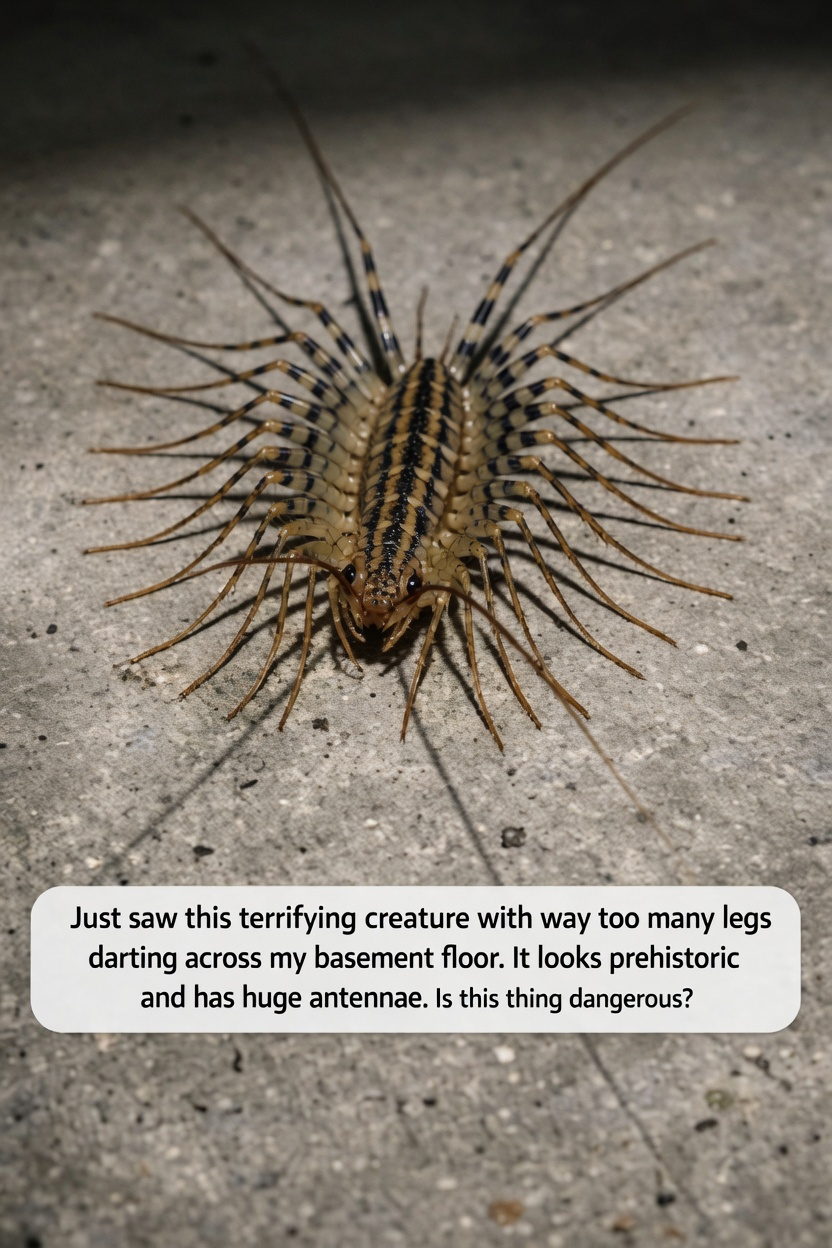
You go downstairs to grab a tool or a forgotten box, flip on the light, and there it is — a fast-moving, multi-legged horror skittering across the floor like it owns the place. Dozens of legs waving, long antennae twitching, body flattened for speed. Your heart jumps. Is it a centipede? A millipede? Something worse? For many homeowners, this moment triggers instant panic. But before you reach for the nearest shoe or bug spray, take a breath. That creepy basement dweller is almost certainly a house centipede — and despite its nightmare appearance, it’s one of the most misunderstood (and surprisingly helpful) creatures sharing your home.
What Exactly Is This Multi-Legged Monster?
The house centipede (Scutigera coleoptrata) is not a spider, not a worm, and definitely not the alien invader it appears to be. It’s an arthropod with 15 pairs of long, delicate legs, giving it that signature “too many legs” terror. Adults grow to about 1–2 inches long, with bodies that are yellowish-gray and striped. Their antennae are even longer than their bodies, making them look like they’re constantly sensing everything around them.
Unlike the slow-moving millipedes that curl into defensive balls, house centipedes are lightning-fast hunters. They can sprint up walls, across ceilings, and disappear into tiny cracks in seconds. This speed, combined with their many legs and waving antennae, triggers a primal fear response in humans — we’re wired to be alarmed by fast, many-legged things.
Why They Love Your Basement
House centipedes thrive in damp, dark, undisturbed environments. Basements, crawl spaces, bathrooms, and laundry rooms are perfect habitats. They need high humidity to survive and are drawn to areas with plenty of prey. And here’s the surprising part: they’re actually beneficial. These “monsters” are voracious predators that hunt silverfish, cockroaches, spiders, bed bugs, and other household pests. One house centipede can eat dozens of unwanted insects over its lifespan.
They enter homes through small cracks, gaps around pipes, or doors left open. Once inside, they’re hard to eliminate completely because they hide in walls and under floors during the day, emerging at night to hunt.
Are They Dangerous?
The good news: house centipedes are not venomous to humans in any meaningful way. They have small fangs and can deliver a tiny bite if handled roughly, but it feels like a weak pinprick and rarely causes more than mild irritation. They don’t carry diseases, they don’t infest food, and they don’t damage your home’s structure. In fact, their presence often means you have other pests for them to eat — so they’re like free, natural pest control.
The bad news? They look terrifying, move like lightning, and can reproduce quickly in ideal conditions. A single female can lay up to 150 eggs, leading to sudden population spikes if moisture and food sources are abundant.
How to Get Rid of Them Without Harsh Chemicals
If the sight of them makes your skin crawl, here are effective, humane ways to reduce their numbers:
- Reduce moisture — Fix leaks, use dehumidifiers, and improve ventilation. Centipedes hate dry environments.
- Declutter — Remove piles of cardboard, old papers, and stored items where they hide.
- Seal entry points — Caulk cracks around windows, doors, and pipes.
- Natural repellents — Peppermint oil, diatomaceous earth, or cedar oil can discourage them.
- Sticky traps — Place them in dark corners to monitor and reduce populations.
- Encourage predators — Spiders (ironically) and certain ground beetles will eat them.
Avoid broad-spectrum insecticides if possible — they kill the beneficial insects along with the centipedes and can create worse pest problems later.
When You Should Actually Worry
While most house centipede sightings are harmless, excessive numbers (dozens visible at once) or bites that cause significant swelling could indicate a larger underlying issue like a hidden moisture problem or another pest infestation providing them with food. In rare cases, people with allergies may react more strongly to their bites. If you’re seeing them in bedrooms or high-traffic areas regularly, it’s worth investigating further.
The Psychological Side of Basement Creepy-Crawlies
Our fear of multi-legged creatures is largely evolutionary. For our ancestors, fast-moving arthropods could mean danger — venom, disease, or larger predators nearby. Modern brains still trigger that same alarm response, even when the “threat” is completely harmless. Understanding this can help reduce the panic when you spot one skittering across the floor at 2 a.m.
Many people who learn about house centipedes’ beneficial role report feeling less fear over time. They shift from “kill on sight” to “live and let live” — or at least “tolerate from a distance.”
Living Peacefully With Your Basement Roommates
The presence of house centipedes doesn’t mean your home is dirty or broken. It means your basement has the right conditions for life — moisture, hiding spots, and prey. With simple adjustments, you can make your home less appealing to them while keeping it healthy for your family.
The next time you see those long legs darting across the floor, remember: that “monster” is probably hunting the actual pests you don’t want around. It’s doing the dirty work so you don’t have to.
Your basement isn’t haunted by nightmare creatures. It’s just hosting a few misunderstood hunters who prefer the dark and damp. Learn their habits, reduce what attracts them, and you can share the space with minimal drama.
Some household “pests” are actually allies in disguise. The multi-legged basement dweller might look like something from a horror movie, but it’s quietly helping keep your home balanced — one silverfish at a time.
Have you ever encountered house centipedes or other strange basement creatures? What was your reaction, and how did you handle it? Share your stories in the comments below — you might help someone else turn panic into understanding.
Most Popular!
-
 The Strange Humming Beneath Our New House Turned Out to Be Something No One Could Have Imagined
-
The Absolute Insane Backyard Prank That Sent My Nosy Neighbors Packing for Good
-
The Hidden Backyard Superfood That Is Seven Times More Powerful Than Kale
-
The Secret Four-Ingredient Frozen Strawberry Fluff That Will Make You Completely Forget About Traditional Ice Cream
-
The Tragic Downfall of a Hollywood Goddess Whose Legendary Beauty Completely Vanished
-
She Backed Out of Her Family Home in Secret and Left This Brutal Note on the Dresser
-
Pop Icon Lou Christie Dies Suddenly After Secret Battle, Leaving the Music World in Absolute Shock and Grief
-
Chelsea Clinton Shocks Cameras With a Positive Diagnosis Reveal After Collapsing From a Secret Health Battle She Could No Longer Outrun