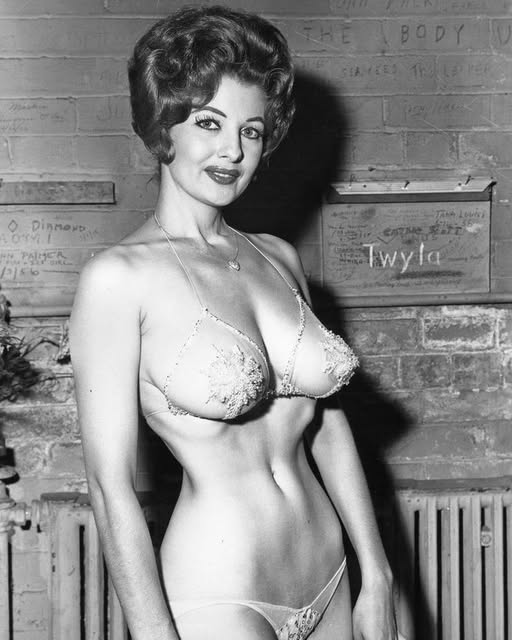
In the golden age of burlesque, when rhinestones, feathers, and carefully choreographed tease ruled the stage, one woman stood out like a flame in the darkness. With her signature fiery red hair, voluptuous figure, and unapologetic confidence, Tempest Storm didn’t just perform — she commanded the spotlight in a way that felt revolutionary. But behind the glamour and the sold-out theaters was a woman who risked everything time and again, not just for fame, but for the right to love freely in an America still crippled by racial barriers.
Born Annie Blanche Banks on February 29, 1928, in the small segregated town of Eastman, Georgia, her early life was marked by poverty and hardship. By her mid-teens, she had already run away from home twice, married and annulled once, and married again — all while dreaming of something bigger than the limited world around her. That dream eventually carried her to Hollywood, where a chance encounter as a cocktail waitress led to her first striptease performance. Almost overnight, Annie became Tempest Storm, and the transformation was electric.
What set Tempest apart wasn’t just her striking looks or her elaborate routines. It was her refusal to play by anyone else’s rules. While many burlesque performers of the era relied on shock value, Tempest brought elegance, humor, and undeniable star power to the stage. She shared bills with legends like Blaze Starr and even appeared alongside Bettie Page in cult classics. Her performances drew massive crowds, including a near-riot at the University of Colorado in 1955 when over 1,500 students rushed the stage. Yet she maintained a remarkably disciplined personal life — no smoking, no heavy drinking, and a firm commitment to natural beauty over surgery.
At the height of her fame in the late 1950s, Tempest made a choice that would cost her dearly. She fell in love with Herb Jeffries, the pioneering Black actor and singer known as the first Black singing cowboy in Hollywood. In 1959, they married in an era when interracial marriage was still illegal in many states and socially explosive everywhere. The backlash was immediate and brutal. Venues that once welcomed her with open arms suddenly canceled shows. Public interest waned as racial prejudices of the time clashed with her very public defiance. Many predicted the end of her career.
But Tempest refused to hide or apologize. She stood by her marriage, raised their daughter Patricia with pride, and continued performing when and where she could. Though the union eventually ended, she and Jeffries remained close until his death. Her willingness to love across racial lines at a time when doing so could destroy a career revealed the depth of her character. In an industry built on fantasy and escapism, she brought raw truth to the stage.
What makes Tempest’s story even more remarkable is her longevity. While many performers faded as tastes changed, she continued working well into her 80s. She became a mentor to a new generation of burlesque artists, including modern icons like Dita Von Teese, who have openly credited her as a major inspiration. In 1999, San Francisco declared a Tempest Storm Day in her honor. She remained a fixture at the Burlesque Hall of Fame, passing down the art of the tease with grace and wisdom.
Her journey from the dusty roads of Georgia to international stages wasn’t just about personal ambition. It was about breaking barriers for women who refused to be defined by their circumstances or the color of the person they loved. In an era when both women and interracial couples faced intense scrutiny, Tempest lived boldly and loved fearlessly. She proved that sensuality and power have no expiration date and that true glamour comes from an unbreakable spirit.
When she passed away in 2021 at the age of 93, the world lost more than a performer. It lost a pioneer who helped transform burlesque from simple entertainment into a form of empowerment and self-expression. Her life reminds us that the most revolutionary acts often happen quietly — a red-haired woman choosing love over career safety, authenticity over acceptance, and legacy over fleeting fame.
Today, as modern burlesque enjoys a vibrant renaissance, Tempest Storm’s influence is more visible than ever. New performers study her routines, adopt her confidence, and carry forward her message that every body and every love story deserves to be celebrated. Her fiery red hair may no longer light up the stage, but the spark she ignited continues to burn brightly in those who dare to follow her path.
The red-haired queen didn’t just change burlesque. She challenged an entire society’s ideas about race, beauty, and a woman’s right to live and love on her own terms. In doing so, she left behind a legacy far more enduring than any single performance — the courage to be unapologetically yourself, no matter the cost.
Most Popular!
-
 The Ultimate Wedding Revenge: When the Mother Who Abandoned Her Six Daughters Showed Up with Her Millionaire Boss, the Bride Opened a Box That Destroyed Lives Forever
-
The Beach Shaming Disaster: What My 8-Year-Old Said to the Prying Stranger Left Everyone Speechless
-
My Husband Abandoned Me With Twin Babies for a Luxury Fishing Trip — When He Returned, I Had Already Packed His Bags
-
The Three-Dollar Miracle: How a Dust-Covered Vase Revealed a Heartbreaking Decades-Old Secret
-
The $80,000 Battle to Erase a Birthmark: Why One Mother Risked Everything for Her Daughter’s Future
-
The Silent Thief: Why Millions of Men Are Living with a Time Bomb They Can’t See
-
The Final Curtain Falls: Beloved Sanford and Son Legend Hal Williams Gone at 91
-
Found at a Yard Sale: This “Useless” Vintage Contraption Is Actually a Forgotten Piece of Human History