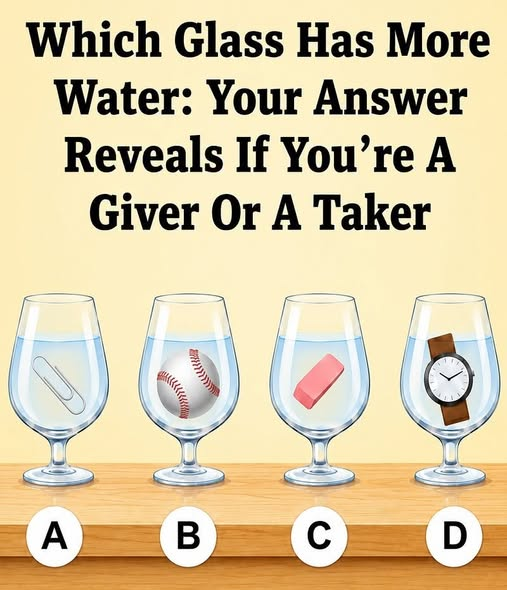
You’re staring at four identical glasses, each filled right to the brim with crystal-clear water. Inside them sit different objects: a tiny paperclip in the first, a large baseball in the second, a standard eraser in the third, and a bulky wristwatch in the fourth. The question seems simple enough — which glass actually holds the most water? Most people answer within seconds, feeling confident in their choice. But the vast majority get it completely wrong. This visual brain teaser has been circulating online, leaving thousands frustrated and questioning their own reasoning. What looks like a basic observation test is actually a clever trap that exposes how our brains take shortcuts and fall for assumptions.
At first glance, your eyes tell you the water levels are the same, so the amount of water must be identical across all glasses. This quick visual judgment feels so obvious that doubting it seems unnecessary. That’s exactly where the puzzle hooks you. Your brain relies on rapid pattern recognition and surface-level cues to make fast decisions — a survival mechanism that works well most of the time. But in this case, it leads you straight into error. The real answer has nothing to do with how high the water appears and everything to do with a fundamental principle of physics that many of us haven’t thought about since school.
The key concept here is displacement. When an object is submerged in a liquid, it pushes aside a volume of that liquid equal to its own volume. Since these glasses are filled to the absolute brim, any object inside takes up space that would otherwise be occupied by water. The larger the submerged object, the less room remains for actual water. This means the glass containing the smallest object holds the greatest volume of water, even though the surface level looks identical to the others.
Applying this logic, the tiny paperclip in the first glass displaces almost no volume at all. The baseball, being much bulkier, pushes out a significant amount of water. The eraser and wristwatch fall somewhere in between. Therefore, the glass with the paperclip contains the most water. The counterintuitive part is that your eyes see the same water line everywhere, tricking you into ignoring the hidden space taken up by the objects below the surface. It’s a perfect demonstration of how perception and reality can diverge when we don’t slow down to consider what’s actually happening.
This puzzle resonates so strongly because it mirrors challenges we face in everyday decision-making. We constantly make quick judgments based on incomplete information — whether evaluating people, investments, news stories, or relationships. The brain defaults to mental shortcuts (heuristics) to save energy, but those shortcuts can lead us astray when the situation requires deeper analysis. Puzzles like this one train us to pause, question initial impressions, and look for the hidden variables that matter most. In a world full of manipulated images, misleading headlines, and surface-level opinions, developing this skill feels more important than ever.
Beyond the pure logic, many who encounter the puzzle enjoy the playful personality analysis that often accompanies it. While not scientifically rigorous, these interpretations add fun to the experience. Choosing the paperclip glass might suggest you’re analytical and detail-oriented, someone who looks beyond appearances. Picking the baseball could indicate a big-picture thinker who moves quickly and trusts instincts. The eraser might appeal to balanced, methodical minds, while the wristwatch draws those who value symbolism and deeper meaning. Whatever your choice, the real value lies in recognizing when your first instinct might be wrong.
The enduring appeal of such riddles also reveals something about human nature. We love being surprised by our own minds. There’s satisfaction in realizing you’ve been tricked and then mastering the correct reasoning. These mental exercises keep our brains sharp, encourage humility about our perceptions, and remind us that certainty should always be tempered with curiosity. In professional settings, this kind of flexible thinking separates good problem-solvers from truly exceptional ones. The ability to step back, challenge assumptions, and consider alternative explanations is invaluable whether you’re leading a team, negotiating a deal, or navigating complex personal decisions.
Parents often share this puzzle with their children, turning it into a teaching moment about critical thinking. Kids who grow up questioning easy answers and examining evidence develop stronger analytical skills that serve them throughout life. In classrooms and family game nights, these challenges create engaging discussions that go far beyond the original question. They spark conversations about science, perception, bias, and how we interpret the world around us.
On a broader level, the water glasses puzzle serves as a metaphor for many real-world situations where surface appearances deceive. We see companies with impressive facades that hide shaky foundations, relationships that look perfect from outside but lack substance, or policies that sound good but create unintended consequences. Training ourselves to look for “displacement” — the hidden factors taking up space and affecting outcomes — leads to wiser choices and fewer regrets.
The next time you encounter a situation that seems straightforward, remember the four glasses. Ask yourself what might be displacing the obvious answer. What assumptions are you making based on surface details? What deeper variables deserve consideration? Cultivating this habit doesn’t make life more complicated — it makes your understanding more accurate and your decisions more effective.
This simple yet powerful brain teaser continues to spread because it delivers both entertainment and insight. It’s accessible to almost anyone, requires no special knowledge, and yet reveals something profound about how our minds work. Whether you got it right on the first try or fell for the visual trick, the experience itself is what matters. It’s a gentle reminder that staying curious, questioning first impressions, and remaining open to being wrong are strengths, not weaknesses.
In our fast-paced world that rewards quick responses and snap judgments, puzzles like this one offer a valuable pause. They encourage us to slow down, think more deeply, and appreciate the difference between seeing and truly understanding. The glass with the paperclip holds the most water — but more importantly, it holds a lesson about perception that stays with you long after the initial frustration fades.
The next time someone shares this puzzle with you, take a moment before answering. Look past the obvious, consider the displacement, and enjoy the satisfying click when the correct answer finally makes sense. Your brain will thank you for the workout, and you might just discover that the most valuable insights often hide in the places we least expect them. In a world full of optical illusions and mental shortcuts, learning to see clearly is one of the most useful skills you can develop. And it all starts with four simple glasses of water.
Most Popular!
-
 The Heartbreaking Reality: Why Jelly Roll and Bunnie XO’s Fairytale Marriage Has Finally Imploded
-
Is That Tiny Canker Sore Actually a Death Sentence? The Silent Signs of Oral Cancer You’re Likely Ignoring
-
The Indecency Scandal: Why Bianca Censori’s Latest Cat Mask Ensemble Has the Public Demanding Her Arrest
-
The Secret Message from Beyond: Why Cemetery Officials Are Desperate to Destroy This Man’s Final Tribute
-
The Miracle Weed: Why This Common Backyard Menace Is Worth Its Weight in Gold
-
The Innocent Selfie That Ended a Wedding: How One Tiny Detail Destroyed Everything
-
The Secret Whisper That Left a Nation Stunned: What Trump Actually Said to the Fighter Who Insulted Michelle Obama
-
These Mind-Bending Riddles Are Humiliating Millions Online — Can You Solve Them Without Losing Your Mind?