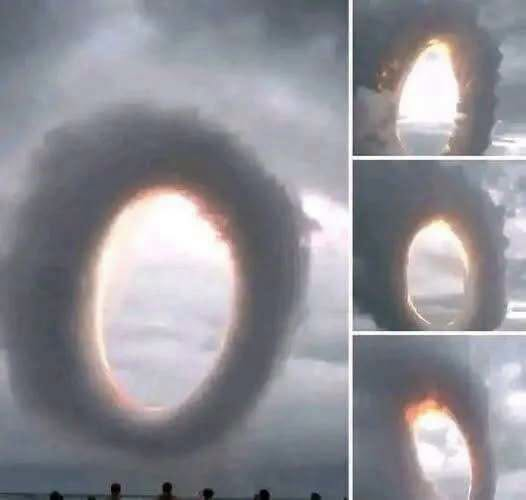
When a glowing, circular hole suddenly appears in the clouds with an otherworldly shimmer, it’s easy to understand why people reach for dramatic explanations. Videos of these rare sky events spread rapidly online, sparking theories ranging from dimensional gateways to secret experiments. In reality, what looks like a portal ripping through the atmosphere is a fascinating natural occurrence known as a fallstreak hole or hole-punch cloud. Understanding the science behind it reveals just how remarkable our planet’s weather systems can be.
These formations occur in mid-level clouds containing supercooled water droplets — tiny bits of liquid water that remain unfrozen even well below freezing temperatures. They exist in a delicate, unstable state, waiting for a disturbance to trigger change. When that trigger arrives, often from an airplane flying through the cloud layer, the droplets rapidly freeze into ice crystals. The crystals grow heavier and fall, creating a clear, expanding void in the cloud deck. Sunlight refracting through the ice crystals produces the beautiful glowing or iridescent edges that captivate viewers.
Aircraft frequently play a role in initiating these displays. As planes pass through supercooled layers, pressure changes and wing disturbances provide the exact catalyst needed for the chain reaction. This explains why many observed holes appear remarkably symmetrical and circular. The ice crystals eventually evaporate in drier air below, leaving behind the striking circular gap. While they can look supernatural in photos and videos, they result from straightforward physics involving temperature, moisture, and atmospheric dynamics.
Social media amplifies the wonder and speculation surrounding these events. Within minutes of sightings, posts flood platforms with questions about government involvement, UFO activity, or apocalyptic signs. This reaction stems from our natural fascination with the unknown and the human tendency to seek extraordinary explanations for unusual sights. Yet meteorologists consistently identify them as hole-punch clouds, documented and studied for decades. Scientific literacy helps separate genuine mysteries from beautiful but explainable phenomena.
Similar atmospheric wonders include lenticular clouds, which resemble flying saucers, or crepuscular rays that appear as beams of light through clouds. Each demonstrates nature’s ability to create awe-inspiring visuals through everyday processes. Appreciating these moments encourages us to look up more often and notice the dynamic theater playing out overhead. Our atmosphere is a constantly shifting canvas influenced by wind patterns, temperature variations, and human activity.
For sky watchers hoping to spot one, certain conditions increase chances. Mid-level altocumulus clouds in colder months provide prime settings. Airports or busy flight paths sometimes see more frequent occurrences due to aircraft traffic. When conditions align, the result can be a breathtaking display that reminds us of Earth’s capacity for surprise. Capturing clear photos or videos helps share the beauty while contributing to citizen science observations.
Understanding these phenomena doesn’t diminish their magic — it deepens appreciation for the intricate systems governing our world. Physics produces effects that rival any science fiction imagery, highlighting how much remains to discover even in familiar skies. Encouraging curiosity about weather and atmospheric science fosters greater environmental awareness and critical thinking when sensational claims circulate online.
The next time you witness or see footage of a glowing hole in the clouds, remember the elegant science at work. Supercooled droplets, phase changes, and falling ice crystals create moments of wonder that connect us through shared amazement. These events invite us to pause, look upward, and marvel at a planet that continues revealing its secrets in spectacular fashion. Nature doesn’t need portals to other dimensions when it can craft such breathtaking artistry right above our heads. Keep watching the skies with open eyes and an open mind — the real explanations often prove just as captivating as the myths.
Most Popular!
-
 Every Store Told My Daughter She Was “Too Big” for Prom – Until Her Best Friend’s Secret Left Everyone in Tears
-
The Wrong Number That Saved a Mother’s Life: How a Mistaken Text to a Billionaire Changed Everything
-
My Mother Threw My Clothes on the Porch After a Long Nursing Shift – But She Had No Idea the House Was Actually Mine
-
I Nearly Walked Out on My Newborn Daughter – Until My Wife’s Shocking Revelation Changed Everything
-
Veteran Astronaut Sounds Alarm on Artemis II: Why Safety Culture Matters for Humanity’s Return to the Moon
-
When My High School Bully’s Husband Called 20 Years Later – The Shocking Cycle of Cruelty That Finally Ended
-
ABC News Interrupts Programming for Major Trump Update: What Breaking News Culture Reveals About Our Media Landscape
-
That Tiny Loop on the Back of Your Shirt Has a Surprising History – From Practical Tool to Secret Social Signal