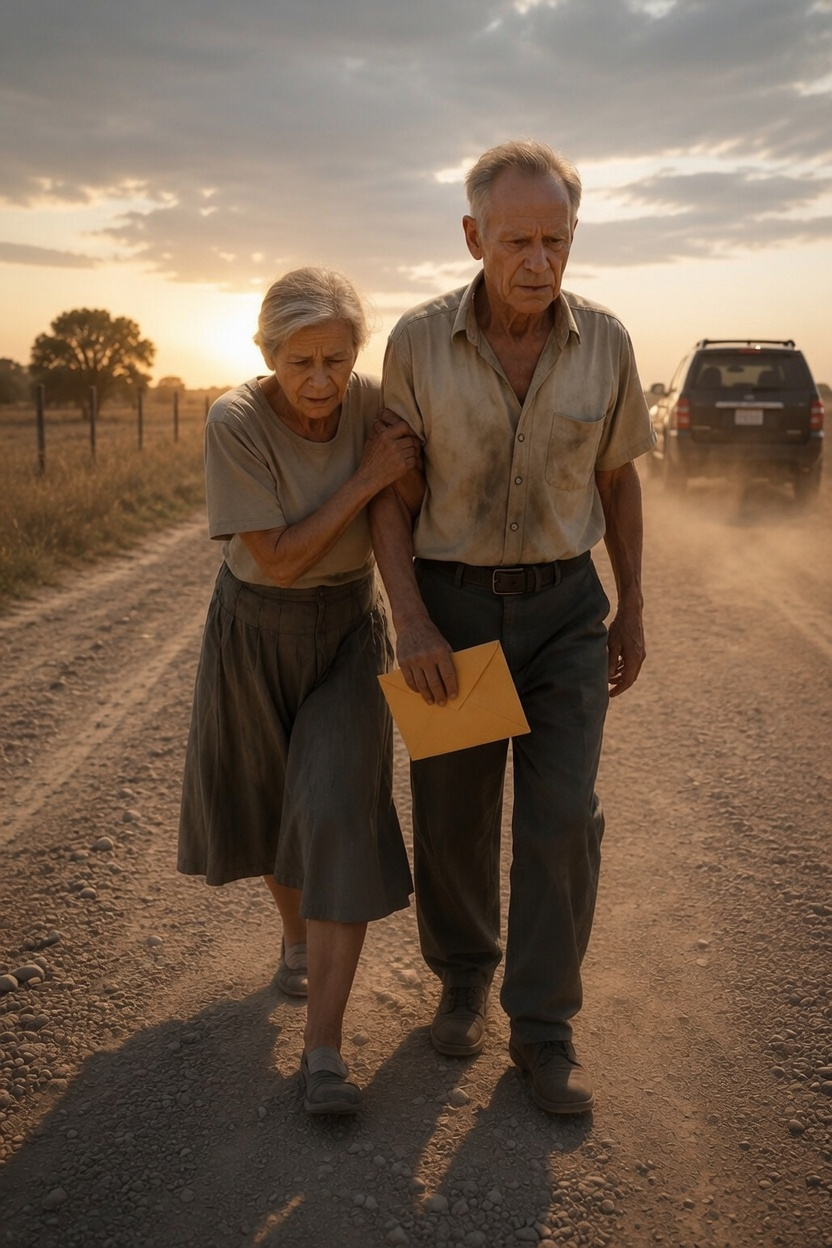
The sun was already dipping low behind the jagged hills when the car door slammed shut for the last time. I stood there on the side of that empty desert road, holding my husband’s trembling hand, watching the taillights of my own children’s vehicles disappear into the dusty horizon. The silence that followed was heavier than any words could ever be. At seventy-two years old, after raising three children, sacrificing decades of my life for their dreams, and building what I thought was a unbreakable family bond, I found myself abandoned like an old piece of furniture no one wanted anymore. My daughter Sarah, the oldest and once the closest to me, didn’t even look back. My son Michael, who had always been the golden boy, simply drove away without a single wave. And my youngest, Rebecca, who used to call me every Sunday without fail, rolled up her window and left us standing there with nothing but two small suitcases and the clothes on our backs.
My husband Robert squeezed my hand gently. He was eighty now, his body weakened by years of hard work and the arthritis that had slowly stolen his mobility. “It’s okay, Eleanor,” he whispered, his voice cracking. “We’ll figure this out.” But I could see the fear in his eyes. We were miles from the nearest town, with no cell service, no water beyond what was left in our small bottles, and no idea how we would survive the night. The betrayal burned hotter than the desert sun that had beaten down on us all day. These were the same children I had carried in my body, stayed up nights with when they were sick, worked double shifts to put through college, and sacrificed my own dreams to give them better lives. And now, in what they thought was their moment of victory, they had left us to die on the side of a road.
The story didn’t begin that morning. It had been building for years, like cracks in the foundation of a house no one wanted to acknowledge. After Robert retired from the construction company he had built from nothing, our finances should have been secure. We had the family home paid off, a decent pension, and savings we had carefully accumulated over decades. But our children saw dollar signs instead of parents. Sarah, now a successful real estate agent, constantly complained about her “struggling” lifestyle despite her luxury car and designer clothes. Michael, a businessman who jumped from one failing venture to another, always had a new “opportunity” that required “just a little help from family.” Rebecca, the youngest, had never held a steady job, preferring instead to live off whatever support we provided while chasing vague dreams of becoming an influencer.
I had tried to set boundaries. I really had. But every time I said no, the guilt trips would begin. “After everything we’ve been through as a family…” Sarah would say with tears in her eyes. “You always favored the others,” Michael would accuse. Rebecca was the most direct: “You owe us this. You brought us into the world.” Robert, ever the peacemaker, would often give in, dipping into our savings to “help them through this rough patch.” I watched our retirement fund dwindle, our emergency savings disappear, and our golden years become a constant source of stress rather than the peaceful chapter we had planned.
The final straw came when Robert’s health took a serious turn. His doctor diagnosed him with advanced heart failure, warning that without proper care and medication, he might not have much time left. The medical bills started piling up, and our savings were nearly gone. That’s when the children called a “family meeting” at our house. I thought they were coming to offer support. Instead, they presented a plan they had already drawn up: selling our home, moving us into a cheap assisted living facility, and dividing the proceeds among themselves. “It’s for your own good,” Sarah explained with that practiced smile. “You’ll have professional care, and we can use the money to secure our futures.” Michael nodded enthusiastically. Rebecca looked at her phone the whole time.
Robert and I refused. The house was our home, filled with memories of raising them, of holidays and birthdays, of the life we had built together. But our refusal only made them angrier. Over the next few weeks, the pressure intensified. They stopped visiting. They spread rumors to extended family that we were becoming “difficult” and “unreasonable.” And then came the road trip — the one they insisted would be a “family bonding experience” to discuss “next steps.” We should have known better. But hope dies hard when it comes to your own children.
They drove us out to the desert under the pretense of visiting an old family cabin. Halfway there, the car “broke down.” The children got out, made phone calls, and then announced they had arranged for a tow truck. But instead of waiting with us, they piled into Sarah’s SUV and drove away, leaving us with a single bottle of water and instructions to “wait here.” Robert tried to stay strong for me, but I could see the pain and confusion in his eyes. We sat on the side of that road for hours as the sun beat down and the realization slowly sank in: our children had planned this. They had intentionally stranded us, hoping the desert would do what they didn’t have the courage to do themselves.
As night fell and the temperature dropped, I reached into my purse and pulled out the small black notebook I had been carrying for months. Robert looked at me with surprise when I opened it under the moonlight. “What is that?” he asked quietly.
I took a deep breath and began to explain the secret I had been hiding from everyone — including him at first.
Years earlier, when I first noticed the pattern of financial manipulation, I started preparing. While the children thought I was simply the quiet, compliant mother who baked cookies and never caused trouble, I had been meeting with lawyers, financial advisors, and estate planners in secret. I created a revocable living trust that protected our assets from being easily seized or divided. I transferred ownership of the house and the small investment accounts into the trust, with specific provisions that prevented any single child from gaining control. I also set up a separate emergency fund that none of them knew about — money I had quietly saved from part-time work and careful budgeting over the years. Most importantly, I had documented everything: every request for money, every broken promise, every instance of emotional manipulation. Those records were now safely stored with my attorney.
When the sun rose the next morning, a kind truck driver found us and gave us a ride to the nearest town. From there, I called my lawyer. Within forty-eight hours, legal notices were delivered to each of our children. The house was secure. The accounts were protected. And the children were informed that any further attempts to access our assets would result in legal action. Sarah called first, furious and demanding to know what I had done. Michael followed, alternating between threats and tears. Rebecca sent a long text message filled with accusations of selfishness. I read each message carefully, then deleted them without responding. For the first time in years, I felt something I had almost forgotten: peace.
The weeks that followed were difficult but necessary. Our children tried everything — guilt trips, public accusations, even attempts to declare us incompetent. But the documentation and legal protections held strong. Eventually, they stopped calling. The silence was painful at first, but it also brought clarity. We had spent decades enabling their entitlement, believing that love meant endless giving. Now we understood that real love sometimes requires firm boundaries.
Robert and I moved into a smaller, more manageable home closer to town. We sold some assets to cover medical expenses and created a simple but comfortable life. We planted a garden together, took gentle walks when his health allowed, and spent quiet evenings talking about the past without the weight of resentment. The children’s absence left holes, but those holes were gradually filled with new connections — neighbors who became friends, support groups for seniors, and the deep satisfaction that comes from living on your own terms.
Looking back, that day on the deserted road wasn’t the end of our story. It was the beginning of our freedom. I had spent years hiding my preparations not because I didn’t trust my husband, but because I knew our children would try to interfere if they discovered them. That quiet planning, done in the shadows while pretending to be the compliant mother, became our salvation.
This experience taught me lessons I wish every parent would learn before it’s too late. First, love should never be confused with endless financial support. Children who are capable of working should be encouraged to stand on their own feet. Second, proper estate planning isn’t about distrust — it’s about protection. Update your wills. Create trusts. Document everything. Third, never underestimate a mother’s quiet strength. While I appeared soft and accommodating on the surface, I was preparing for the worst in the background. That preparation wasn’t born from paranoia. It was born from watching my children’s behavior over many years and realizing they could not be trusted with our future.
If you’re a parent reading this and recognizing patterns of entitlement in your own children, please take action now. Have the difficult conversations. Set clear boundaries. Protect your assets and your peace of mind. Don’t wait until you’re stranded on a deserted road to realize that love without limits can become a dangerous trap.
My story doesn’t have a fairy-tale ending where everyone reconciles and lives happily ever after. Some relationships cannot be repaired once trust has been completely shattered. But it does have a peaceful ending — one where Robert and I can enjoy our remaining years without the constant stress of manipulation and greed. We have each other, our health (as much as it allows), and the dignity of knowing we stood up for ourselves when it mattered most.
The children eventually tried to reach out again, but the conversations were superficial and short. They wanted access to the money they believed was theirs. We offered them love and relationship instead. They chose not to accept it. That choice was theirs to make. Ours was to protect what remained of our lives and our marriage.
Standing on that dirt road that day, watching my children drive away, I felt abandoned and betrayed. But I also felt something else — a quiet strength rising from deep within. I realized I wasn’t just fighting for our house or our savings. I was fighting for the dignity Robert and I had earned together. For the right to grow old in peace. For the ability to protect the life we had built without interference from those who only saw dollar signs when they looked at us.
That fight changed me. It made me stronger, wiser, and more determined to live the rest of my life on my own terms. The dirt road wasn’t the end of my story. It was the beginning of a new chapter — one written with courage, clarity, and the deep satisfaction that comes from refusing to let anyone take what you’ve rightfully earned.
If you’re facing your own family struggles, remember this: you are allowed to protect yourself. You are allowed to say no. You are allowed to choose peace over pretense. And sometimes, the greatest act of love you can offer your children is teaching them that actions have consequences — even when those actions come from your own flesh and blood.
I stood on that dirt road and chose myself. And I’ve never regretted it for a single day since. Because in letting go of the need to please everyone, I finally found the freedom to live for the two people who mattered most: my husband and me. And that, more than any inheritance or family approval, is the real victory worth celebrating.
Most Popular!
-
 I Opened the Box Nine Months After My Husband’s Funeral — And the Secret Inside Destroyed the Family That Betrayed Him
-
She Locked Me in the Bathroom During Labor So I Wouldn’t Ruin Her Daughter’s Wedding — But the Photo Changed Everything
-
I Was Lying Helpless on the Living Room Floor When My Husband Whispered the Words That Finally Set Me Free
-
When My Husband Kicked My Pregnant Belly and Whispered Those Words, I Knew I Had to Save My Baby — And Myself
-
My Sister Ripped My Shirt Open on a Luxury Beach in Front of Navy Officers — And the Truth That Came Out Changed Our Family Forever
-
I Pretended to Be the Quiet Wife for Years — Until My Husband’s Mistress Posted That Video and I Finally Showed Who Really Held the Power
-
I Was Eight Months Pregnant and Secretly Shopping for My Baby — When I Ran Into My Ex-Husband and Everything Changed
-
The Most Feared Man in Chicago Walked Into a Hospital With His New Girlfriend — And Everything Changed in One Night