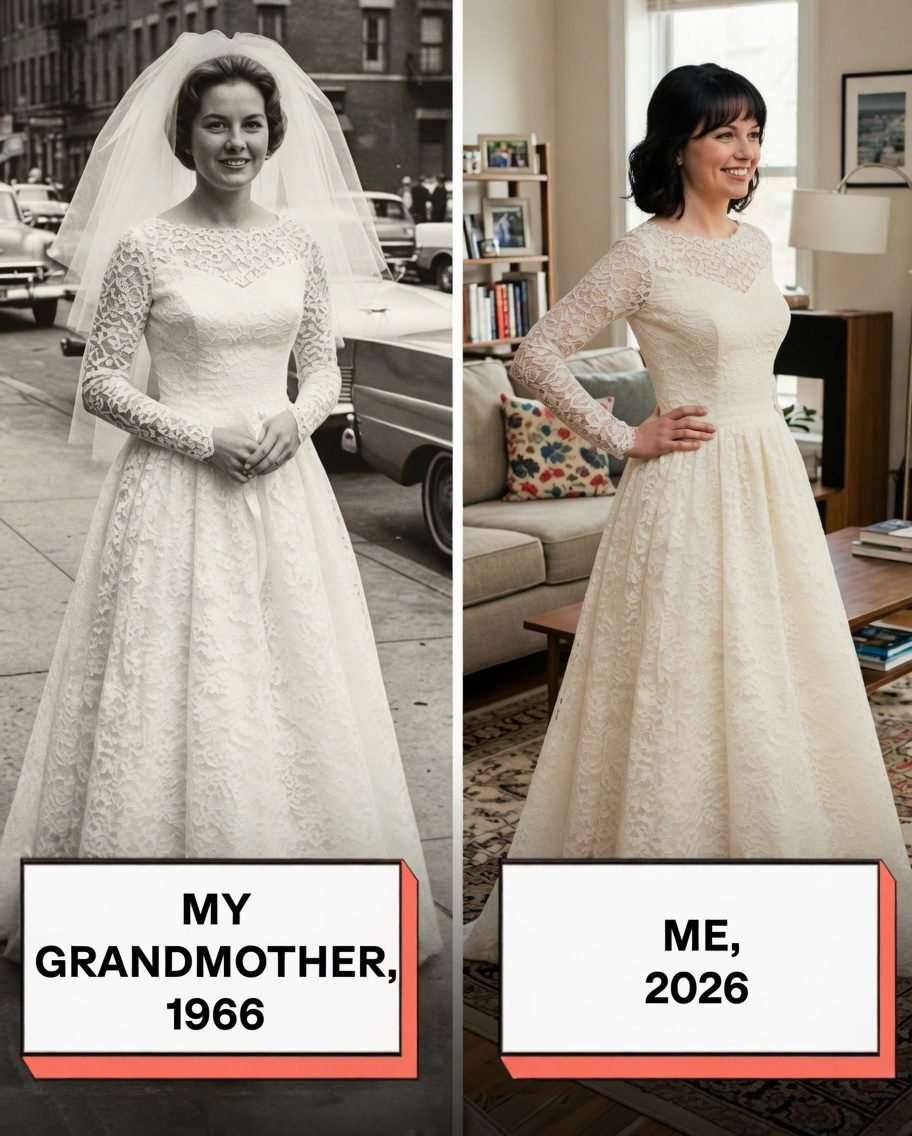
Some wedding traditions feel like carrying love from one generation to the next. For me, slipping into my grandmother’s 1972 wedding dress was supposed to be that kind of moment — a way to honor the woman who had been my biggest cheerleader, my secret-keeper, and the glue that held our family together after my parents’ divorce. The dress was simple yet elegant: soft ivory satin with hand-stitched lace sleeves and a modest train that whispered when I moved. Nana had worn it when she married my grandfather, and she made me promise I would wear it on my own big day. “It brings good luck,” she always said with that gentle smile. I believed her. Until the morning of my final fitting, when I found a small, yellowed envelope sewn into the lining — a note that didn’t just reveal a secret. It rewrote thirty years of family history and forced me to question every story I thought I knew about love, loyalty, and the woman I admired most.
I was alone in the bridal boutique’s fitting room when I noticed the slight bulge near the waist seam. Curious, I carefully unpicked a few stitches and pulled out the envelope. Inside was a single sheet of paper in Nana’s elegant handwriting, dated just weeks before she passed away from cancer two years earlier. The note began with love but quickly turned into a confession that left me sitting on the floor in my wedding dress, tears streaming down my face.
“My dearest granddaughter, if you’re reading this, you’re about to walk down the aisle in the dress that once held my greatest joy and my deepest regret. Your grandfather was not your mother’s biological father. I had an affair during a very dark time in our marriage — a brief moment of connection with a man who made me feel seen when I felt invisible. I chose to stay and build the life you know, but the guilt has followed me every single day. Your mother never knew. I couldn’t bear to break her heart. Now I pass that truth to you with this dress. Wear it with courage. Love honestly. And know that even imperfect love can create something beautiful.”
The words hit like a physical blow. My grandmother — the woman who baked cookies for every birthday, who sat with me through every heartbreak, who taught me that family was everything — had been living with this secret for over thirty years. My mother had grown up believing her father was the man who raised her, the grandfather who taught me to fish and told me bedtime stories. The entire foundation of our family story was built on a lie my grandmother carried to her grave.
I sat there for what felt like hours, the dress suddenly feeling heavier than before. My wedding was only nine days away. My fiancé, Ben, knew nothing about any of this. My mother was already emotional about me wearing Nana’s dress. How could I walk down the aisle knowing what I now knew? How could I keep this from my mother on what should be one of the happiest days of her life?
I made a decision that morning. I would tell her. Not to hurt her, but to free us both from the weight of a secret that had lived too long in the shadows.
The conversation with my mother was one of the hardest things I’ve ever done. We sat in her living room with the dress between us on the couch. When I handed her the note, she read it slowly, her hands trembling. For a long moment she didn’t speak. Then she started crying — not the angry, bitter tears I expected, but quiet, almost relieved ones. “I always felt something was missing,” she whispered. “There was a distance I could never explain. Now I understand.”
What followed was a beautiful, painful unraveling of family history. My mother decided she wanted to know more about her biological father. Through old letters and careful research, we discovered he had passed away years ago, but he had left behind a sister who welcomed us with open arms. We found cousins we never knew existed. Old wounds began to heal as we chose understanding over anger. My grandmother’s secret didn’t destroy us. It gave us the chance to know each other more fully.
My wedding day became something deeper than I had planned. I walked down the aisle in Nana’s dress carrying not just love, but truth. I felt her with me more strongly than ever — not as the perfect grandmother, but as a real woman who had made hard choices out of love and fear. During the reception, my mother and I shared a dance. She told me she was proud of me for choosing honesty. The dress that once hid a painful secret now carried healing instead.
This experience taught me several profound lessons about family, secrets, and the courage it takes to face the truth:
- The women who came before us were far more complex than the polished stories we inherit.
- Secrets don’t die with the people who keep them — they wait for someone brave enough to face them.
- Honesty, even when painful, creates stronger bonds than comfortable lies ever could.
- Family isn’t about perfection. It’s about choosing love and understanding even when the truth is messy.
- Sometimes the most meaningful heirlooms are the ones that carry both joy and sorrow.
My grandmother’s dress still hangs in my closet today. It no longer feels like a symbol of a perfect past. It feels like a testament to resilience, love, and the bravery required to live honestly. I wear it sometimes on quiet anniversaries, remembering the woman who taught me that even imperfect choices can lead to beautiful lives.
If you’re carrying a family secret or suspect there are truths hidden in your own history, consider this: the truth may hurt at first, but it almost always leads to freedom. My grandmother carried her secret for decades out of love. I chose to speak it out of love too. Both choices came from the same place — wanting the best for the people we care about.
The wedding I almost canceled became the beginning of something more authentic. The dress that once hid pain now carries healing. And the grandmother I thought I knew became even more extraordinary once I saw her full, complicated, human story.
Some secrets are meant to stay buried. Others wait patiently in the lining of a wedding dress until the right person finds the courage to read them. I’m grateful I was that person. And I’m even more grateful that my grandmother trusted me with her truth, even from beyond this life.
Most Popular!
-
 Selfish Husband Leaves Pregnant Wife Stranded on Front Steps with a Broken Leg to Save His Back for Boys’ Trip – But His Grandfather Delivers the Ultimate Justice
-
Iconic Bond Girl Walked Away from Hollywood Fame and Fortune for the Love of This Legendary Beatles Icon
-
Millions of Drivers Shocked to Discover True Meaning of Mysterious Letter “E” Hidden on Vintage Car Gear Sticks
-
Storage Wars Legend Darrell “The Gambler” Sheets Found Dead in His Arizona Home After Tragically Long and Secret Battle
-
Generous Nine-Year-Old Sells Her Beloved Toy Collection to Help a Friend – But Next Day Furious Parents Confront Her Mother with a Life-Changing Truth
-
Terrifying Midnight Panic Ends in Hilarity After Family Investigates Mysterious Spiky Object in Bed Sheets
-
Jennifer Aniston’s Secret Heartbreak: The Tragic Losses That Left the Friends Star Grieving Alone
-
Why Do My Privates Smell? The Honest Guide to Understanding, Preventing, and Fixing Unpleasant Odors Down There