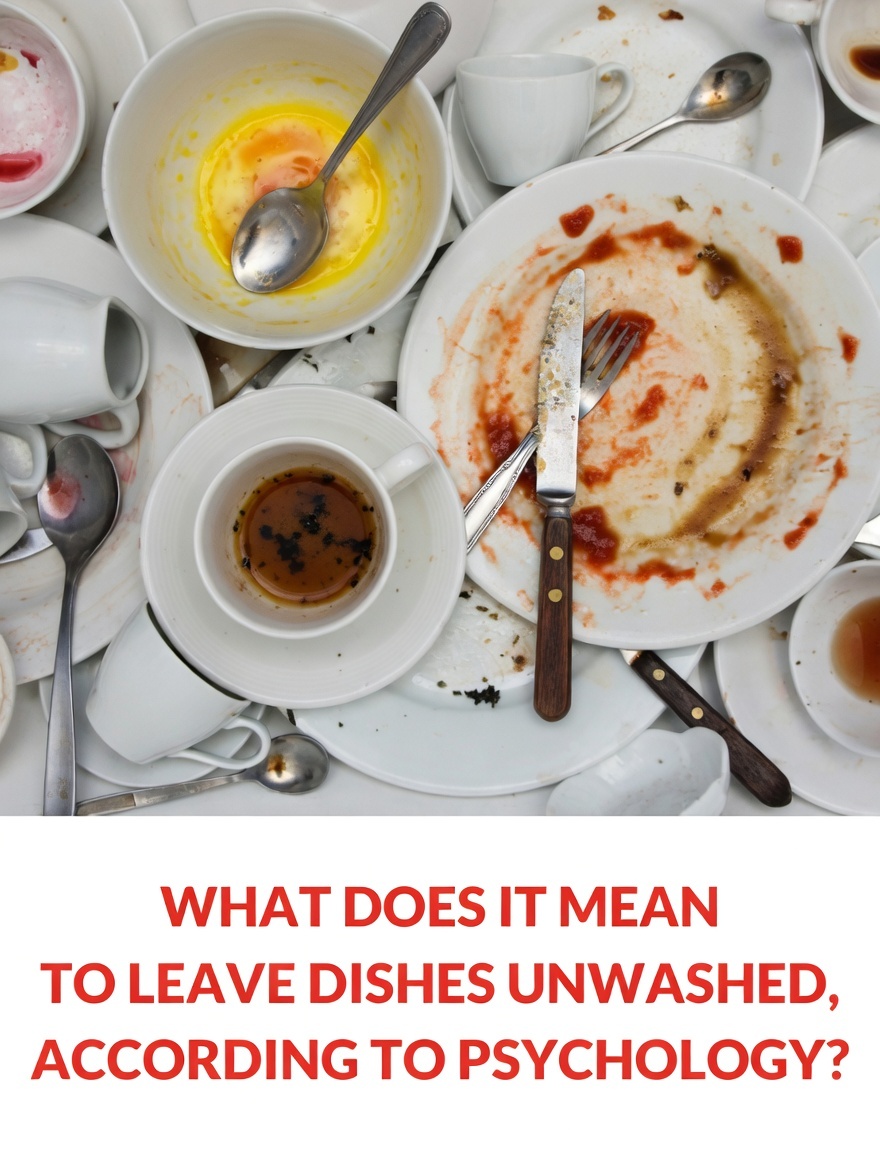
The dishes sit there. One plate becomes three. Three become a dozen. The sink slowly disappears under a growing tower of plates, mugs, pots. You walk past it every day — sometimes you stare at it, sometimes you pretend it’s not there. You tell yourself: “I’ll do it tomorrow.” Tomorrow comes. The pile grows. And quietly, without you noticing, the dishes stop being just dishes.
Therapists see this pattern constantly — especially in people over 40. It’s rarely about laziness. It’s almost always about something deeper.
Here are the most common psychological meanings behind letting dishes pile up:
- Emotional Overload / Avoidance When life feels too heavy (job stress, aging parents, kids leaving home, health worries, marital tension), the brain protects itself by shutting down non-essential tasks. Dishes become symbolic of “everything I can’t handle right now.” Ignoring them is a subconscious way of saying: “If I don’t look at the mess, maybe the bigger mess inside me will stay hidden too.”
- Perfectionism Paralysis Many high-achieving adults over 40 carry a hidden belief: “If I can’t do it perfectly (soak, scrub, dry, put away exactly right), I won’t do it at all.” The pile grows because starting feels like failure if it won’t be flawless. One woman told her therapist: “I’d rather have a dirty kitchen than a half-clean one. At least dirty is honest.”
- Depression’s Invisible Weight In clinical depression (even mild or high-functioning versions), executive function drops. The brain’s “start task” button malfunctions. You want to wash the dishes. You know you should. You feel shame for not doing it. But the neural signal to stand up and begin simply never arrives. The pile becomes visual proof of “I’m not okay,” which deepens the shame cycle.
- Resentment / Passive Protest In relationships, unwashed dishes can become a silent protest. “If I’m always the one cleaning up everyone’s mess — emotional and literal — maybe I’ll stop. Maybe someone will finally notice.” The pile is communication when words have failed.
- Grief & Transition Overload After major life changes (divorce, empty nest, death of a parent/spouse, retirement), many people unconsciously let household tasks slide. The dishes become a physical representation of paused life: “I’m not ready to clean up and move forward yet.”
Why letting them pile up hurts more than we realize:
- Visual clutter spikes cortisol (stress hormone) every time you see it.
- Chronic shame erodes self-worth (“I can’t even keep my kitchen clean”).
- The longer it sits, the bigger the mental barrier to starting — creating a self-fulfilling cycle of avoidance.
- In shared homes it quietly breeds resentment between partners or roommates.
Gentle ways to break the cycle (from therapists who specialize in this):
- Start with the “one thing” rule: wash only one item. Often momentum kicks in.
- Use a timer — 7 minutes max. You’re allowed to stop after.
- Play music or a podcast — make it less lonely.
- Reframe: “I’m not cleaning dishes. I’m creating calm for tomorrow’s me.”
- Ask for help without shame — “I’m overwhelmed. Can we do this together?”
- If it’s depression-related, talk to a doctor/therapist — sometimes medication or therapy lifts the executive function block.
One 52-year-old client told her therapist after finally tackling a three-week pile: “I cried the whole time I washed them. Not because it was hard — because I realized how much I’d been punishing myself by letting them sit there. It wasn’t about the dishes. It was about believing I didn’t deserve a clean space.”
So tonight — if the sink is calling your name (or screaming it) — don’t aim for perfection. Aim for one dish. One small act of kindness toward yourself. The rest will follow.
The conversation is just getting started — and for countless people over forty quietly drowning in small daily tasks, it is already changing everything for the better.
A clean sink won’t fix everything. But it can be the first gentle signal to your nervous system that you’re allowed to feel safe again. Start small. You deserve that peace. 🧼❤️
Most Popular!
-
 The Ultimate Wedding Revenge: When the Mother Who Abandoned Her Six Daughters Showed Up with Her Millionaire Boss, the Bride Opened a Box That Destroyed Lives Forever
-
The Beach Shaming Disaster: What My 8-Year-Old Said to the Prying Stranger Left Everyone Speechless
-
My Husband Abandoned Me With Twin Babies for a Luxury Fishing Trip — When He Returned, I Had Already Packed His Bags
-
The Three-Dollar Miracle: How a Dust-Covered Vase Revealed a Heartbreaking Decades-Old Secret
-
The $80,000 Battle to Erase a Birthmark: Why One Mother Risked Everything for Her Daughter’s Future
-
The Silent Thief: Why Millions of Men Are Living with a Time Bomb They Can’t See
-
The Final Curtain Falls: Beloved Sanford and Son Legend Hal Williams Gone at 91
-
Found at a Yard Sale: This “Useless” Vintage Contraption Is Actually a Forgotten Piece of Human History