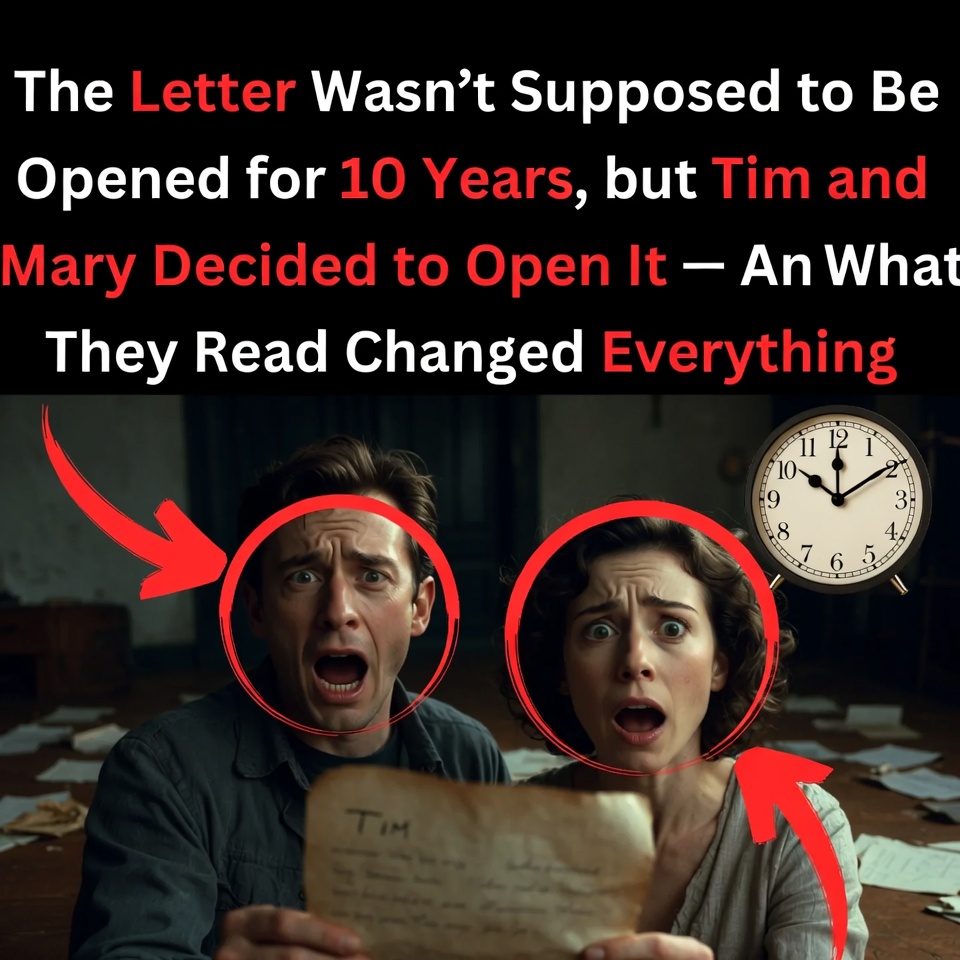
The safe had been in the basement since Tim’s father passed in 2015. It was heavy, fireproof, combination-locked — the kind of thing you buy when you think your life needs protecting. Inside were the usual documents: deeds, insurance policies, the will. And one plain white envelope, sealed with red wax, his father’s handwriting on the front: “Tim & Mary — Do NOT open until 2025. This is for both of you.” For ten years they honored the request. Life moved fast — kids grew up, grandkids arrived, retirement planning took over. But every time Tim opened the safe for paperwork, that envelope stared back like a question he wasn’t ready to answer.
Last Tuesday night they were alone in the house. The kids were away, the grandkids asleep at their daughter’s. Tim turned 58 that week. Mary joked, “If we wait until 2025 we might forget how to read.” They laughed, but the laugh was nervous. They carried the envelope upstairs to the kitchen table. Tim slid his pocketknife under the flap. Mary held her breath. One sheet of paper. One page. One bombshell that changed everything.
The first line was an apology. “I’m sorry I never told you the truth about the farm.” Tim’s father had always said the family farm — 80 acres in rural Pennsylvania — was paid off, passed down free and clear from his own father. It was supposed to be their retirement safety net: sell it when the time came, move to something smaller, leave the rest to the grandkids. But the letter revealed the farm had a reverse mortgage taken out in 2005. Payments deferred until death. Now that his father was gone, the lender had quietly started the clock. The balance had grown to over $420,000. The farm — worth maybe $650,000 on a good day — was no longer theirs.
What really broke them was the second paragraph. Tim’s father admitted he took the reverse mortgage to pay off gambling debts he never told anyone about. Not Tim. Not Mary. Not even his own wife before she passed. He thought he could outlive the loan or win enough to pay it back. He didn’t. The shame had kept him silent. He wrote that he hoped by 2025 the debt would be forgotten or forgiven — or that Tim would have enough saved to save the farm. He was wrong on both counts.
The financial reality landed like a physical blow. They had counted on that farm equity for retirement — downsizing, healthcare costs, maybe helping their daughter with a house down payment. Now it was underwater. The lender had already sent notices they hadn’t seen. Foreclosure proceedings could start any month. At 58 and 56, with modest 401(k)s and Social Security still years away, losing the farm meant losing their biggest asset. They sat in silence as the numbers sank in.
Health effects showed up almost immediately. Tim’s blood pressure spiked that night. Mary couldn’t sleep. Stress from financial betrayal can accelerate every age-related issue — heart strain, insomnia, depression. For couples over forty who thought their biggest worries were behind them, this kind of late-life shock feels like a second midlife crisis.
The emotional toll was the deepest cut. Tim felt betrayed by the man he had idolized. Mary felt the loss of security she had trusted in. They had raised two kids in that house, hosted every holiday, buried pets in the backyard. The farm wasn’t just property — it was memories. Now it felt tainted. They argued — quietly at first, then louder — about whether to fight the foreclosure or walk away.
The broader conversations this has started in support groups and online forums are raw. Adult children discovering parents’ secret debts. Widows finding reverse mortgages they never knew existed. Many in their fifties and sixties are quietly checking their own parents’ paperwork, updating their own plans, and talking openly about money for the first time. The awareness spreading is painful but necessary because it touches every part of daily life we care about — our legacy, our retirement security, and the trust we place in family.
Protective instincts kicked in hard. They called a lawyer the next morning. They contacted the lender. They started documenting every payment Tim’s father had made on the original mortgage before the reverse. They told their kids the truth — no sugarcoating. The honesty hurt, but hiding it hurt more. They’re fighting to keep the farm — refinancing, selling off acreage, anything.
Many of us over forty are now facing our own versions of this — parents gone, secrets surfacing, futures suddenly uncertain. Tim and Mary’s story became one more reminder that love and trust don’t always protect us from financial reality — but facing it together might.
The emotional reflection has been the hardest part. There is something deeply lonely about discovering a parent wasn’t who you thought. You grieve the image you held. But in the pain they’ve found something new: honesty. They’re talking more — about money, fears, hopes. They’re rebuilding trust, one difficult conversation at a time.
Friends who have heard their story keep sharing how it prompted them to dig into their own family papers. The conversations they’re having only deepen the sense that hidden debts and secrets are more common than we admit — and facing them is the only way forward.
Looking back at the promise Tim made to his father — to open the letter in 2025 — he realizes waiting would have been worse. The truth came early, painful, but early enough to act. At 58 and 56 they still have time to rebuild. Not the same future they planned, but a new one — honest, hard-won, together.
So if you’ve ever found a sealed letter, a hidden document, or a secret you weren’t supposed to know — take a breath and decide when to face it. Waiting can cost more than knowing. Share this with the person you share a life with because sometimes the most powerful thing we can do is open the envelope before it’s too late. The conversation is just getting started, and for countless couples over forty it is already changing everything for the better.
Most Popular!
-
 The Ultimate Wedding Revenge: When the Mother Who Abandoned Her Six Daughters Showed Up with Her Millionaire Boss, the Bride Opened a Box That Destroyed Lives Forever
-
The Beach Shaming Disaster: What My 8-Year-Old Said to the Prying Stranger Left Everyone Speechless
-
My Husband Abandoned Me With Twin Babies for a Luxury Fishing Trip — When He Returned, I Had Already Packed His Bags
-
The Three-Dollar Miracle: How a Dust-Covered Vase Revealed a Heartbreaking Decades-Old Secret
-
The $80,000 Battle to Erase a Birthmark: Why One Mother Risked Everything for Her Daughter’s Future
-
The Silent Thief: Why Millions of Men Are Living with a Time Bomb They Can’t See
-
The Final Curtain Falls: Beloved Sanford and Son Legend Hal Williams Gone at 91
-
Found at a Yard Sale: This “Useless” Vintage Contraption Is Actually a Forgotten Piece of Human History