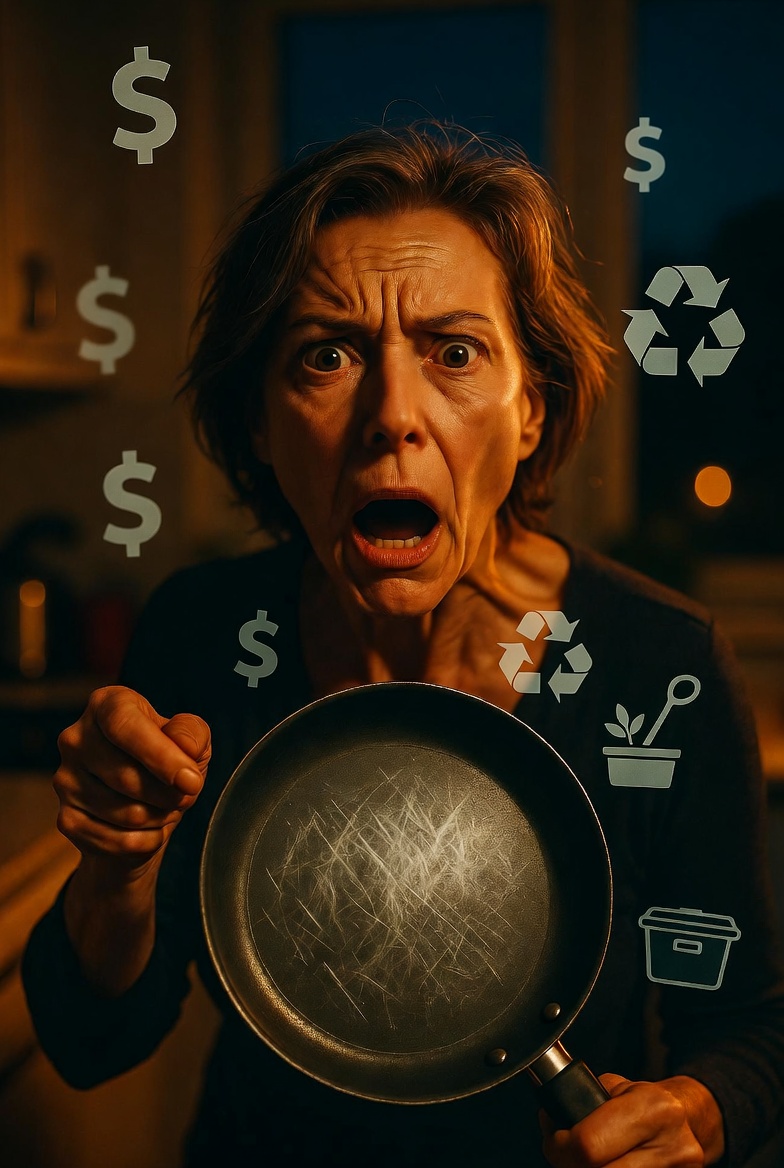
The day I stood over the trash can ready to toss three scratched-up nonstick pans, I felt guilty. They weren’t even that old — maybe four years — but the coating was flaking, the bottoms warped, and every time I cooked eggs they stuck like glue. I had already replaced two others and hated the waste. My neighbor saw me hesitating and said, “Don’t throw them out. I’ve been reusing ruined pans for years — saves a fortune.” I laughed at first, but when she showed me what she did with hers, I brought mine back inside and started experimenting. What I discovered changed how I look at kitchen “junk” forever.
Like so many of us over forty who have spent decades stretching every dollar — raising kids, paying mortgages, saving for retirement — we hate waste. Nonstick pans are expensive, and when they fail, most people just buy new ones. But the truth is, scratched or warped pans still have plenty of life left if you stop thinking of them as cookware and start seeing them as raw material. My neighbor’s hacks turned three “ruined” pans into tools I use every week — and saved me hundreds I would have spent replacing them.
The first reuse was the easiest and most obvious: garden markers. I cut the pans into long strips with tin snips, wrote plant names with a permanent marker, and stuck them in the soil. They last forever, don’t rot like wooden markers, and cost nothing. I used to buy plastic or metal markers every spring — $15–$20 a season. Now I have dozens from old pans.
The second trick saved even more. I flattened one pan and used it as a drip pan under my grill. No more buying disposable aluminum trays. It fits perfectly, cleans easily with a hose, and has paid for itself ten times over. For anyone who grills often, this alone eliminates a recurring expense.
The third use was for storage. I bent another pan into a shallow tray shape and lined it with felt — perfect for organizing jewelry, keys, or loose hardware in the garage. It keeps things from sliding around and looks better than plastic bins. Small, but over years those little savings add up.
The fourth hack was my favorite. I drilled holes in the bottom of one pan and turned it into a hanging planter for herbs on the porch. The scratched surface doesn’t matter — it’s decorative now. Fresh basil and rosemary all summer without buying new pots.
The fifth reuse was practical and frugal. I cut circles from the pans and used them as stencils for spray-painting garden signs. No need to buy craft stencils — just trace and cut. My garden looks custom without spending a dime.
The sixth idea came from my husband. He used a flattened pan as a heat shield behind our wood stove. It reflects heat back into the room instead of letting it escape into the wall. Our heating bills dropped noticeably last winter. For retirees on fixed income, that kind of savings feels huge.
The seventh use was for tool organization. I cut strips and bent them into hooks for hanging screwdrivers and pliers in the garage. Strong, rust-resistant, free. No more buying pegboard accessories.
The eighth hack was for pet owners. I lined the bottom of my dog’s crate with a cut pan section — easy to clean, keeps bedding from getting dirty, and lasts forever. Saved me from buying replacement trays.
The ninth reuse was sentimental. I saved the handle from one pan, polished it, and mounted it on the wall as a towel holder in the guest bathroom. Every time I see it I remember my grandmother’s kitchen — and smile instead of regretting the waste.
The tenth and final trick was the most unexpected. I used pieces of the pans to patch holes in my old wheelbarrow. The metal is durable and weather-resistant. It’s not pretty, but it works — and I didn’t have to buy a new one.
The financial relief from these hacks has been real. I used to replace nonstick pans every two to three years — $80–$120 each. Now I reuse them and spend zero. That money stays in the savings account or goes toward the grandkids’ college funds. For anyone over forty watching every dollar, these small wins feel big.
Health and environmental benefits are bonuses. Fewer pans in landfills means less waste. No more worrying about scratching coatings or ingesting flakes. My kitchen feels cleaner and my conscience lighter.
The broader impact has been surprising. I shared the hacks with my walking group and suddenly everyone was repurposing old cookware. The conversation shifted from “what should I buy next” to “what can I reuse?” — a mindset shift that saves money and reduces stress.
Protective instincts kicked in for many of us after trying these. We started looking at other “ruined” items with new eyes — old cookie sheets as garden trays, damaged skillets as plant saucers. The simple act of not throwing things away became a way to protect our wallets and our planet.
Many of us over forty are now focused on frugal living and legacy — teaching grandkids to value what they have. These hacks became one more lesson: nothing has to be wasted if you’re willing to get creative.
The emotional lift that came with this discovery surprised me most. There is something deeply satisfying about turning trash into treasure. It gives the same proud feeling you get when the garden blooms or the family budget balances. In the middle of busy lives full of bigger worries, this small act of reuse became a quiet anchor that reminded us we’re still in control.
Friends who have tried the hacks keep sharing their own creations. The stories they tell about saving money and feeling resourceful only deepen the sense that these simple ideas could be the frugal wake-up call an entire generation needs.
Looking back at those scratched pans I almost tossed I realize they were never trash. They were opportunities waiting to be seen. The 10 ways people are reusing ruined cookware can literally add dollars to our budgets and peace to our homes.
So the next time you’re about to throw out a scratched nonstick pan, pause for a second and look at it differently. You might find 10 new uses — and save money you didn’t expect. Share this with the person you share a kitchen with because sometimes the most valuable things in life are hiding in the drawer you were about to empty. The conversation is just getting started, and for countless families over forty it is already changing everything for the better.
Most Popular!
-
 The Ultimate Wedding Revenge: When the Mother Who Abandoned Her Six Daughters Showed Up with Her Millionaire Boss, the Bride Opened a Box That Destroyed Lives Forever
-
The Beach Shaming Disaster: What My 8-Year-Old Said to the Prying Stranger Left Everyone Speechless
-
My Husband Abandoned Me With Twin Babies for a Luxury Fishing Trip — When He Returned, I Had Already Packed His Bags
-
The Three-Dollar Miracle: How a Dust-Covered Vase Revealed a Heartbreaking Decades-Old Secret
-
The $80,000 Battle to Erase a Birthmark: Why One Mother Risked Everything for Her Daughter’s Future
-
The Silent Thief: Why Millions of Men Are Living with a Time Bomb They Can’t See
-
The Final Curtain Falls: Beloved Sanford and Son Legend Hal Williams Gone at 91
-
Found at a Yard Sale: This “Useless” Vintage Contraption Is Actually a Forgotten Piece of Human History