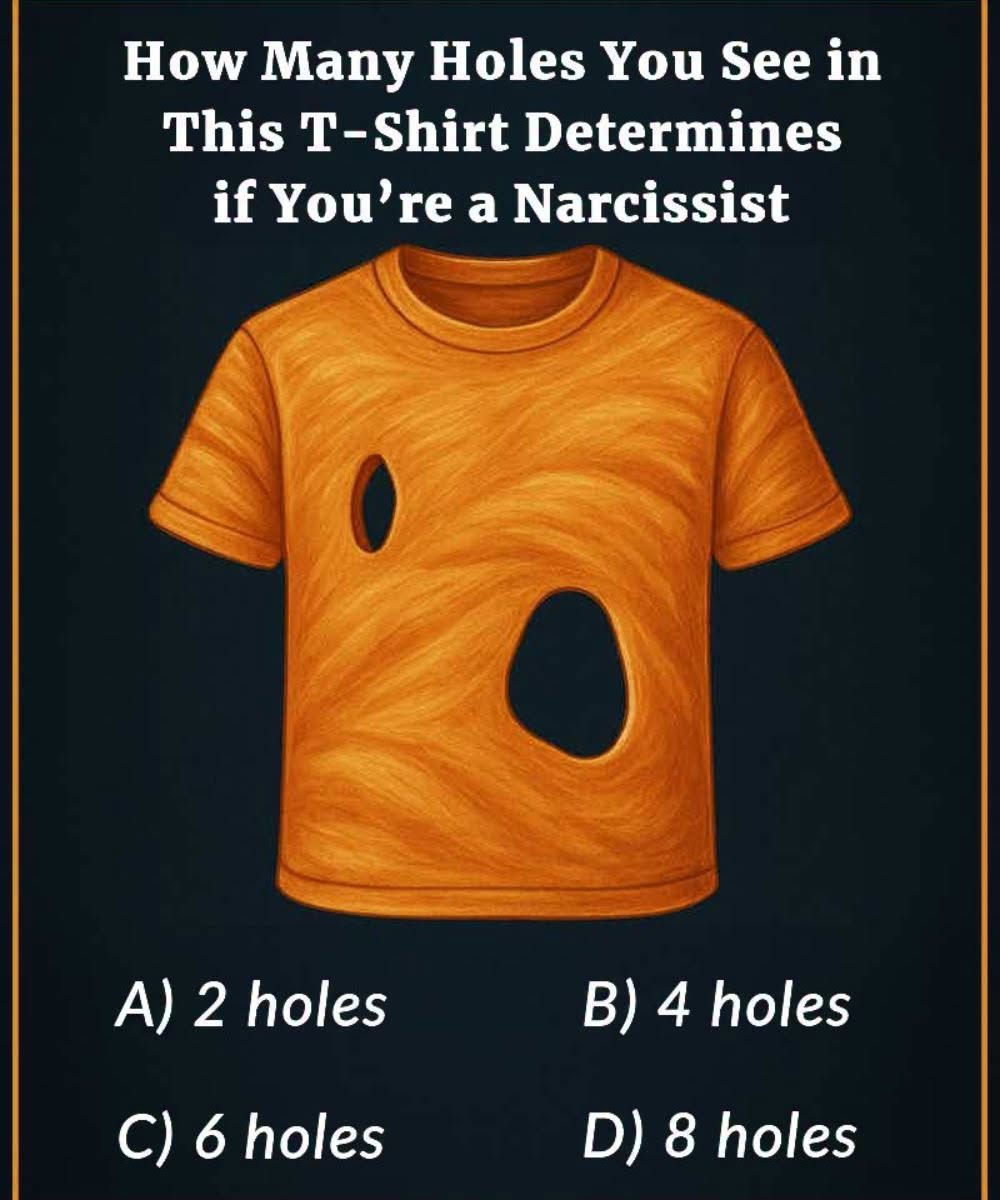
A plain T-shirt with a few visible openings can generate surprising disagreement. Ask a group of people to count the holes and you will often receive several different numbers, each defended with sincere logic. Some count only the tears in the fabric. Others include the neckline, the sleeve openings, and the bottom hem. A few multiply the through-holes by two because each creates an entrance and an exit. The object remains the same; the answers diverge because the rules of counting are never fully stated.
This small exercise exposes a larger pattern in everyday thinking. Human perception does not deliver a neutral inventory of the world. It delivers an interpretation shaped by prior assumptions about what counts as relevant. When the question is “how many holes,” the unstated definitions do most of the work. Is a hole any opening that passes through the material? Does the continuous tube of a sleeve count as one hole or two? Is the neck opening part of the shirt’s design or an interruption of it? Each choice feels obvious to the person who makes it and debatable to everyone else.
The popularity of such puzzles online is not accidental. They create a low-stakes arena in which people discover that their “clearly correct” answer is not universal. The discomfort that follows is useful. It interrupts the habit of treating personal perception as objective reality. In ordinary conversation the same mechanism operates with higher consequences. Two people can examine the same set of facts—about a workplace decision, a family conflict, or a public event—and produce incompatible summaries because they have silently prioritized different elements.
Counting holes also illustrates the speed with which the mind fills gaps. A photograph of a shirt shows only one side. Viewers routinely assume the presence of matching openings on the reverse or treat the garment as a three-dimensional object whose topology must be considered. Those assumptions are efficient. They are also unexamined. The puzzle works because it makes the usually invisible process of assumption briefly visible.
There is no single authoritative number that settles the matter for every possible definition. The value of the exercise lies in the conversation it forces rather than in a final tally. When someone arrives at a different total, the productive response is not immediate correction but curiosity about the criteria they used. That shift—from defending an answer to exploring a framework—transfers usefully to more important disagreements. It replaces the urge to declare victory with the more interesting work of understanding how another mind organized the same information.
Personality interpretations sometimes attached to these puzzles are mostly decorative. Claiming that one number reveals a detail-oriented character while another reveals big-picture thinking overreaches what a single response can show. People adopt different counting rules for many reasons: literalism, playfulness, engineering habits, or simply the first framing that occurs to them. The more durable insight is that every observer brings a set of default settings to any scene, and those settings are rarely announced in advance.
In daily life the equivalent of the T-shirt appears constantly. A project deadline can be viewed as a fixed constraint or as a negotiable target. A partner’s silence can be read as withdrawal or as concentration. A news event can be summarized by its most dramatic detail or by its structural causes. None of these readings is automatically false. They become problematic only when each person assumes their reading is the only coherent one and treats alternative readings as evidence of confusion or bad faith.
Practicing the pause that the hole-counting puzzle encourages costs little and returns a measurable benefit. Before asserting that an interpretation is obvious, it is worth asking what unstated rules produced it. Before dismissing another person’s conclusion, it is worth asking what they decided to include and what they decided to leave out. The shirt itself is unimportant. The momentary recognition that two careful observers can occupy the same room and still be counting different things is the part worth keeping. That recognition does not require abandoning one’s own view. It only requires holding it a little more lightly—lightly enough to notice that the world contains more possible tallies than any single mind generates on first glance.
Most Popular!
-
 The Quiet Stories Inside Secondhand Objects: When a Thrift-Store Find Carries Someone Else’s History
-
Bra Care Basics: Hygiene, Longevity, and Why Rotation Matters More Than You Think
-
Green Onions and Food Safety: What the Risks Actually Are and How to Handle Them Sensibly
-
When Family Hospitality Becomes a One-Way Street: Setting Boundaries with In-Laws Without Destroying the Relationship
-
When Strength Becomes Silence: Hidden Grief and the Distance It Creates in a Marriage
-
The One-Ring Phone Scam: Why a Single Missed Call Can Be Expensive—and How to Protect Yourself
-
When Money and Loyalty Collapse Together: Navigating Financial Betrayal in a Marriage
-
The Mattress Tag Myth: Why “Do Not Remove Under Penalty of Law” Does Not Apply to You