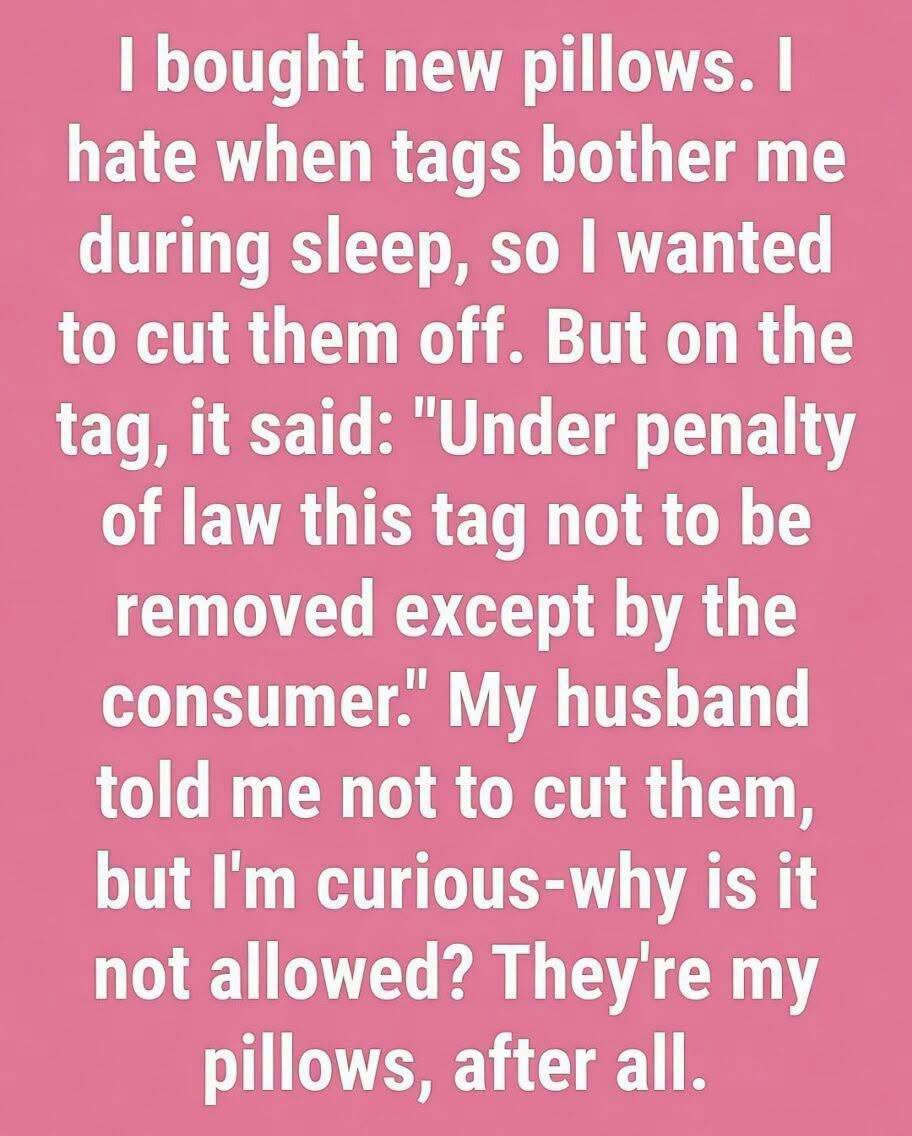
For generations, a small fabric label attached to mattresses and pillows has inspired disproportionate caution. The wording is stern: “Do Not Remove Under Penalty of Law.” Many people treat the tag as an official warning that cutting it off could bring legal trouble. The fear is so widespread that it has become a running joke and a genuine source of hesitation for anyone who simply wants a smoother sleeping surface. The reality is far less dramatic. Once you own the mattress, the legal restriction no longer applies to you.
The original purpose of the label was consumer protection, not household policing. In the early twentieth century, the mattress industry had a serious credibility problem. Some manufacturers filled products with unsanitary materials—used rags, contaminated animal hair, industrial scraps, and other debris that posed genuine health risks. Buyers had no reliable way to know what lay beneath the outer fabric. Lawmakers responded by requiring that a label listing the filling materials remain attached through the manufacturing, distribution, and retail stages. The goal was transparency and accountability. Sellers who removed or altered the tag to hide low-quality or hazardous contents could face penalties.
That requirement still exists for the commercial chain. Manufacturers, wholesalers, and retailers must keep the label intact until the product is sold to the end consumer. The moment the mattress becomes private property, the legal force of the warning ends. You are not a dealer attempting to misrepresent the contents. You are the owner. Removing the tag for comfort, aesthetics, or any other personal reason is not a crime. No agency is monitoring bedroom scissors.
The persistence of the myth says something about how warnings travel through culture. A strongly worded label, repeated across decades of products, acquires an authority that outlives its original legal target. Children grow up seeing the tag, parents caution them not to touch it, and the story hardens into assumed fact. Few people ever look up the actual statute or notice that the fine print often clarifies the rule applies only before sale. The result is a collective over-reading of a regulation that was never aimed at ordinary households.
Keeping the tag can still be practical even though removing it is legal. Many labels carry care instructions—whether the mattress can be flipped, what cleaning methods are safe, or temperature guidelines. Some list material details useful for people with allergies or chemical sensitivities. If you later decide to sell or donate the mattress, donation centers and secondhand buyers frequently prefer or require an intact label because it helps verify contents and age. A missing tag can make an otherwise usable mattress harder to pass along.
There is no universal rule that the tag must stay forever. If it scratches, peeks out from under sheets, or simply bothers you, cutting it off is a reasonable choice. Some owners photograph or note the information first so the practical details are not lost. Others leave the tag in place and tuck it out of the way. Both approaches are fine. The decision belongs to the person who sleeps on the mattress, not to a lingering misunderstanding of the law.
The broader background of the label remains relevant. Consumer protection rules around bedding materials helped push the industry toward greater honesty about fillings. Modern regulations and manufacturing standards are stronger than those of a century ago, yet the principle of clear disclosure still matters. Knowing what is inside the product you spend roughly a third of your life on is useful information. The tag is one small remnant of that principle.
In daily life the issue is minor. Most people will never face a situation in which the presence or absence of a mattress label has legal consequences. The real cost of the myth has been unnecessary caution and the slight inconvenience of leaving an itchy or unsightly tag in place out of misplaced fear. Understanding the actual history and scope of the rule removes that friction. You can treat the label as what it is: a historical consumer-protection device that completed its main job at the point of sale. After that, the mattress is yours to manage as you see fit.
Most Popular!
-
 How Many Holes Are in a T-Shirt? What a Simple Puzzle Reveals About How We See
-
The Quiet Stories Inside Secondhand Objects: When a Thrift-Store Find Carries Someone Else’s History
-
Bra Care Basics: Hygiene, Longevity, and Why Rotation Matters More Than You Think
-
Green Onions and Food Safety: What the Risks Actually Are and How to Handle Them Sensibly
-
When Family Hospitality Becomes a One-Way Street: Setting Boundaries with In-Laws Without Destroying the Relationship
-
When Strength Becomes Silence: Hidden Grief and the Distance It Creates in a Marriage
-
The One-Ring Phone Scam: Why a Single Missed Call Can Be Expensive—and How to Protect Yourself
-
When Money and Loyalty Collapse Together: Navigating Financial Betrayal in a Marriage