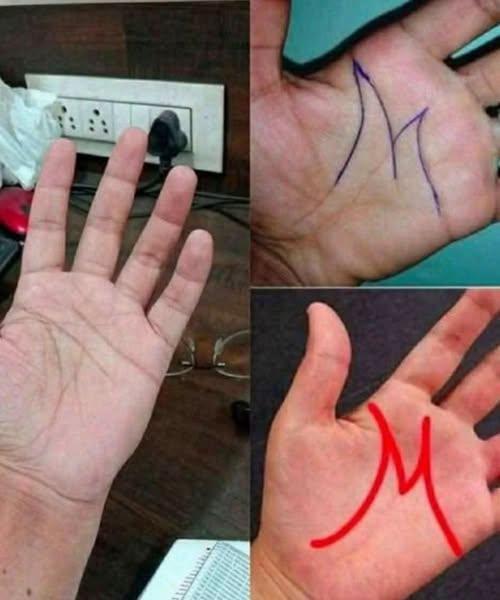
Look at the palm of your hand and you may notice that the major creases sometimes intersect in a way that resembles the letter M. For centuries this formation has captured attention in popular palmistry, where it is often described as rare, powerful, and full of hidden meaning. Online articles promise that the marking reveals exceptional intuition, leadership ability, financial skill, or an unstoppable destiny. The language is dramatic and the claims are sweeping. Yet the real story of the lines on your hand is far more ordinary, grounded in biology rather than prophecy.
Palm creases, also called palmar flexion creases, form early in fetal development. They are created by the folding of the skin as the hand moves in the womb and are influenced by genetics and the physical environment inside the uterus. The three most commonly discussed lines—the heart line, head line, and life line—appear in the majority of people, though their exact paths, depth, and connections vary widely. When these lines cross or connect in certain ways, the resulting shapes can look like letters or symbols to an imaginative eye. The so-called M is simply one of those visual patterns. It is not a secret code written by fate.
One related feature that does have a documented medical association is the single transverse palmar crease, sometimes historically called the Simian crease. In this variation, a single line runs straight across the palm instead of the more common separate head and heart lines. It occurs in a small percentage of the general population and appears more frequently in people with certain chromosomal conditions, most notably Down syndrome. Even then, the crease itself is only one minor physical trait among many and carries no predictive power about personality or future success. Most people who have an M-like pattern on their palms do not have a true single transverse crease and have no associated medical findings.
Palmistry as a practice has deep cultural roots. Versions of hand reading appear in ancient India, China, and parts of the Mediterranean world. Over time the system absorbed layers of symbolism, astrology, and moral interpretation. By the nineteenth and early twentieth centuries it had become a popular form of entertainment and self-reflection in the West. Practitioners assigned meanings to every line, mount, and marking, creating elaborate systems that felt comprehensive. The difficulty is that these systems were never subjected to rigorous testing. When researchers have examined palmistry claims under controlled conditions, the results consistently fail to support the idea that hand features reliably predict character or life outcomes.
The enduring appeal of such interpretations rests on familiar psychological mechanisms. Vague, positive statements tend to feel accurate because most people can find evidence for them in their own lives. The Barnum effect, well documented in psychology, shows that individuals readily accept general descriptions as uniquely personal. When an article tells you that the M on your palm means you are intuitive, determined, and destined for leadership, it is easy to recall moments that seem to confirm the description. Contradictory evidence is quietly set aside. The marking itself becomes a convenient canvas for the story you are already inclined to believe.
There is also a simple visual reason the M stands out. Human brains are exceptionally good at detecting patterns, especially familiar shapes like letters. Once someone points out that certain creases form an M, the eye begins to see it more readily. The same tendency explains why people notice faces in clouds or animals in rock formations. Pattern recognition is a useful survival skill, but it does not mean the pattern carries intentional meaning.
None of this makes looking at your hands uninteresting. The variation in creases, fingerprints, and skin texture is a reminder of how uniquely each person develops. Dermatoglyphics, the scientific study of these patterns, has legitimate uses in medicine and identification. Fingerprints remain one of the most reliable biometric tools precisely because they are complex and highly individual. Palm creases, while less distinctive, still reflect the intricate process of human growth. Studying them through a scientific lens offers genuine insight into development and genetics without requiring any leap into destiny.
For those who enjoy palmistry as a form of cultural curiosity or light self-reflection, there is little harm in the practice as long as it remains entertainment. Problems arise only when the claims are treated as factual guidance for major life decisions. Career choices, relationship judgments, and self-worth should rest on evidence, experience, and reflection rather than the accidental geometry of skin folds. Real strengths—resilience, empathy, practical intelligence—are demonstrated through actions over time, not revealed by a single glance at the palm.
The next time you notice an M-shaped intersection on your hand, you can appreciate it as a small anatomical curiosity. It does not unlock hidden powers or guarantee future success. It simply shows that your skin folded in a particular way before you were born. That fact is ordinary and, in its own way, more remarkable than any mystical interpretation. The human body is full of variations that carry no cosmic significance yet still reward careful observation. Understanding the difference between pattern and prophecy is itself a useful form of clarity—one that requires no special marking on the hand to develop.
Most Popular!
-
 When an Absent Parent Returns: Boundaries, Time, and the Limits of Making Amends
-
When Secrets in the Home Become Dangerous: Recognizing Control, Betrayal, and the Path Back to Safety
-
The Quiet Crisis Next Door: Loneliness, Small Gestures, and What We Miss in Ordinary Neighborhoods
-
When a Community Refuses to Forget: Memorials, Missing Children, and the Complicated Search for Meaning
-
High School Cruelty, Body Shame, and the Quiet Work of Reclaiming Your Place
-
James Spader’s Quiet Rebellion: Why One of Hollywood’s Most Private Actors Still Fascinates Us
-
Shared Spaces, Small Cruelties, and the Quiet Power of Choosing Kindness on Vacation
-
When a False Accusation Echoes Across Decades: Trust, Silence, and the Long Path Back to Truth