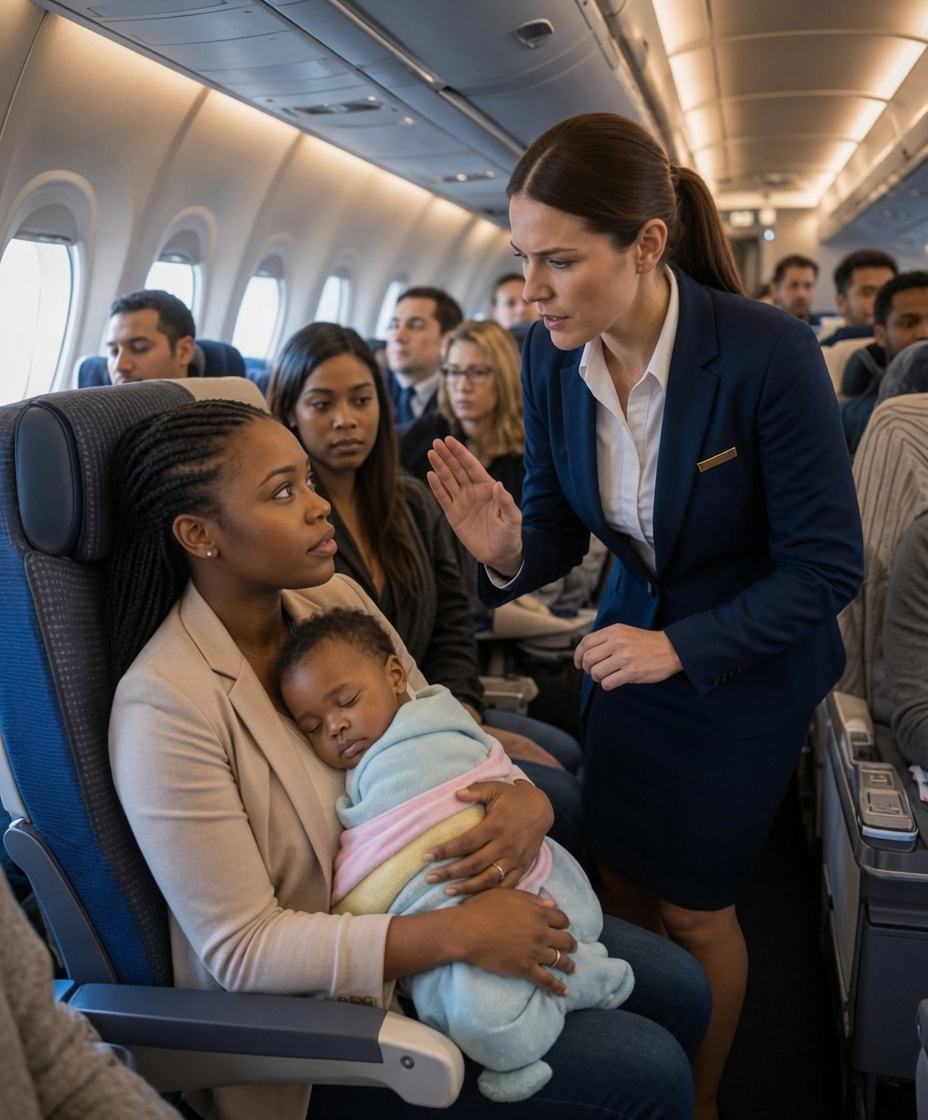
The cabin was already tense when my six-month-old son started crying again. We were somewhere over the Midwest on a crowded red-eye flight, and I had been walking the narrow aisle for what felt like hours, gently bouncing him while whispering every lullaby I knew. My arms ached. My eyes burned from lack of sleep. As a single mom traveling alone for the first time since his birth, I was doing everything I could to keep him calm and the other passengers comfortable. But when the flight attendant marched toward me with a tight expression, I knew trouble was coming.
“Ma’am, you need to sit down and control your child,” she said sharply, loud enough for several rows to hear. “This is not acceptable. People are trying to sleep.” Her tone carried zero compassion — only irritation and authority. I felt my face burn with humiliation as passengers turned to stare. My son wailed louder, sensing my stress. I tried to explain that I had been walking him to keep him from disturbing others, but she cut me off, pointing firmly to my seat. Tears stung my eyes as I squeezed back into the window seat, my baby’s cries echoing through the cabin. I felt like a failure. Every eye on me seemed to judge. In that moment, I just wanted the flight to end so I could disappear into the anonymity of the airport.
What happened next silenced the entire plane.
A calm, deep voice came over the intercom. “This is your captain speaking. I’d like everyone to listen carefully for a moment.” The cabin grew quiet. Even my son seemed to pause, as if sensing the shift in energy. “I understand there’s a mother traveling with a young baby who is doing her best under difficult circumstances. Flying with infants is never easy, especially alone. I want her to know she’s not a disturbance — she’s doing something brave and important. To the crew member who just spoke to her, I’d like you to remember that every passenger on this flight was once someone’s crying baby. A little compassion goes further than rules in moments like these.”
The words hung in the air. No one moved. I sat frozen, tears now flowing freely down my cheeks. The flight attendant who had scolded me stood still near the galley, her face flushed. The captain wasn’t finished. “I know this from personal experience. Twenty years ago, my wife and I lost our first child during a medical emergency on a flight very similar to this one. The crew at the time followed every protocol perfectly… but no one showed the mother the kindness she desperately needed. I’ve never forgotten that. So tonight, while I have the honor of flying this plane, I’m asking all of you to choose kindness over convenience. And to that young mother — you’re doing a wonderful job. We’ll get you both home safely.”
The cabin remained completely silent for several long seconds. Then something beautiful happened. The passenger next to me, an older gentleman who had looked annoyed earlier, reached over and offered to hold my diaper bag so I could comfort my son more easily. A woman across the aisle passed me a fresh bottle of water and a pack of tissues with a gentle smile. Another passenger began quietly humming a lullaby. The atmosphere in the plane transformed from tense judgment to collective support in the span of one intercom message.
I later learned the full story from a kind flight attendant who came to check on us afterward. The captain had been listening to the cabin audio the entire time. When he heard the way I was spoken to, something inside him shifted. His personal tragedy from two decades earlier had stayed with him, shaping how he viewed every family traveling with small children. He made it a point on his flights to set a tone of compassion from the cockpit, especially on overnight routes when families were most vulnerable. That night, his words didn’t just defend one mother — they reminded every person on board of our shared humanity.
For the rest of the flight, the energy was completely different. Passengers offered to hold my baby so I could rest. The same flight attendant who had scolded me returned with warm milk, fresh blankets, and a quiet apology. She explained that the airline had strict policies about noise and movement during nighttime flights, but she admitted she had let frustration get the better of her. The captain’s words had humbled her. By the time we landed, my son was sleeping peacefully against my chest, and I felt something I hadn’t expected — gratitude mixed with healing.
That experience taught me several profound lessons about travel, motherhood, and human connection. First, never underestimate the power of one calm voice speaking up against unkindness. The captain could have stayed silent in his cockpit, focused only on flying the plane. Instead, he chose to use his authority to protect and humanize. Second, we all carry invisible stories. The frustrated flight attendant, the annoyed passengers, and even I were operating from our own exhaustion and pressures. When we remember that everyone has a story we don’t know, judgment becomes much harder. Third, kindness is contagious. Once the captain set the tone, the entire cabin followed. One act of empathy created a ripple effect that turned a miserable flight into a memorable one for all the right reasons.
As a mother, the incident also reinforced how vulnerable we can feel when traveling with little ones. Society often expects perfect behavior from children while offering little grace to the parents doing their best. Single parents, in particular, carry an extra weight — there’s no partner to tag in when exhaustion hits. Stories like this remind us that we’re not alone, even when it feels that way at 30,000 feet. There are good people everywhere willing to step up when they see a need.
The captain’s personal revelation also highlighted something deeper about grief and purpose. Many of us carry painful chapters from our past. Some let those experiences harden them. Others, like this pilot, transform their pain into greater compassion. He turned his family’s tragedy into a commitment to protect other families. That choice didn’t erase his loss, but it gave it meaning. In sharing it over the intercom, he gave every passenger permission to see beyond surface frustrations to the human beings behind them.
Since that flight, I’ve made it a point to pay forward the kindness I received. When I see a struggling parent in public, I offer help instead of judgment. When I witness someone being spoken to harshly, I try to speak up gently. The experience also strengthened my relationship with my son. Every time he has a difficult moment now, I remember that night and respond with more patience. The memory of the captain’s voice still brings me comfort during challenging parenting days.
Air travel can bring out the worst in people — the cramped spaces, delays, and exhaustion create a perfect storm for tension. But it can also bring out the best when someone in a position of authority chooses humanity over policy. That captain reminded everyone on board that rules matter, but compassion matters more. His words didn’t just quiet my crying baby. They quieted judgment in an entire cabin and replaced it with understanding.
If you’re a parent who has ever felt ashamed or overwhelmed while traveling with children, please know this: you are not a burden. You are doing something brave and difficult. The world needs more people like that captain — individuals willing to use their voice and position to protect the vulnerable rather than add to their stress. And it needs more of us willing to follow that example once the message is delivered.
That red-eye flight didn’t just get me and my son home safely. It restored my faith in humanity at a moment when I needed it most. One calm voice over an intercom proved that even at 30,000 feet, kindness can still land exactly where it’s needed. And sometimes, the person best positioned to change the atmosphere is the one flying the plane.
Most Popular!
-
 The 5 That Changed Everything: How a Pair of Baby Shoes Brought Two Mothers Back to Life
-
Why Charlie Kirk and His Wife Are Being Targeted by an Online “Transvestigation” Hoax — And What This Dangerous Trend Really Means
-
I Adopted a Little Girl — Thirteen Years Later, One Phone Screen Brought Everything to a Stop
-
Swollen Feet: The Silent Warning Sign Your Body Is Trying to Send You — And What to Do About It Before It Gets Worse
-
Everyone Misjudged This Tattooed Biker — Until the Truth Came Out and Changed How We See People
-
8 Subtle Signs Someone Secretly Resents You — And How to Protect Your Peace Without Losing Yourself
-
I Found Strange Black Grains Under My Mattress — What I Thought Were Insect Eggs Turned Out to Be Something Beautiful
-
What You Should Never Cook in a Cast Iron Skillet — And Why It Could Ruin Your Pan Forever