Some evenings start with butterflies and end with quiet gratitude for the strangers who see what we cannot. For me, it began as an ordinary first date at a cozy Italian restaurant downtown. The man across the table introduced himself as Deacon. He was charming, well-dressed, and seemed genuinely interested in my stories about work, my weekend hikes, and the rescue dog I had recently adopted. Conversation flowed easily. We laughed at the same jokes. By the time the tiramisu arrived, I was already imagining what a second date might look like. Then the bill came, and everything changed in the span of a few whispered words and a crumpled receipt.
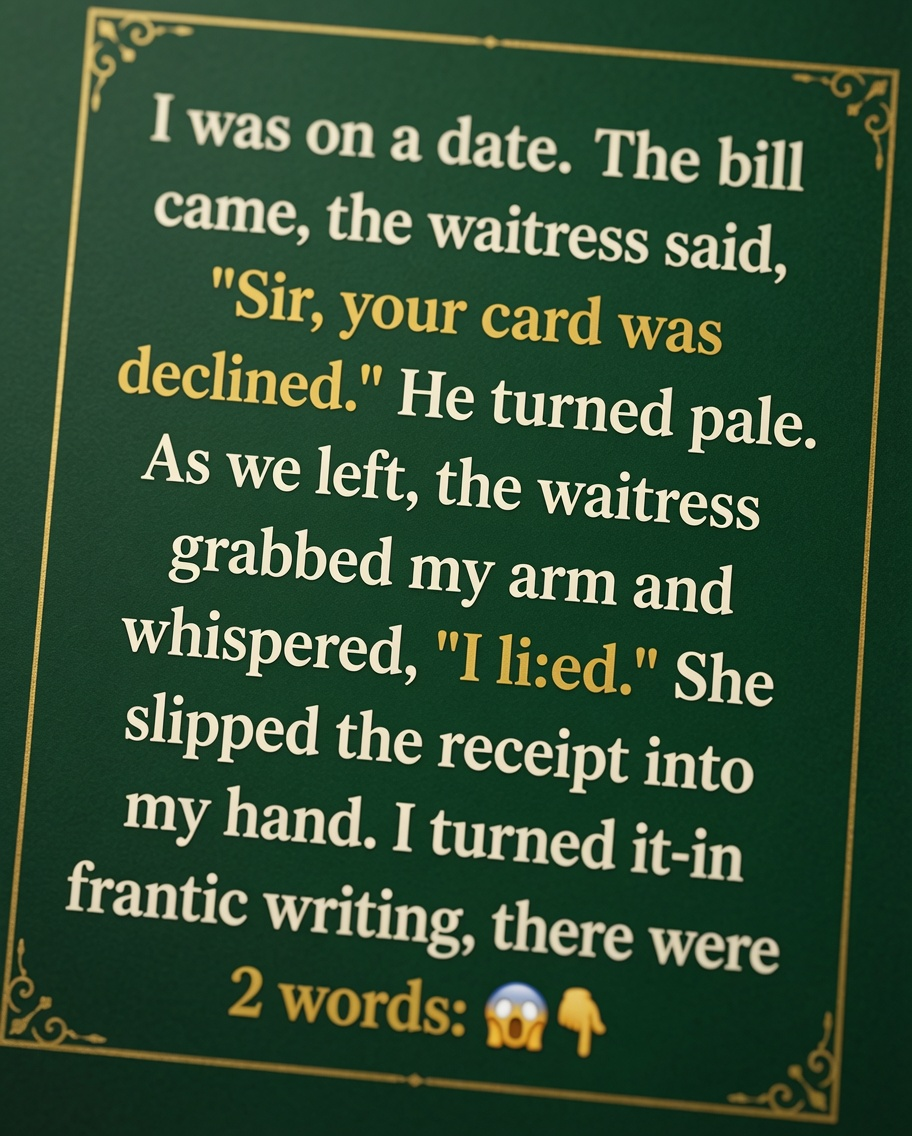
The waitress, a woman in her late forties with kind eyes and a tired but steady smile, placed the leather folder in front of Deacon. He opened it, frowned slightly, and slid his credit card across the table. A few minutes later, she returned with the same card and a gentle but firm expression. “Sir, your card was declined,” she said softly, loud enough for only us to hear. Deacon’s face flushed with what looked like genuine embarrassment. He reached for his wallet again, muttering about “bank mix-ups” and “travel notifications.” I offered to split the bill, assuming it was an honest mistake. But the waitress caught my eye for the briefest moment as she handed me the receipt to sign. Her fingers brushed mine, and I felt a small slip of paper tucked beneath the folder.
I waited until Deacon excused himself to the restroom before unfolding it. Two words were written in hurried handwriting: Be careful.
My heart skipped. The restaurant noise faded into the background as I stared at those simple words. The waitress had risked her job, her tip, and an uncomfortable confrontation to warn a stranger she would likely never see again. In that moment, I understood that this wasn’t about a declined card. It was about something much darker. I slipped the note into my purse, forced a smile when Deacon returned, and made an excuse about needing to leave early for an early morning meeting. He offered to walk me to my car, but I politely declined. Something in my gut — the same instinct that had kept me safe through years of dating after my divorce — told me to get away as quickly as possible.
The drive home felt longer than usual. My mind raced through every detail of the evening. The way he had avoided certain questions about his job. The polished stories that felt rehearsed. The charming smile that now seemed calculated. When I got home, I did what any cautious woman in 2025 would do — I searched. Not just his name, but every variation I could think of. What I found made my stomach turn.
His real name wasn’t Deacon. It was Marvin. And he had a pattern.
Multiple women in the city had posted similar stories in private Facebook groups and on Reddit threads dedicated to dating safety. He would meet them at nice restaurants, act the perfect gentleman, then “forget” his wallet or claim a card issue. Once he gained their trust, he would ask for small loans, crash on their couches, and slowly drain whatever he could before disappearing. Some women had lost thousands. Others had discovered missing jewelry or electronics after he left. One woman had even let him stay at her apartment while she was out of town for work. She returned to find her savings account emptied and her credit cards maxed out.
The waitress had seen this pattern before. She had watched him bring different women to the same table, always with the same script. That night, she chose to act. Her quiet warning on the back of that receipt may have saved me from months of emotional manipulation and financial loss. I will never know her name, but I will always be grateful for her courage.
The experience forced me to reflect on how easily we can ignore red flags when someone presents themselves well. Deacon — or Marvin — had been charming, attentive, and seemingly successful. He asked questions about my life and remembered small details from our conversation. On paper, he checked every box for a “good guy.” But the declined card, the rehearsed stories, and the way he avoided deeper questions about his background were all signals I had chosen to overlook because I wanted the evening to go well. The waitress’s note became the permission I needed to trust my instincts rather than my hopes.
In the days that followed, I did more research. I joined online communities where women share dating safety tips and stories of romance scams. I learned that men like Marvin often target women who are kind, successful, and perhaps a little lonely after a divorce or breakup. They study social media profiles, mirror interests, and build trust quickly before introducing financial pressure. The psychological manipulation is often so gradual that victims don’t realize what’s happening until significant damage has been done.
I also reached out to the restaurant manager to thank the waitress anonymously and ensure she faced no repercussions for helping me. The manager confirmed that she had seen Marvin bring multiple women to the restaurant over the past year. She had tried warning others before, but many had brushed it off. My willingness to listen may have been the first time her warning actually worked.
This experience changed how I approach dating entirely. I now verify details earlier. I meet in public places. I listen more carefully to my gut when something feels even slightly off. Most importantly, I’ve become part of a small network of women who look out for each other. We share names, photos, and patterns. We warn each other before first dates. We celebrate when someone escapes a bad situation unharmed. The sisterhood that formed from that single night at the restaurant has become one of the most empowering parts of my life after divorce.
If you’re reading this and preparing for a first date, please remember a few things. Trust actions more than words. Pay attention to how someone handles small inconveniences like a declined card or a change in plans. Notice if stories shift or details don’t add up. And if a stranger — a waitress, a bartender, or another patron — tries to warn you, listen. Their perspective might be the clarity you need in a moment when attraction or hope is clouding your judgment.
The waitress who slipped me that note took a risk. She could have lost her job or faced an angry customer. Instead, she chose humanity over silence. Because of her, I avoided what could have been months of emotional and financial manipulation. I will never know her name, but I think of her often when I’m out to eat. I tip generously. I smile at the staff. And I remember that sometimes the most important kindness comes from people we will never see again.
Dating after divorce is already complicated. Adding the risk of romance scams makes it even more challenging. But it doesn’t have to be frightening if we stay aware, trust our instincts, and look out for each other. The man who called himself Deacon taught me to be more careful. The waitress taught me that kindness still exists in the world. And the experience as a whole taught me that protecting myself isn’t cynical — it’s wise.
If you ever find yourself on a date that feels too good to be true, pause and look closer. Ask questions. Notice the small details. And if something feels wrong, trust that feeling. Your safety and peace of mind are worth more than any charming smile or polished story.
The bill that night wasn’t just a piece of paper. It was a warning. And because one woman chose to deliver it, I walked away with my dignity, my finances, and my heart intact. In a world that can sometimes feel cold and calculating, that single act of courage reminds me that goodness still exists — often in the most unexpected places, delivered by people we may never see again.
Thank you, whoever you are. Your note on the back of that receipt didn’t just save one evening. It may have saved me from months of pain. And for that, I will always be grateful.
Most Popular!
-
 The 5 That Changed Everything: How a Pair of Baby Shoes Brought Two Mothers Back to Life
-
Why Charlie Kirk and His Wife Are Being Targeted by an Online “Transvestigation” Hoax — And What This Dangerous Trend Really Means
-
The Flight Attendant Scolded a Struggling Mother — Until the Pilot’s Voice Came Over the Intercom and Changed Everything
-
I Adopted a Little Girl — Thirteen Years Later, One Phone Screen Brought Everything to a Stop
-
Swollen Feet: The Silent Warning Sign Your Body Is Trying to Send You — And What to Do About It Before It Gets Worse
-
Everyone Misjudged This Tattooed Biker — Until the Truth Came Out and Changed How We See People
-
8 Subtle Signs Someone Secretly Resents You — And How to Protect Your Peace Without Losing Yourself
-
I Found Strange Black Grains Under My Mattress — What I Thought Were Insect Eggs Turned Out to Be Something Beautiful