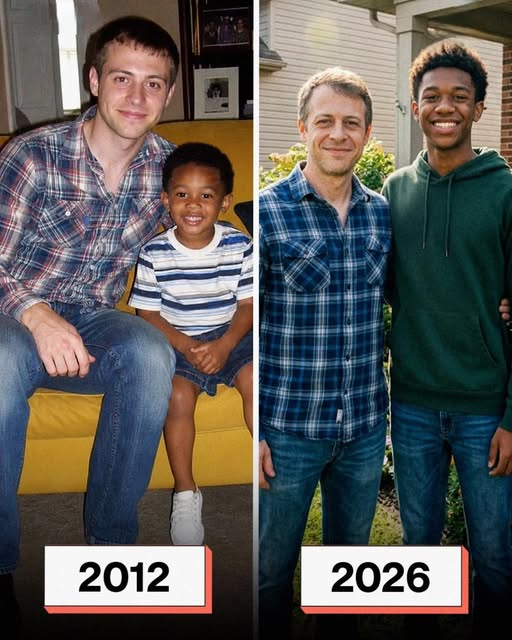
When my best friend Laura passed away in a car accident, her four-year-old son Jimmy had already become a central part of my life. I had loved her quietly for years, never finding the right moment to tell her. After her death, stepping in as Jimmy’s guardian felt like the most natural thing in the world, even though nothing about the situation felt natural at all. I didn’t think of it as becoming a father at first. I simply knew he needed someone, and I couldn’t imagine anyone else doing it.
The early years were a blur of court dates, social worker visits, and learning how to be a parent on the fly. I changed diapers, handled fevers, and stayed up late helping with school projects. Over time, the title “guardian” started to feel too formal for what we had become. Jimmy began calling me by my first name, but the way he looked at me made it clear I was more than just a caretaker. Still, I never pushed for anything more official. I told myself that raising him well was enough.
On his eighteenth birthday, Jimmy handed me an envelope after dinner. Inside was a letter written by his mother years earlier. Laura had written it during a difficult period, when she was worried about what would happen to Jimmy if something happened to her. In it, she asked me — not demanded, but gently asked — to take care of him if she was ever gone. She wrote that she trusted me more than anyone and that she had always known I would love him like my own. Reading her words felt like hearing her voice again after more than a decade of silence.
Along with the letter, Jimmy placed a set of adoption papers on the table. He had filled them out himself. At eighteen, he was old enough to make the decision without anyone else’s permission, and he wanted me to become his legal father. He said he had been thinking about it for a long time and that it felt right to make it official now that he was an adult. The papers weren’t just legal documents — they were his way of telling me that I had always been his dad, even when neither of us said the word out loud.
We spent the rest of the evening going through old boxes in the attic. We found hospital bracelets from when Jimmy was born, a baby blanket Laura had kept, and letters she had written to him for future birthdays. One note mentioned how I had helped calm him down during a particularly rough toddler phase by taking him on long walks. Reading those words together felt like Laura was sitting with us, quietly approving of the life we had built.
The next morning, we went to the courthouse together. Filing the adoption papers felt different from the guardianship process years earlier. This time, it wasn’t about necessity or paperwork. It was about choice. Jimmy was choosing me, and I was finally allowing myself to fully accept the role I had been living for fourteen years. When the judge approved everything, it felt like something that had been unfinished for a long time was finally complete.
Later that day, we went to Laura’s favorite diner. Jimmy had always wanted to go there on special occasions because it made him feel closer to her. As we sat in the booth, he looked across the table and called me “Dad” for the first time. The word landed softly but carried enormous weight. I had waited so long to hear it without realizing how much I needed it.
In the weeks that followed, we talked more openly about Laura and about the family we had created. Jimmy asked questions about my relationship with his mother that he had never asked before. I answered honestly, including the parts I had kept to myself for years. He didn’t seem surprised. He simply said he had always felt that I loved her, and that it made sense why I had stepped in so completely after she was gone.
Raising someone else’s child is a complicated kind of love. It comes with grief, responsibility, and moments of doubt about whether you’re doing enough. But it also comes with extraordinary closeness and the quiet knowledge that you chose each other every single day. The adoption didn’t change how I felt about Jimmy, but it gave that feeling a permanent shape.
Laura’s letter reminded me that she had seen something in me long before I fully saw it in myself. She had trusted me with the most important person in her life, and in doing so, she had given me a family I never expected to have. On Jimmy’s eighteenth birthday, that trust came full circle. He chose me back.
Today, when people ask about my son, I don’t hesitate. I tell them about the boy I helped raise and the young man who decided, on his own, that he wanted to make it official. The letter his mother left behind didn’t just ask me to take care of him. It gave both of us permission to become what we had quietly been all along — a father and son who found each other through love, loss, and an extraordinary act of trust.
Most Popular!
-
 Eggs, Cholesterol, and Timing: What Actually Matters for Most People
-
When a Partner Leaves With More Than a Suitcase: Protecting Yourself From Financial Betrayal
-
When Financial Support Meets Contempt: Recognizing Exploitation Inside a Marriage
-
Why Some Sensory Toys and Household “Hacks” Do Not Belong in the Microwave
-
When Grief Clouds Judgment: Misreading Silence and the Quiet Ways People Show Care
-
When One Partner Does All the Hosting: Recognizing Imbalance Before Resentment Takes Over
-
How Many Holes Are in a T-Shirt? What a Simple Puzzle Reveals About How We See
-
The Quiet Stories Inside Secondhand Objects: When a Thrift-Store Find Carries Someone Else’s History