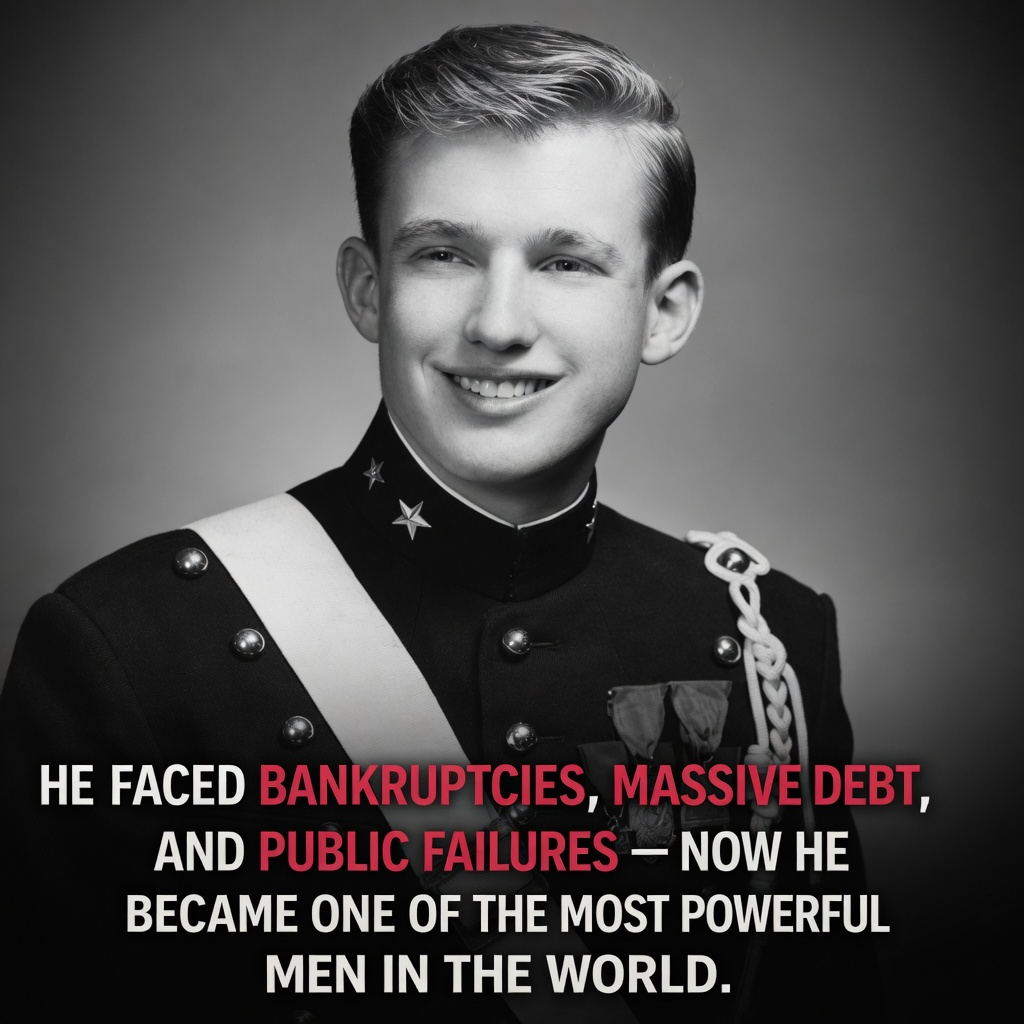
We love to romanticize success as a straight line — steady effort leading to steady rewards. But real life, especially at the highest levels, rarely works that way. Sometimes the path to extraordinary power is paved with spectacular failure, crushing debt, public humiliation, and moments when everyone around you writes you off as finished. Few stories capture this truth more dramatically than that of a brash New York real estate developer who stared into financial oblivion multiple times, only to claw his way back and claim the highest office in the world.
In the late 1980s and early 1990s, this man seemed untouchable. Towering buildings bore his name. Casinos glittered under his brand. He lived large — private jets, glamorous parties, and a public persona that screamed victory. Then the economy turned. The real estate market collapsed. Debt piled up like mountains. By the early 1990s, his companies had filed for bankruptcy protection multiple times. Billions were on the line. Creditors circled. Headlines declared him done. Wall Street laughed. The man who had branded himself as the ultimate winner was suddenly Exhibit A for spectacular failure.
Most people in that position would have faded away, taken a quieter life, or accepted defeat. He did the opposite. Instead of hiding, he doubled down on the one asset that couldn’t be taken away: his name and his unrelenting belief in himself. He negotiated relentlessly with banks, restructuring deals that kept his brand alive even when the numbers looked impossible. He learned to use media attention — even negative attention — as fuel. While others saw ruin, he saw a stage. That refusal to accept the finality of failure became the foundation for everything that came next.
The comeback wasn’t immediate or easy. There were more setbacks, more lawsuits, more moments when the world assumed it was truly over. But each time, he found a new angle. A book deal here. A licensing agreement there. Then came the television opportunity that changed everything. Stepping into the role of the decisive boss on a reality show introduced him to a completely new audience — millions of Americans who had never set foot in a Manhattan boardroom but connected with his direct, no-nonsense style. What started as entertainment became a powerful platform that reshaped his image from flashy developer to authoritative figure.
From that foundation, he took a leap that few serious observers thought possible. He entered the political arena, speaking in a language that bypassed traditional channels and connected directly with people who felt ignored by the system. The campaign was chaotic, polarizing, and relentless. Many called it a publicity stunt. Others dismissed it outright. But the same traits that helped him survive financial disasters — the refusal to back down, the ability to dominate media cycles, and an unshakable confidence — proved devastatingly effective in politics. Against all conventional wisdom, he won.
His time in the highest office was defined by the same pattern that marked his business life: disruption, controversy, and results that defied expectations. Supporters saw a fighter who delivered on promises others only talked about. Critics saw chaos and division. But regardless of where you stood, one fact remained undeniable — the man who had been counted out financially multiple times had achieved the ultimate resurrection. He had gone from billions in debt to the most powerful position on the planet.
What makes this journey so compelling isn’t just the scale of the comeback. It’s what it reveals about resilience, branding, and the nature of modern power. In today’s world, perception often matters as much as reality. The ability to project strength during weakness, to reframe failure as a temporary setback, and to maintain visibility when others would disappear — these skills proved more valuable than perfect balance sheets or flawless reputations. He turned personal and financial disasters into chapters of a larger narrative of triumph.
Of course, this story isn’t without its critics. Some argue that his methods were reckless, that the bankruptcies hurt workers and small businesses, and that his leadership style created unnecessary division. These are fair points in any honest examination. Yet even his harshest detractors must acknowledge the sheer improbability of the trajectory — from financial near-death experiences to commanding global attention on the world stage. Few people in history have managed such a dramatic reinvention.
The deeper lesson here goes beyond one individual. It’s about the American (and increasingly global) belief in second, third, and fourth chances. In many societies throughout history, a major failure marked you permanently. Here, the right combination of determination, timing, and narrative control can flip the script entirely. This man didn’t just recover — he rewrote the rules of the game while doing it. He showed that in the court of public opinion, the story you tell about your setbacks can matter more than the setbacks themselves.
For anyone facing their own version of rock bottom — whether financial, professional, or personal — this saga offers both inspiration and caution. Inspiration that no situation is truly final if you refuse to accept it as such. Caution that resilience alone isn’t enough; you also need strategy, adaptability, and the ability to connect with people on a visceral level. Not everyone will rise to the highest office, but the principles of persistence and reinvention apply at every level.
Today, years after those dark days of debt and doubt, the man who once faced total financial ruin continues to command attention like few others. His story remains polarizing, but it is undeniably one of the most remarkable examples of resilience in modern times. It challenges us to reconsider what we define as failure and what we’re willing to fight for when everything seems lost.
The next time you hear someone being counted out, remember this journey. The distance between total collapse and extraordinary success is sometimes narrower than it appears — if you have the audacity to keep writing your own story when the world tries to end the chapter. From billions lost to the pinnacle of power, this is more than a comeback. It’s a masterclass in never accepting the finality of defeat.
Most Popular!
-
 The Ultimate Wedding Revenge: When the Mother Who Abandoned Her Six Daughters Showed Up with Her Millionaire Boss, the Bride Opened a Box That Destroyed Lives Forever
-
The Beach Shaming Disaster: What My 8-Year-Old Said to the Prying Stranger Left Everyone Speechless
-
My Husband Abandoned Me With Twin Babies for a Luxury Fishing Trip — When He Returned, I Had Already Packed His Bags
-
The Three-Dollar Miracle: How a Dust-Covered Vase Revealed a Heartbreaking Decades-Old Secret
-
The $80,000 Battle to Erase a Birthmark: Why One Mother Risked Everything for Her Daughter’s Future
-
The Silent Thief: Why Millions of Men Are Living with a Time Bomb They Can’t See
-
The Final Curtain Falls: Beloved Sanford and Son Legend Hal Williams Gone at 91
-
Found at a Yard Sale: This “Useless” Vintage Contraption Is Actually a Forgotten Piece of Human History