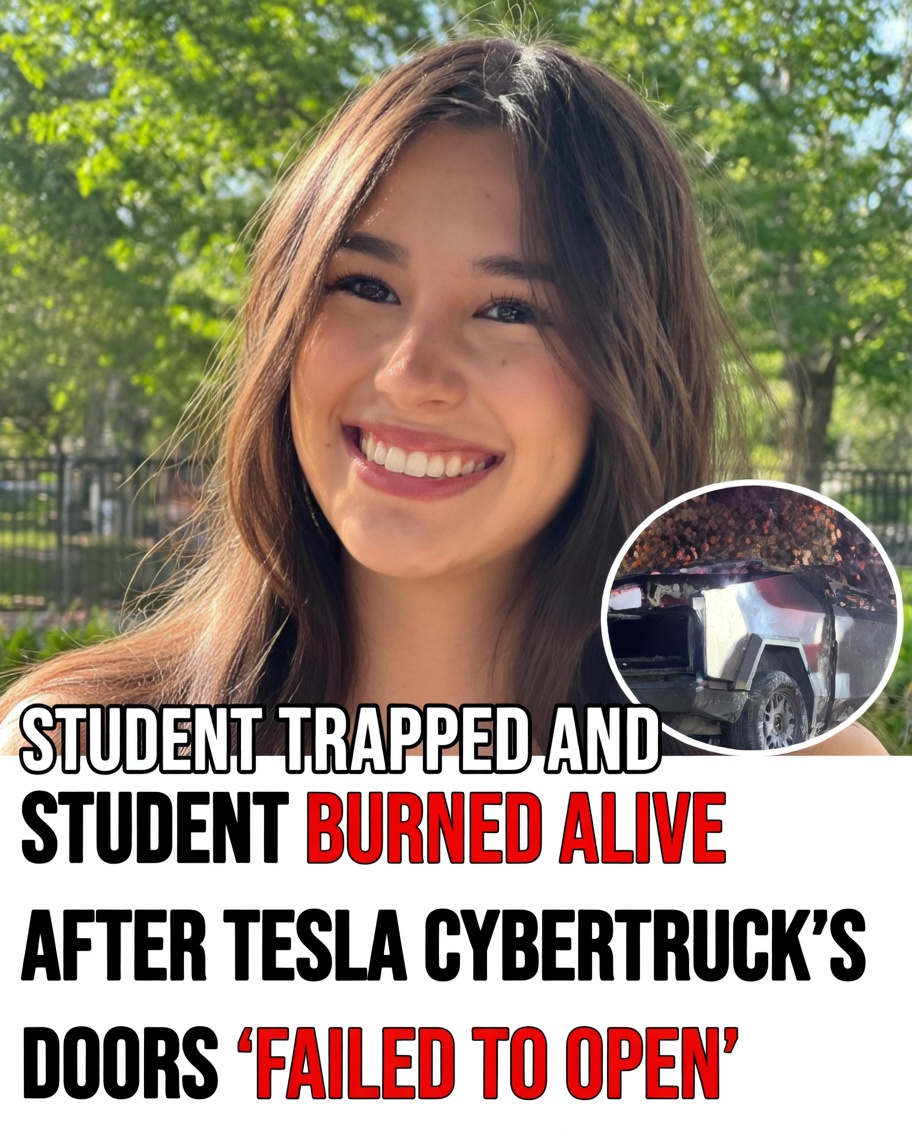
You read the headline and feel an immediate wave of horror as the details emerge about a devastating crash in California where a 19-year-old college student named Krysta Tsukahara was burned alive after being trapped inside a Tesla Cybertruck when its electronic doors failed to open following a high-speed collision, turning what should have been a safe modern vehicle into a deadly trap that claimed two young lives and left a survivor scarred for life while raising serious questions about the safety of advanced automotive technology and the responsibility of companies like Tesla when known design flaws lead to preventable tragedies. The incident happened on November 27, 2024, when the group of recent high school graduates was returning home for Thanksgiving break, and the crash has since sparked multiple wrongful death lawsuits against Tesla, accusing the company of ignoring critical safety issues that left passengers unable to escape as flames consumed the vehicle.
The driver, 19-year-old Soren Dixon, was found to have a blood alcohol level more than twice the legal limit along with meth and cocaine in his system, and autopsies showed that both Krysta and the other victim, 20-year-old Jack Nelson, had also consumed alcohol and cocaine. The only survivor, Jordan Miller, was pulled from the burning vehicle by a friend who smashed a window with a tree branch after repeated attempts, managing to drag him out just moments before the fire engulfed the rest of the car. Krysta, who initially survived the impact with only minor injuries, was unable to escape due to the inoperable doors and a poorly designed manual release system, leading to her death from smoke inhalation and severe burns.
The families of Krysta and Jack have now filed separate wrongful death lawsuits against Tesla and the estate of the vehicle’s owner, claiming the company showed “conscious disregard” for consumer safety by continuing to sell vehicles with known flaws in the electronic door system. According to the lawsuits, the 12-volt battery that powers the doors became inoperable after the crash, trapping the passengers inside while the fire spread rapidly. The families argue that Tesla has long been aware of these dangerous issues but failed to implement effective solutions or warnings, prioritizing innovation and sales over the lives of the people driving their cars.
Krysta’s father, Carl Tsukahara, expressed the family’s profound grief and frustration in a statement, describing his daughter as a bright, kind, and accomplished young woman with her whole life ahead of her. He questioned how a company valued at over a trillion dollars could release vehicles with such critical safety failures, emphasizing that his daughter’s death was preventable and that the family is determined to hold those responsible accountable.
The lawsuits highlight the difficulty of locating and operating the manual door release in an emergency, especially in smoke-filled and chaotic conditions. Attorneys for the families argue that the system is obscure, nonintuitive, and highly unlikely to be found or used successfully when every second counts, effectively turning the high-tech vehicle into a death trap for its occupants.
This tragedy has sparked widespread discussion about the safety of modern electric vehicles and the responsibility of manufacturers to ensure that cutting-edge features do not come at the expense of basic emergency functionality. As the legal battle moves forward, the focus remains on the victims and their families, who are seeking not only justice but also changes that could prevent similar incidents from happening to others in the future.
As the investigation continues and the lawsuits progress, the story serves as a sobering reminder that even the most advanced technology is only as safe as the systems designed to protect people when things go wrong. For the families left behind, the pain of losing their children in such a horrific way is compounded by the knowledge that better design and quicker action from the manufacturer might have changed the outcome.
As you read about this heartbreaking Tesla Cybertruck crash and the families now fighting for accountability, ask yourself this: when companies release vehicles with known safety risks, how important is it for us to demand transparency and immediate fixes rather than waiting for tragedies like this to force change?