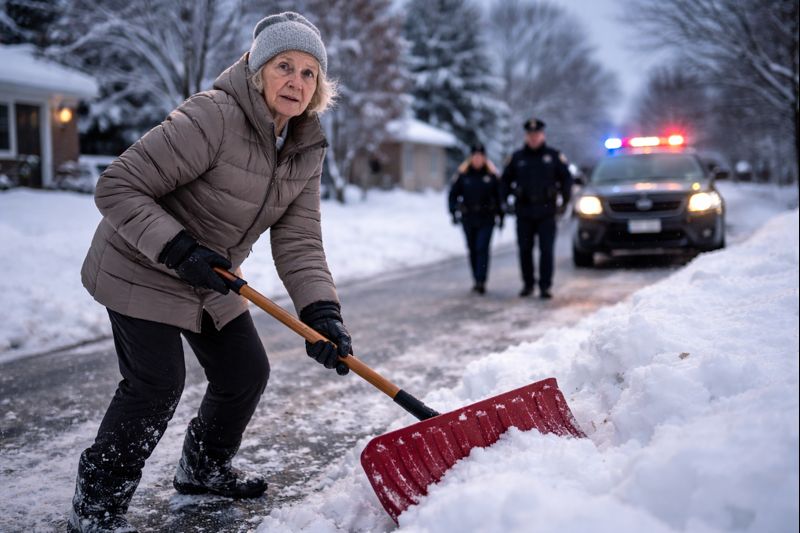
At 4 a.m., while most of the neighborhood slept, a 73-year-old woman was already outside, shovel in hand, battling ice and snow in the freezing dark. By sunrise, her 45-foot driveway was clear. She thought she was doing the right thing — until a city plow stopped, a public works driver scolded her, and moments later, police were called. What rule did she break? And how did a simple act of responsibility turn into a public confrontation that shocked everyone watching?
A Morning of Hard Work Turns Sour
The woman, a longtime resident known for taking care of her property, spent hours scraping snow and ice after a heavy overnight storm. With limited mobility and cold temperatures, the work wasn’t easy — but she wanted to make sure her driveway was safe and accessible.
As dawn approached, a city snowplow came down her street, pushing snow toward the curb and, inevitably, back toward the ends of driveways. That’s when the interaction began.
“You Can’t Do That,” She Was Told
According to witnesses, the public works driver stopped and told the woman she was not allowed to push snow into the street. Confused, she tried to explain that she was only moving the snow that the plow had already pushed into her driveway.
The driver disagreed.
“Whatever they plow into the front of your driveway, you take that across the street,” she was told.
When she asked for clarification — trying to understand what she was allowed to do — the exchange escalated.
Police Were Called
Instead of resolving the issue on the spot, the driver contacted police.
Yes — over snow.
Neighbors watched in disbelief as a patrol car arrived to speak with a woman who had simply shoveled her driveway after a storm. No traffic was blocked. No accidents occurred. No one was endangered.
She was shaken.
“I was scolded,” she later said. “Like I had done something wrong.”
The Rule That Sparked the Dispute
Many municipalities have regulations that prohibit residents from shoveling snow into public streets, as it can create hazards for drivers and interfere with plowing operations. But enforcement — and interpretation — can vary widely.
The woman believed she was complying by only moving snow that the plow itself had deposited. The driver insisted otherwise.
That gray area is where the conflict exploded.
Community Reaction: “This Is Ridiculous”
Once word spread, neighbors and social media users reacted with frustration and anger. Many asked why common sense didn’t prevail.
“She’s 73 years old and up at 4 a.m. doing the right thing,” one resident said. “And this is how she’s treated?”
Others questioned why police resources were used for a situation that could have been resolved with a warning or explanation.
“This is why people don’t trust systems anymore,” one commenter wrote. “No discretion.”
What Police Did — and Didn’t Do
When officers arrived, they spoke calmly with the woman. No citation was issued. No charges were filed. Eventually, the situation ended without penalties — but the emotional impact lingered.
For the woman, the experience was humiliating.
“I was just trying to keep my driveway safe,” she said. “I didn’t expect to be talked to like that.”
A Bigger Issue Beneath the Snow
The story resonated because it highlights a growing tension between strict rule enforcement and human judgment. Many people feel that regulations are increasingly applied without context — especially to seniors and vulnerable residents.
Experts say snow ordinances are meant to prevent dangerous conditions, not punish responsible behavior.
“When enforcement loses compassion,” one municipal governance analyst noted, “public trust erodes.”
What Residents Should Know
If you live in a snowy area, officials recommend:
- Checking local snow-removal ordinances
- Avoiding pushing snow directly into roadways
- Documenting unclear instructions from city workers
- Requesting written clarification when disputes arise
But they also stress that communication matters — on both sides.
A Moment That Should’ve Been Simple
A woman woke early.
She shoveled snow.
She tried to follow the rules.
Instead, she was scolded — and police were called.
The incident ended quietly, but the questions it raised didn’t.
The Question Neighbors Are Still Asking
Rules exist for safety. Enforcement exists for order. But when a 73-year-old doing her best becomes the problem, something feels off.
So here’s the question people can’t stop asking:
If common sense disappears during enforcement, who are the rules really serving?