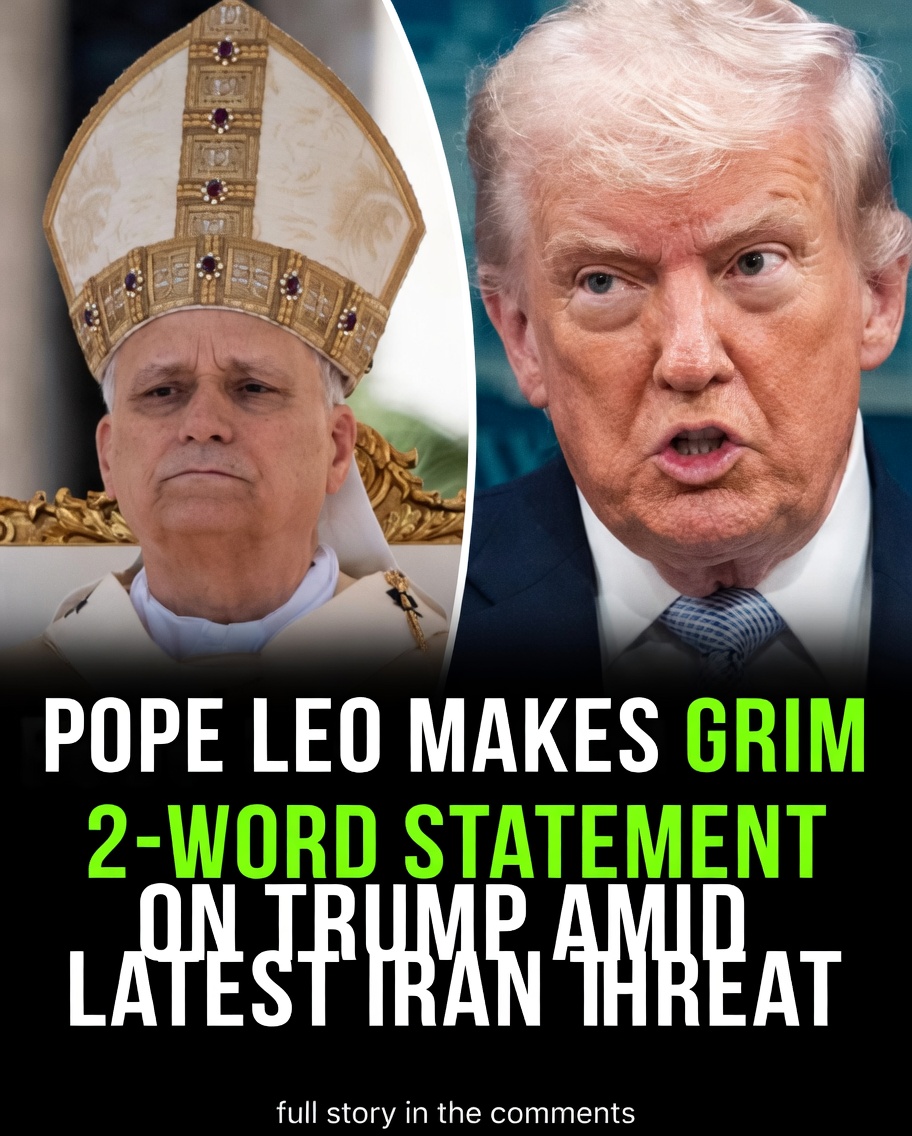
You watched the press conference and felt the weight of the moment settle over the room as Pope Leo XIV stepped forward, his expression heavy with the kind of solemn concern that only comes when the stakes feel impossibly high for the entire world. In the middle of escalating tensions between the United States and Iran, after President Trump had publicly threatened to “wipe out a whole civilization,” the Pope chose not to stay silent or issue a long, carefully worded diplomatic response. Instead, he delivered two short, powerful words that cut through the noise and left everyone listening stunned. Those two words carried the full force of moral clarity and quiet outrage, reminding the world that even in the highest levels of global power, some lines should never be crossed and some threats should never be spoken lightly.
The Back-Story of Rising Global Tension
The war in Iran had dragged on for more than a month, with both sides locked in a dangerous cycle of threats and military posturing. The United States and Iran finally reached a deal for a two-week ceasefire on Tuesday evening, just before Trump’s self-imposed deadline. Both countries claimed victory in their own way, with Trump describing Iran’s 10-point proposal as “a workable basis for negotiations” and announcing that the United States would help ease traffic buildup in the Strait of Hormuz.
The Threat That Shook the World
The day before the ceasefire was reached, President Trump posted a message on Truth Social that sent shockwaves around the globe. He threatened to end the Iranian civilization entirely if the conflict continued. The statement was direct, unfiltered, and carried the kind of weight that immediately raised fears of escalation, including the terrifying possibility of nuclear involvement. World leaders, diplomats, and ordinary citizens alike held their breath, wondering how far the situation might spiral.
The Complication That Prompted the Pope’s Response
The complication was clear: Trump’s words went far beyond standard political rhetoric. They crossed into territory that many saw as deeply dangerous, especially given the fragile state of the region and the human lives hanging in the balance. The threat didn’t just affect governments — it affected families, children, and entire communities who had already suffered through weeks of conflict and uncertainty.
The Turning Point in the Pope’s Statement
In the middle of all this tension, Pope Leo XIV stepped forward and made his position unmistakably clear. His grim two-word statement was simple yet powerful, cutting straight to the heart of the matter without needing long explanations or diplomatic language. It was a moral rebuke delivered with the quiet authority that only the leader of the Catholic Church could command, and it resonated far beyond the Vatican walls.
The Climax of Global Attention
The Pope’s words spread instantly across every major news outlet and social media platform. World leaders took notice. Faith communities around the globe paused to reflect. Even those who rarely follow religious figures found themselves moved by the clarity and courage behind such a brief but pointed response. The statement became a defining moment in an already volatile chapter of international relations.
In the Immediate Aftermath
In the hours following the Pope’s statement, reactions poured in from every corner of the world. Some praised the moral clarity. Others debated the role of religious leaders in political matters. Meanwhile, the ceasefire held, but the underlying tensions remained high, leaving many to wonder whether the Pope’s words would have any lasting impact on the decisions still being made behind closed doors.
The Practical Insight That Matters
This moment highlights how powerful a few carefully chosen words can be when spoken from a place of moral authority. In times of high-stakes conflict, leaders who speak with clarity and conscience can help shift the tone of the conversation, even if they don’t hold direct political power. The Pope’s response served as a reminder that humanity and restraint should never be forgotten, no matter how heated the situation becomes.
The Hopeful Lesson That Still Resonates
Even in the middle of serious international threats, voices calling for peace, reflection, and human dignity still carry weight. The Pope’s grim two-word statement showed that sometimes the most powerful response is the simplest one — a clear line drawn in defense of life and decency when others seem ready to cross it.
As you watch these tense global developments unfold and feel the weight of words spoken by world leaders, ask yourself this: when someone in a position of power crosses a dangerous line with their words, will you stay silent or find your own voice to call for restraint and humanity before it’s too late?