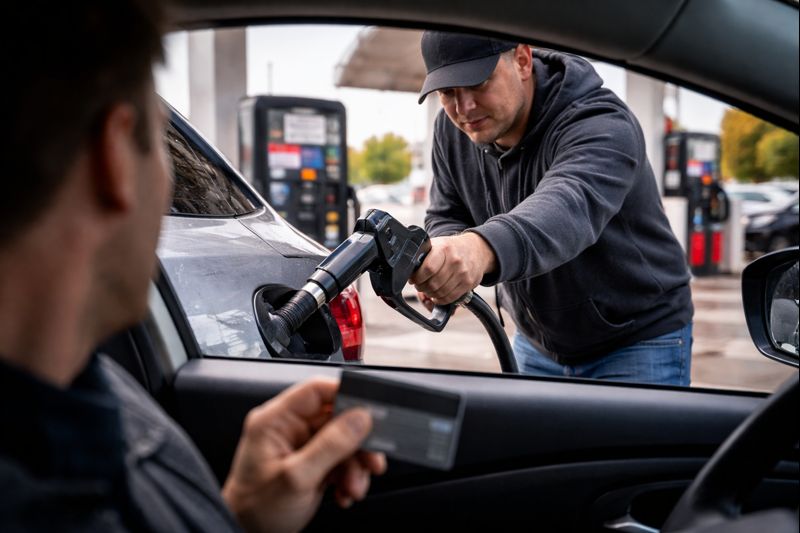
It happens in seconds, in broad daylight, with other drivers all around. You’re pumping gas, mind on autopilot, when a stranger steps closer and offers help — or casually takes the nozzle from your hand. Nothing feels wrong. You leave like normal. Weeks later, your bank account tells a different story. Police say this fast-spreading gas station scam is quietly draining credit cards nationwide, and by the time most victims notice, the money — and the trail — is already gone.
A Scam Hiding in Plain Sight
Law enforcement agencies across the country are issuing warnings about a growing scheme known as pump switching. Unlike card skimmers or hacked machines, this scam relies on human distraction — and it’s proving alarmingly effective.
The setup is simple. A driver pulls up to a gas station, inserts their credit or debit card, and begins fueling. While the pump is running, a stranger approaches. Sometimes they pretend to be helpful. Sometimes they claim the pump is malfunctioning. Other times, they simply grab the nozzle and say they’ll “finish it for you.”
That’s the moment everything changes.
What Victims Don’t See
Police say the key to the scam is never properly ending the transaction. When the stranger takes control, they either cancel the pump incorrectly or move it to another vehicle without closing out the original payment.
The victim drives away thinking the transaction is complete.
It isn’t.
The pump remains active — and the scammer uses it to fuel their own vehicle or multiple vehicles, all charged to the original card.
By the time the transaction times out, hundreds of dollars may be gone.
Why It Takes Weeks to Discover
One of the most dangerous aspects of this scam is how long it can go unnoticed. Gas station charges often blend into bank statements. Many drivers don’t check fuel receipts closely, and the charge may post days later.
Police report that many victims only discover the fraud weeks later, when reviewing statements or noticing unusually high fuel charges.
By then:
- Surveillance footage may be overwritten
- The scammer is long gone
- Disputing the charge becomes more complicated
Busy Stations Are Prime Targets
Authorities say the scam is most common at:
- Crowded gas stations
- Highway rest stops
- Urban areas with high turnover
- Stations without attendants
Scammers rely on chaos and courtesy. Drivers hesitate to be rude. They assume help is genuine. That split-second trust is all it takes.
“This crime works because people are polite,” one officer explained. “And distracted.”
Variations of the Same Trick
Police have identified multiple versions of pump switching:
- The “helpful stranger” offering assistance
- Someone claiming the pump is broken
- A person pretending to work at the station
- A fake apology after grabbing the nozzle
Different approach. Same result.
What Police Want Drivers to Do
Law enforcement agencies are urging drivers to follow a few critical rules:
- Never let a stranger handle the pump once your card is inserted
- End the transaction yourself before stepping away
- Watch the screen until it confirms completion
- Take a receipt or verify the final amount
- Cancel immediately if interrupted
If anyone interferes, police recommend canceling the transaction and moving to a different pump.
Why This Scam Is Spreading Now
Experts say rising gas prices and financial pressure have fueled the increase. Unlike complex cybercrime, pump switching requires no equipment, no hacking skills, and no upfront cost.
Just timing and confidence.
And because it looks like a misunderstanding — not theft — many victims don’t report it right away.
What To Do If You’ve Been Targeted
If you suspect pump switching:
- Contact your bank immediately
- Report the incident to local police
- Notify the gas station
- Monitor statements for additional charges
Quick action improves the chances of recovering funds.
A Small Moment With Big Consequences
This scam doesn’t rely on fear. It relies on routine.
A glance away.
A polite nod.
A few seconds of trust.
Police say that’s exactly why it’s working — and why drivers need to stay alert even during the most ordinary stops.
The Warning Drivers Can’t Ignore
You don’t have to lose your card.
You don’t have to enter a PIN.
You don’t even have to leave your car.
Sometimes, all it takes is letting go of the pump.
And the question police want every driver to ask themselves is simple:
At the gas station, are you watching the pump — or trusting the wrong person?