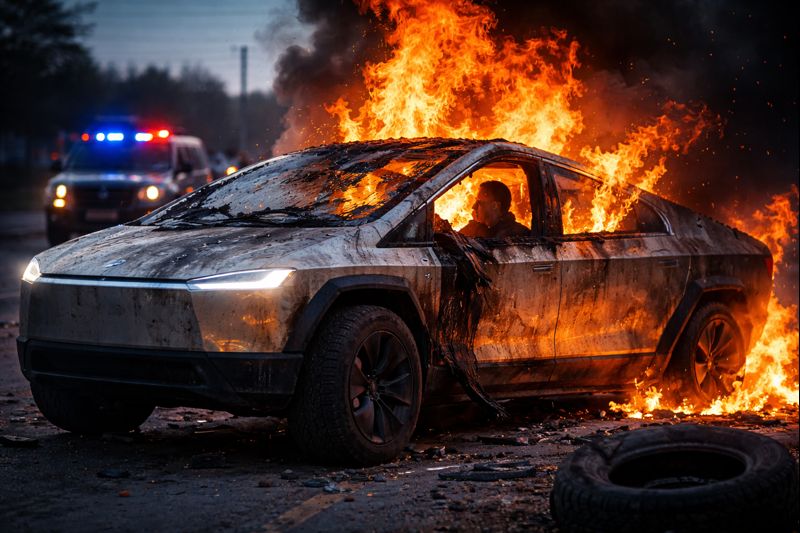
The crash itself wasn’t fatal. First responders say the impact was survivable. The road wasn’t engulfed in flames. And yet, minutes later, a 47-year-old man was dead inside his $100,000 electric truck. As details emerged, public outrage followed — not just because of how he died, but because of what the manufacturer reportedly said afterward. Now, a single word has ignited a firestorm: “expected.”
A Brand-New Truck. A Short Drive. A Tragic End.
Shane, 47, had owned his Tesla Cybertruck for just 102 days. According to early reports, he was driving in Harris County when he was involved in a collision.
Authorities say the crash itself did not kill him.
But moments after impact, the Cybertruck caught fire. Shane became trapped inside as flames spread. By the time help arrived, it was too late.
What should have been a survivable accident turned deadly — and that’s where the controversy begins.
Why This Case Is Different
Vehicle fires after severe crashes are not unheard of. Gas-powered cars burn. Electric vehicles burn. Safety experts are clear on that.
But this case has drawn intense scrutiny because of three factors:
- The vehicle was nearly new
- The occupant survived the initial crash
- The fire reportedly prevented escape
Public attention escalated when reports surfaced claiming Tesla described the outcome as within expectations given the nature of high-energy impacts and lithium-ion battery systems.
That phrase — expected — struck a nerve.
What “Expected” Means in Engineering — And Why People Are Furious
Automakers often use the term “expected” in a technical sense. In safety documentation, it can mean:
- A known risk
- A scenario accounted for in design standards
- A behavior consistent with testing models
But to the public, the word carries a very different meaning.
“It sounds like they’re saying this was acceptable,” one safety advocate said. “And that’s what people can’t stomach.”
Tesla has not admitted fault and has maintained that electric vehicle battery fires, while rare, can occur in extreme collisions — similar to fuel-fed fires in gasoline vehicles.
Still, critics argue that escape time and door functionality should be a top priority in any vehicle design.
Trapped Inside a High-Tech Vehicle
One of the most troubling questions surrounding Shane’s death is whether he could have exited the vehicle.
Modern vehicles — especially electric ones — rely heavily on electronic systems for doors, locks, and controls. While most include manual emergency releases, consumer advocates say many drivers:
- Don’t know where they are
- Can’t access them during panic or injury
- Aren’t trained to use them under stress
If power systems fail during a fire, seconds matter.
And seconds, in this case, were everything.
Are Electric Vehicles More Dangerous?
Experts caution against broad conclusions.
Statistically, electric vehicles do not catch fire more often than gasoline cars. However, when lithium-ion batteries ignite, fires can:
- Burn hotter
- Reignite after suppression
- Be harder for firefighters to control
That reality has forced emergency responders nationwide to update protocols.
But critics say consumers were never fully prepared for those risks.
Legal Questions Are Now Emerging
While no official lawsuit details have been finalized publicly, legal experts say cases like this often focus on:
- Design defects
- Failure to warn
- Emergency escape accessibility
- Battery enclosure safety
Manufacturers are not automatically liable for deaths following crashes — but preventability is the key issue courts examine.
If a jury believes a death could have been avoided with reasonable design changes, everything changes.
Tesla’s Silence — And the Public Reaction
Tesla has faced criticism before for its communication style during high-profile incidents. The company often relies on technical explanations rather than emotional statements.
In this case, many say that approach backfired.
Online, drivers are now asking:
- How do I get out if my EV loses power?
- Do I know where my emergency release is?
- What happens if my car catches fire?
These are questions few people were asking before.
What Drivers Should Know Right Now
Safety experts recommend all EV owners:
- Learn the manual door release locations
- Keep emergency tools accessible
- Understand post-crash fire risks
- Review manufacturer safety guides
Knowledge can buy time. And time can save lives.
The Question No One Can Ignore
A man survived a crash — but died in the vehicle meant to protect him.
A company called the outcome “expected.”
And thousands of drivers are suddenly rethinking what safety really means.
So here’s the question that’s haunting this story — and every electric vehicle owner watching closely:
If this outcome was “expected”… what else are drivers expected to survive?